




Malpighian corpuscles occur in
A. Medulla
B. Cortex
C. Pelvis
D. Pyramid
Answer
 Verified
600.9k+ views
Hint: Cells of the human body produces a waste product that leads to a change in the pH of our blood which is to be regulated. Kidneys help in the regulation of the pH of the blood. Malpighian corpuscles are the functional unit of nephrons.
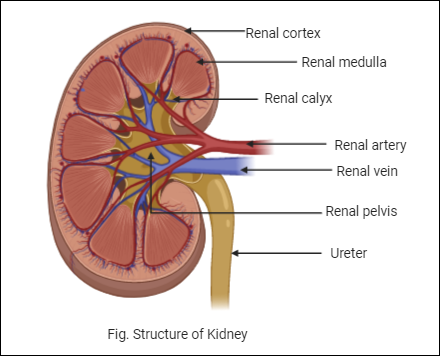
Complete answer: The human body is a complex structure with a number of complex organs performing specific functions. As it is important for our body to take up nutrients from the food we eat, it is also important to excrete out unwanted waste material from the body. This process or function of excretion in the human body is majorly carried out by Kidneys. Kidneys are the specialized organ mainly involved in excretion and maintenance of the blood pH (homeostasis). The human body has one pair of kidneys which can hold up to 22 percent of your entire blood supply at any time. Kidneys take up the blood through renal arteries, filter it, and then give out urine through ureters. Nephrons are the functional unit of the kidney responsible for filtration. Nephrons are present in between the renal cortex and renal medulla. It is composed of the renal tubule and renal corpuscle. Malpighian corpuscles are also known as renal corpuscles are the small part of nephrons that contains glomerulus (a knot of capillaries) surrounded by Bowman’s capsule (a double-walled capsule). It occurs in the Cortex of the kidney and is involved in filtration.
Hence, the correct answer is option B.
Note: Kidney performs two functions, filtration, and collection. In the collection, the blood entering the kidney is processed for the absorption of useful nutrients again, which is taken by renal veins and is passed back to the blood. Not all structures in the kidney perform both filtration and collection, only the nephron is involved in both these functions.
Complete answer: The human body is a complex structure with a number of complex organs performing specific functions. As it is important for our body to take up nutrients from the food we eat, it is also important to excrete out unwanted waste material from the body. This process or function of excretion in the human body is majorly carried out by Kidneys. Kidneys are the specialized organ mainly involved in excretion and maintenance of the blood pH (homeostasis). The human body has one pair of kidneys which can hold up to 22 percent of your entire blood supply at any time. Kidneys take up the blood through renal arteries, filter it, and then give out urine through ureters. Nephrons are the functional unit of the kidney responsible for filtration. Nephrons are present in between the renal cortex and renal medulla. It is composed of the renal tubule and renal corpuscle. Malpighian corpuscles are also known as renal corpuscles are the small part of nephrons that contains glomerulus (a knot of capillaries) surrounded by Bowman’s capsule (a double-walled capsule). It occurs in the Cortex of the kidney and is involved in filtration.
Hence, the correct answer is option B.
Note: Kidney performs two functions, filtration, and collection. In the collection, the blood entering the kidney is processed for the absorption of useful nutrients again, which is taken by renal veins and is passed back to the blood. Not all structures in the kidney perform both filtration and collection, only the nephron is involved in both these functions.
Recently Updated Pages
Master Class 11 English: Engaging Questions & Answers for Success

Master Class 11 Social Science: Engaging Questions & Answers for Success
Master Class 11 Maths: Engaging Questions & Answers for Success
Master Class 11 Biology: Engaging Questions & Answers for Success
Master Class 11 Physics: Engaging Questions & Answers for Success
Master Class 11 Chemistry: Engaging Questions & Answers for Success
Trending doubts
One Metric ton is equal to kg A 10000 B 1000 C 100 class 11 physics CBSE
Difference Between Prokaryotic Cells and Eukaryotic Cells
Difference between physical and chemical change class 11 chemistry CBSE
Find the value of the expression given below sin 30circ class 11 maths CBSE
Two of the body parts which do not appear in MRI are class 11 biology CBSE
Draw a diagram of a plant cell and label at least eight class 11 biology CBSE