




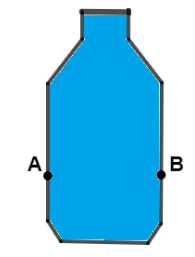
Make two tiny holes, of the same size, at equal heights from bottom in a plastic bottle. Cover them and fill the bottle with water. Let the ‘covers’ be now removed. State the ‘observations’, and the ‘conclusions’, based on this activity.
Answer
 Verified
526.2k+ views
Hint: In order to solve this question we need to understand buoyancy. We know from Newton’s laws of motion that any material opposes the change in its state so when water or any liquid is being pressed by some object then water opposes this behavior in its change of state and hence it exerts an upward or buoyant force on the volume of object inside liquid, this is known as buoyancy.
Complete step by step answer:
Before opening the lid water is filled in under pressure so it’s obvious that if some exit point is there then water tries to exit from it and release the pressure inside it.
Observations:
-If the holes are uncovered then water exits from both holes with the same pressure.
-Velocity with which liquid flows out of hole is the same.
-Range of water during efflux from holes is same
Conclusions:
-For explanation of the same pressure. Since the pressure inside liquid is given by,
$P = \rho gh$
Where, $\rho $ is density of liquid, $g$ is acceleration due to gravity, $h$ is height of liquid above hole and $p$ is pressure at that point.
-So for both liquid height and every other component is same, hence pressure would be equal.
For explanation of same velocity:
-From Torricelli’s theorem, velocity of efflux is defined as, $v = 2gh$.
-So for both the holes, height and acceleration due to gravity is same so velocity of efflux is same.
For explanation of same range covered by water:
Water effluxing out from both holes trace the projectile motion, so the range covered by water is given as,
$R = \sqrt {2h(H - h)} $
Here, $H$ is the height of liquid and $h$ is the height of liquid above hole. Since for both the holes H and h is same so water effluxing would cover the same range.
Note: It should be remembered that water flowing out of hole would trace only projectile motion is evident from the fact that motion is happening only under one acceleration and that is under acceleration due to gravity and it is only in y direction. If the water bottle is spined up after removing the cover then it may not cover the same range although velocity and pressure would be the same.
Complete step by step answer:
Before opening the lid water is filled in under pressure so it’s obvious that if some exit point is there then water tries to exit from it and release the pressure inside it.
Observations:
-If the holes are uncovered then water exits from both holes with the same pressure.
-Velocity with which liquid flows out of hole is the same.
-Range of water during efflux from holes is same
Conclusions:
-For explanation of the same pressure. Since the pressure inside liquid is given by,
$P = \rho gh$
Where, $\rho $ is density of liquid, $g$ is acceleration due to gravity, $h$ is height of liquid above hole and $p$ is pressure at that point.
-So for both liquid height and every other component is same, hence pressure would be equal.
For explanation of same velocity:
-From Torricelli’s theorem, velocity of efflux is defined as, $v = 2gh$.
-So for both the holes, height and acceleration due to gravity is same so velocity of efflux is same.
For explanation of same range covered by water:
Water effluxing out from both holes trace the projectile motion, so the range covered by water is given as,
$R = \sqrt {2h(H - h)} $
Here, $H$ is the height of liquid and $h$ is the height of liquid above hole. Since for both the holes H and h is same so water effluxing would cover the same range.
Note: It should be remembered that water flowing out of hole would trace only projectile motion is evident from the fact that motion is happening only under one acceleration and that is under acceleration due to gravity and it is only in y direction. If the water bottle is spined up after removing the cover then it may not cover the same range although velocity and pressure would be the same.
Recently Updated Pages
Three beakers labelled as A B and C each containing 25 mL of water were taken A small amount of NaOH anhydrous CuSO4 and NaCl were added to the beakers A B and C respectively It was observed that there was an increase in the temperature of the solutions contained in beakers A and B whereas in case of beaker C the temperature of the solution falls Which one of the following statements isarecorrect i In beakers A and B exothermic process has occurred ii In beakers A and B endothermic process has occurred iii In beaker C exothermic process has occurred iv In beaker C endothermic process has occurred

Master Class 11 Social Science: Engaging Questions & Answers for Success
Master Class 11 Physics: Engaging Questions & Answers for Success
Master Class 11 Maths: Engaging Questions & Answers for Success
Master Class 11 Economics: Engaging Questions & Answers for Success
Master Class 11 Computer Science: Engaging Questions & Answers for Success
Three beakers labelled as A B and C each containing 25 mL of water were taken A small amount of NaOH anhydrous CuSO4 and NaCl were added to the beakers A B and C respectively It was observed that there was an increase in the temperature of the solutions contained in beakers A and B whereas in case of beaker C the temperature of the solution falls Which one of the following statements isarecorrect i In beakers A and B exothermic process has occurred ii In beakers A and B endothermic process has occurred iii In beaker C exothermic process has occurred iv In beaker C endothermic process has occurred
Master Class 11 Social Science: Engaging Questions & Answers for Success
Master Class 11 Physics: Engaging Questions & Answers for Success
Trending doubts
One Metric ton is equal to kg A 10000 B 1000 C 100 class 11 physics CBSE
There are 720 permutations of the digits 1 2 3 4 5 class 11 maths CBSE
State and prove Bernoullis theorem class 11 physics CBSE
Draw a diagram of a plant cell and label at least eight class 11 biology CBSE
Difference Between Prokaryotic Cells and Eukaryotic Cells
1 Quintal is equal to a 110 kg b 10 kg c 100kg d 1000 class 11 physics CBSE