



Make the greatest and smallest \[4\] -digit number by using any one digit twice from:
\[8,5,1\] .
Answer
 Verified
524.7k+ views
Hint: We have to form a four-digit number from the given information for which we will form different numbers as per highest and lowest number logic. We know that we can only repeat one digit twice.
Complete step-by-step answer:
We have to form a four-digit number hence there will be units/ones, tens, hundreds and thousands placed in the final answer. The number placement system is explained below for better understanding:
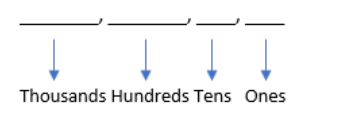
For example, in \[1,000\] - The thousands place is occupied by \[1\] and hundreds, tens and ones place is occupied by \[0\] .
In the given sum we can use the digit \[8,5,1\] by repeating any one digit.
Hence the greatest number can be formed as follows:
Since we have to form the highest number, we have to write the highest digits in descending order from left to right. We know that out of the given numbers, \[8\] is the highest so we shall write it first at thousands places. Next, we shall repeat the number \[8\] at hundreds of places since we are using descending order. Finally, \[5\] will be used at tens place and \[1\] at one's place to form the greatest number.
Hence the greatest number will be \[8851\] .
Smallest number can be formed as follows:
We have to write the smallest digits in ascending order from left to right. We know that out of the given numbers, \[1\] is the smallest so we shall write it first at thousands places. Next, we shall repeat the number \[1\] at hundreds of places since we are using ascending order. Finally, \[5\] will be used at tens place and \[8\] at one's place to form the smallest number.
Hence the smallest number will be \[1158\] .
Note: We have to carefully analyse the question in order to arrive at the solution. The conditions will provide us the way to solve the sum. We can do trial and error methods also by eliminating different options and arrive at one conclusion.
Complete step-by-step answer:
We have to form a four-digit number hence there will be units/ones, tens, hundreds and thousands placed in the final answer. The number placement system is explained below for better understanding:
For example, in \[1,000\] - The thousands place is occupied by \[1\] and hundreds, tens and ones place is occupied by \[0\] .
In the given sum we can use the digit \[8,5,1\] by repeating any one digit.
Hence the greatest number can be formed as follows:
Since we have to form the highest number, we have to write the highest digits in descending order from left to right. We know that out of the given numbers, \[8\] is the highest so we shall write it first at thousands places. Next, we shall repeat the number \[8\] at hundreds of places since we are using descending order. Finally, \[5\] will be used at tens place and \[1\] at one's place to form the greatest number.
Hence the greatest number will be \[8851\] .
Smallest number can be formed as follows:
We have to write the smallest digits in ascending order from left to right. We know that out of the given numbers, \[1\] is the smallest so we shall write it first at thousands places. Next, we shall repeat the number \[1\] at hundreds of places since we are using ascending order. Finally, \[5\] will be used at tens place and \[8\] at one's place to form the smallest number.
Hence the smallest number will be \[1158\] .
Note: We have to carefully analyse the question in order to arrive at the solution. The conditions will provide us the way to solve the sum. We can do trial and error methods also by eliminating different options and arrive at one conclusion.

Recently Updated Pages
Master Class 7 English: Engaging Questions & Answers for Success

Master Class 7 Maths: Engaging Questions & Answers for Success
Master Class 7 Science: Engaging Questions & Answers for Success
Class 7 Question and Answer - Your Ultimate Solutions Guide
Master Class 9 General Knowledge: Engaging Questions & Answers for Success
Master Class 9 Social Science: Engaging Questions & Answers for Success
Trending doubts
The value of 6 more than 7 is A 1 B 1 C 13 D 13 class 7 maths CBSE
Convert 200 Million dollars in rupees class 7 maths CBSE
List of coprime numbers from 1 to 100 class 7 maths CBSE
AIM To prepare stained temporary mount of onion peel class 7 biology CBSE
The plural of Chief is Chieves A True B False class 7 english CBSE
Write a letter to the editor of the national daily class 7 english CBSE