



How can you make a quadrilateral rigid?
Answer
 Verified
480.3k+ views
Hint: To do this question first we should know what is a rigid quadrilateral. There is a way to make a quadrilateral rigid. Add a cross brace connecting two parts of the quadrilateral, avoiding some non-rigid cases.
Complete answer:
Any quadrilateral is naturally non-rigid.
The simplest cross brace to describe that will render a convex quadrilateral non rigid is to add a line segment from one vertex to the opposite one. This will subdivide the quadrilateral into two rigid triangles.
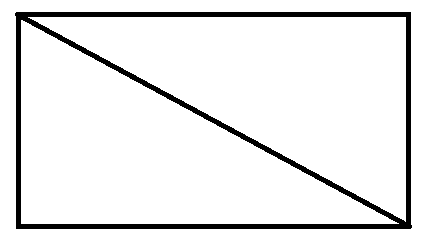
Therefore, in this question, It is possible to make a quadrilateral rigid with a cross brace that connects a point on one side to another point on the quadrilateral, but this does not always result in a rigid structure.
For example, a line segment joining the mid-point of one side of a rectangle to the midpoint of the opposite side would not make the structure more rigid.
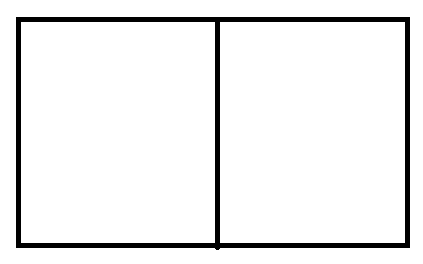
Therefore, On the other hand, if you have a line segment that runs from $\dfrac{1}{3}$ of the way along one side to $\dfrac{2}{3}$ of the way along the opposite side, then the resulting structure would be rigid.
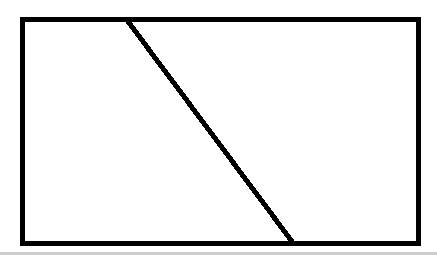
Note: It is possible to make a quadrilateral rigid with a cross brace that connects a point on one side to another point on the quadrilateral, but this does not always result in a rigid structure. For example, a line segment joining the mid-point of one side of a rectangle to the midpoint of the opposite side would not make the structure more rigid.
Complete answer:
Any quadrilateral is naturally non-rigid.
The simplest cross brace to describe that will render a convex quadrilateral non rigid is to add a line segment from one vertex to the opposite one. This will subdivide the quadrilateral into two rigid triangles.
Therefore, in this question, It is possible to make a quadrilateral rigid with a cross brace that connects a point on one side to another point on the quadrilateral, but this does not always result in a rigid structure.
For example, a line segment joining the mid-point of one side of a rectangle to the midpoint of the opposite side would not make the structure more rigid.
Therefore, On the other hand, if you have a line segment that runs from $\dfrac{1}{3}$ of the way along one side to $\dfrac{2}{3}$ of the way along the opposite side, then the resulting structure would be rigid.
Note: It is possible to make a quadrilateral rigid with a cross brace that connects a point on one side to another point on the quadrilateral, but this does not always result in a rigid structure. For example, a line segment joining the mid-point of one side of a rectangle to the midpoint of the opposite side would not make the structure more rigid.

Recently Updated Pages
Master Class 7 English: Engaging Questions & Answers for Success

Master Class 7 Maths: Engaging Questions & Answers for Success
Master Class 7 Science: Engaging Questions & Answers for Success
Class 7 Question and Answer - Your Ultimate Solutions Guide
Master Class 9 General Knowledge: Engaging Questions & Answers for Success
Master Class 9 Social Science: Engaging Questions & Answers for Success
Trending doubts
The value of 6 more than 7 is A 1 B 1 C 13 D 13 class 7 maths CBSE
Convert 200 Million dollars in rupees class 7 maths CBSE
List of coprime numbers from 1 to 100 class 7 maths CBSE
AIM To prepare stained temporary mount of onion peel class 7 biology CBSE
The plural of Chief is Chieves A True B False class 7 english CBSE
Write a letter to the editor of the national daily class 7 english CBSE