




How many major types of blood have scientists discovered?
A) One: Type “O”
B) Two: white cells and red cells
C) Three: white cells, red cells and plasma
D) Four: Types A, B, AB and O
Answer
 Verified
615.3k+ views
Hint:The classification of blood based on the presence or absence of antigens and antibodies on the surface of Red Blood Cells (RBCs) is called Blood type
Complete answer:
The common blood typing system (ABO blood typing) allocates four different blood types to individuals based on the presence of two antigens ‘A’ and ‘B’ on the surface of RBCs. Blood type ‘A’ has only the A antigen on RBCs’ surface and blood type ‘B’ has only the B antigen. If neither ‘A’ nor ‘B’ are present then the blood type is ‘O’ and if both ‘A’ and ‘B’ are present then the blood type is ‘AB’.
The following table will help in better understanding of the blood typing system.
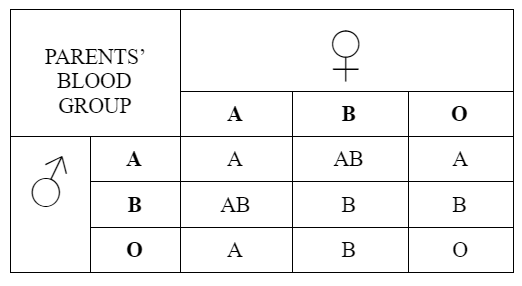
Now, let us look at each option one by one
>Option A: Type “O” is one of the four blood types. Therefore, this option is incorrect.
>Option B: White cells and Red cells are the major cell types of the circulatory system, while white cells (also called leukocytes) are responsible for protecting the body against infection and diseases, the red cells are responsible for the transport of oxygen throughout the body. These cells do not define the blood typing system. Therefore, this option is incorrect.
>Option C: As mentioned in the previous point, white and red cells are not responsible for defining the blood typing system. The plasma is the liquid content of the blood that remains after the removal of red cells, white cells, platelets and other cellular components are separated from the blood. Thus, plasma also does not play any role in blood typing. Hence, this option is incorrect.
>Option D: Types “A”, ”B”, ”AB” and “O” are the four blood types as determined by the ABO blood grouping system discussed earlier. Therefore, this is the correct option.
Thus, the answer is option (D) Four: Types A, B, AB and O
Note: Aside from the ABO blood grouping system, blood groups are additionally defined by the presence of the “Rh factor” on the membrane of RBCs. If the Rh factor is present, then the positive (+) sign is assigned to the ABO blood groups and in its absence the negative (-) sign is assigned.
Complete answer:
The common blood typing system (ABO blood typing) allocates four different blood types to individuals based on the presence of two antigens ‘A’ and ‘B’ on the surface of RBCs. Blood type ‘A’ has only the A antigen on RBCs’ surface and blood type ‘B’ has only the B antigen. If neither ‘A’ nor ‘B’ are present then the blood type is ‘O’ and if both ‘A’ and ‘B’ are present then the blood type is ‘AB’.
The following table will help in better understanding of the blood typing system.
Now, let us look at each option one by one
>Option A: Type “O” is one of the four blood types. Therefore, this option is incorrect.
>Option B: White cells and Red cells are the major cell types of the circulatory system, while white cells (also called leukocytes) are responsible for protecting the body against infection and diseases, the red cells are responsible for the transport of oxygen throughout the body. These cells do not define the blood typing system. Therefore, this option is incorrect.
>Option C: As mentioned in the previous point, white and red cells are not responsible for defining the blood typing system. The plasma is the liquid content of the blood that remains after the removal of red cells, white cells, platelets and other cellular components are separated from the blood. Thus, plasma also does not play any role in blood typing. Hence, this option is incorrect.
>Option D: Types “A”, ”B”, ”AB” and “O” are the four blood types as determined by the ABO blood grouping system discussed earlier. Therefore, this is the correct option.
Thus, the answer is option (D) Four: Types A, B, AB and O
Note: Aside from the ABO blood grouping system, blood groups are additionally defined by the presence of the “Rh factor” on the membrane of RBCs. If the Rh factor is present, then the positive (+) sign is assigned to the ABO blood groups and in its absence the negative (-) sign is assigned.
Recently Updated Pages
Master Class 11 English: Engaging Questions & Answers for Success

Master Class 11 Social Science: Engaging Questions & Answers for Success
Master Class 11 Maths: Engaging Questions & Answers for Success
Master Class 11 Biology: Engaging Questions & Answers for Success
Master Class 11 Physics: Engaging Questions & Answers for Success
Master Class 11 Chemistry: Engaging Questions & Answers for Success
Trending doubts
One Metric ton is equal to kg A 10000 B 1000 C 100 class 11 physics CBSE
Difference Between Prokaryotic Cells and Eukaryotic Cells
Two of the body parts which do not appear in MRI are class 11 biology CBSE
Find the value of the expression given below sin 30circ class 11 maths CBSE
Draw a diagram of a plant cell and label at least eight class 11 biology CBSE
10 examples of friction in our daily life