




What is the major product (s) when 2-methyl-2-butene reacts with (i) ${{O}_{3}}$ (ii) $Zn/C{{H}_{3}}COOH(aq)$?
I

II

III

IV

(a) I + II
(b) II + III
(c) III + IV
(d) II
Answer
 Verified
590.7k+ views
Hint: As we can see that the reagents provided in the question directs us toward the process of ozonolysis which is the oxidative cleavage of alkenes’ double bond with the help of ozone and zinc dust so as to form aldehyde and ketone as product. So we will solve this question by the process of Ozonolysis.
Complete answer:
Let us first understand the process of Ozonolysis:-
-Ozonolysis is a reaction in which the unsaturated bonds of alkenes, alkynes or compounds containing azo groups are cleaved with ozone. Alkenes and alkynes generally form compounds in which the multiple carbon–carbon bonds get replaced by a carbonyl group whereas azo compounds form nitrosamines. The outcome of this reaction actually depends on the type of multiple bonds being oxidized and the work-up conditions provided as reagents.
-Ozonolysis of 2-methyl-2-butene:-

-When an alkene reacts with an ozone molecule, 1, 3 dipolar reaction takes place. Here alkene gets reduced and attaches itself to the oxygen atoms as shown in the above diagram.
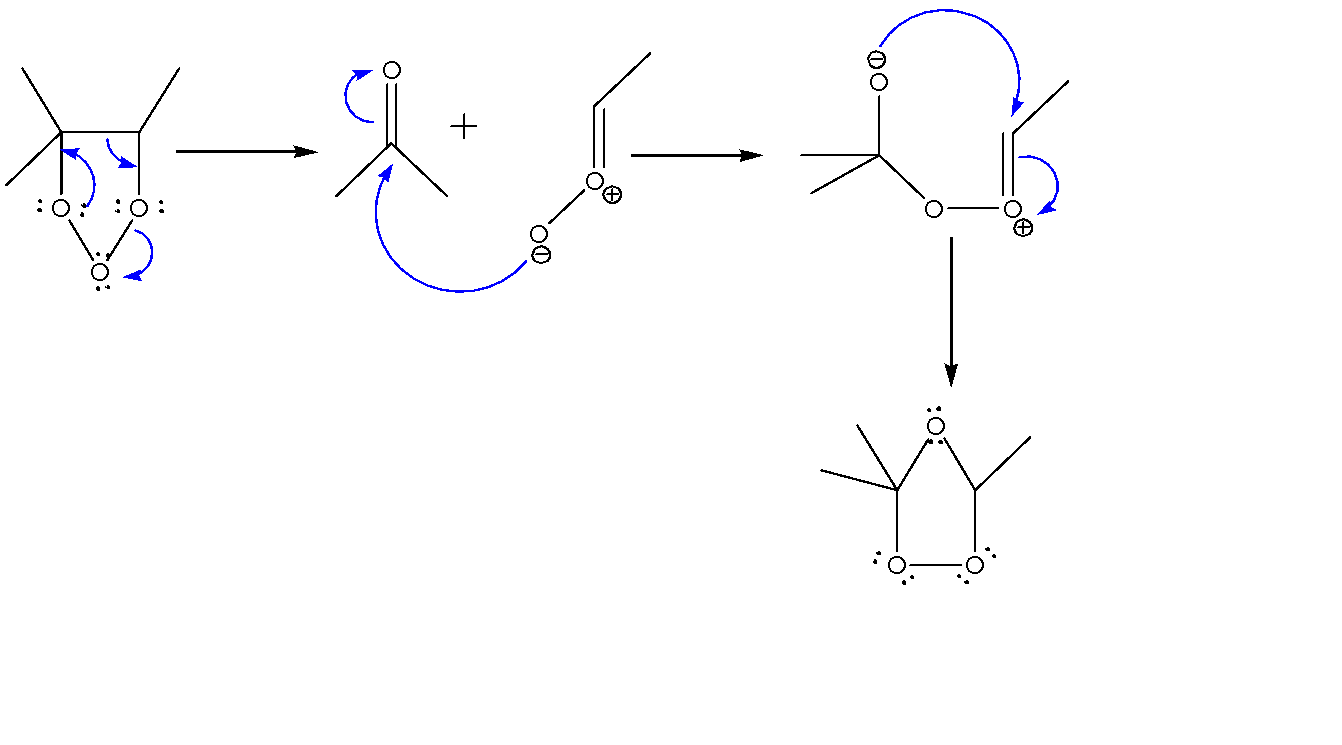
-Since the entire oxygen atoms present carry lone pairs along with it, so repulsion starts creating between them which leads to the breaking of the molecule due to which carbonyl molecule and a dipolar ion are formed. Now the negative part of the ion attacks the electrophilic part of the carbonyl compound which further attacks the dipolar ion.
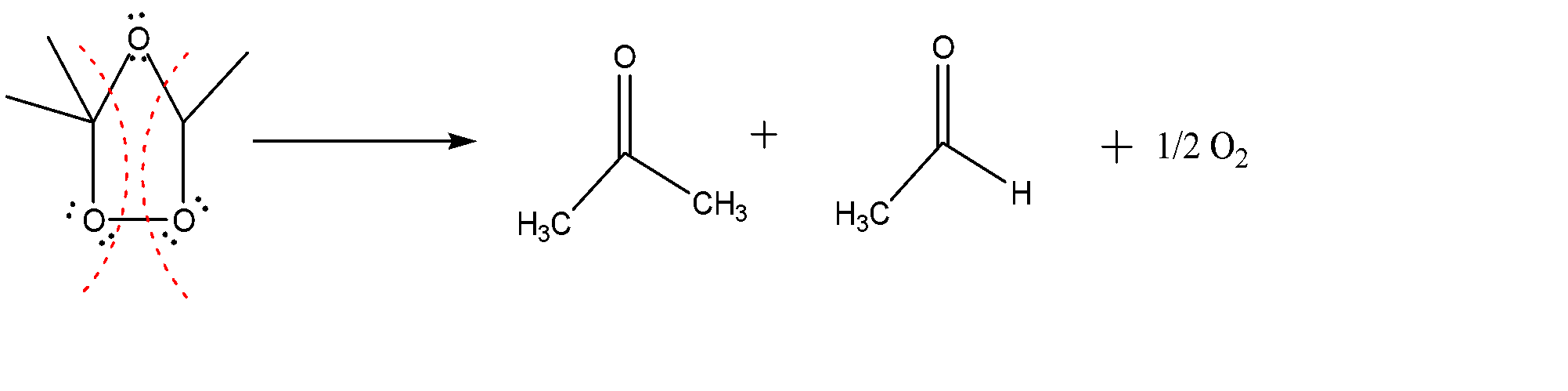
-The molecule formed is again full of repulsions due to which it breaks apart and we get following carbonyl compounds as product: ketone + aldehyde.
Hence the major products are: (b) II + III
Note:
$Zn/C{{H}_{3}}COOH(aq)$ is used because when oxygen gas (${{O}_{2}}$) is formed it reacts with ${{H}_{2}}O$ to form ${{H}_{2}}{{O}_{2}}$ which acts like an oxidizing agent. The ${{H}_{2}}{{O}_{2}}$ oxidizes the aldehyde product and further converts it into carboxylic acid. So to stop this further oxidation, we require zinc dust to convert ${{H}_{2}}{{O}_{2}}$ to zinc oxide and water.
Hence in ozonolysis, the last work-up decides the nature of the product formed.
Complete answer:
Let us first understand the process of Ozonolysis:-
-Ozonolysis is a reaction in which the unsaturated bonds of alkenes, alkynes or compounds containing azo groups are cleaved with ozone. Alkenes and alkynes generally form compounds in which the multiple carbon–carbon bonds get replaced by a carbonyl group whereas azo compounds form nitrosamines. The outcome of this reaction actually depends on the type of multiple bonds being oxidized and the work-up conditions provided as reagents.
-Ozonolysis of 2-methyl-2-butene:-
-When an alkene reacts with an ozone molecule, 1, 3 dipolar reaction takes place. Here alkene gets reduced and attaches itself to the oxygen atoms as shown in the above diagram.
-Since the entire oxygen atoms present carry lone pairs along with it, so repulsion starts creating between them which leads to the breaking of the molecule due to which carbonyl molecule and a dipolar ion are formed. Now the negative part of the ion attacks the electrophilic part of the carbonyl compound which further attacks the dipolar ion.
-The molecule formed is again full of repulsions due to which it breaks apart and we get following carbonyl compounds as product: ketone + aldehyde.
Hence the major products are: (b) II + III
Note:
$Zn/C{{H}_{3}}COOH(aq)$ is used because when oxygen gas (${{O}_{2}}$) is formed it reacts with ${{H}_{2}}O$ to form ${{H}_{2}}{{O}_{2}}$ which acts like an oxidizing agent. The ${{H}_{2}}{{O}_{2}}$ oxidizes the aldehyde product and further converts it into carboxylic acid. So to stop this further oxidation, we require zinc dust to convert ${{H}_{2}}{{O}_{2}}$ to zinc oxide and water.
Hence in ozonolysis, the last work-up decides the nature of the product formed.
Recently Updated Pages
Which will be the least stable resonating structure class 11 chemistry CBSE

How many 5 digit telephone numbers can be construc-class-11-maths-CBSE
How do you find the angle of the resultant vector class 11 physics CBSE
Draw labelled diagram of the following i Gram seed class 11 biology CBSE
1 Quintal is equal to a 110 kg b 10 kg c 100kg d 1000 class 11 physics CBSE
What is the need and importance of classification class 11 biology CBSE
Trending doubts
One Metric ton is equal to kg A 10000 B 1000 C 100 class 11 physics CBSE
Find the value of the expression given below sin 30circ class 11 maths CBSE
Draw a diagram of nephron and explain its structur class 11 biology CBSE
10 examples of friction in our daily life
Proton was discovered by A Thomson B Rutherford C Chadwick class 11 chemistry CBSE
The teeth used for biting and cutting food are called class 11 biology CBSE