




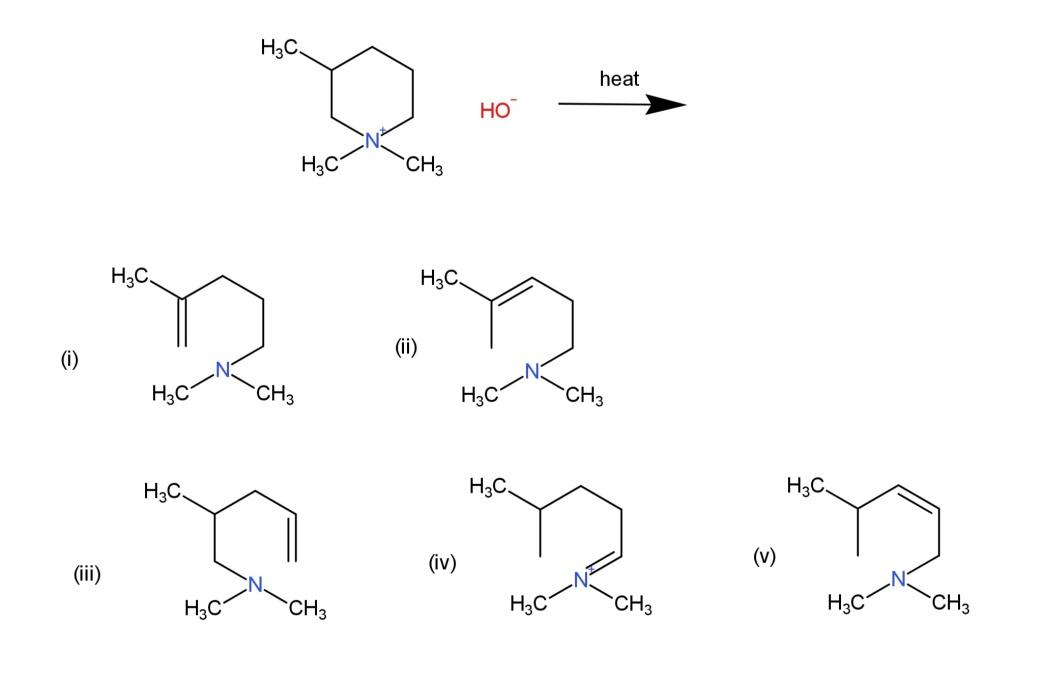
What is the major alkene formed in the following Hofmann elimination?
A. i
B. ii
C. iii
D. iv
E. v
Answer
 Verified
585.3k+ views
Hint: Hofmann elimination is the reaction where an aliphatic or aromatic amine that has beta-hydrogen is converted to an unsaturated compound. It takes place in the presence of a base along with high temperature (heat).
Complete answer:
Hofmann elimination is the reaction where an amine reacts with a base to form an alkene. The amine consist of a $\beta $ - hydrogen whose removal marks the formation of a double bond. This elimination is based on the Saytzeff rule that states that the major product will be that product which is more stable.
The given compound when subjected to a base and heat, have the $\beta $ - hydrogen removed, after the removal of $\beta $ - hydrogen, the most stable carbocation will form the major product. The carbocation is stable when the saturation takes place on the $2{}^\circ $ carbocation, which is the product (i), while other products contain less stable $1{}^\circ $ carbocations. Therefore the reaction will be as follows:

Hence, the product formed is (i), so, option A is correct.
Note:
Hofmann elimination reaction and Hofmann bromamide degradation reactions are two different reactions, but both consist of a base as a reactant. Hofmann bromamide consists of the formation of aliphatic or aromatic amines from the reaction of amide, bromine and sodium hydroxide (base). Hofmann elimination is the preparation of unsaturated compounds.
Complete answer:
Hofmann elimination is the reaction where an amine reacts with a base to form an alkene. The amine consist of a $\beta $ - hydrogen whose removal marks the formation of a double bond. This elimination is based on the Saytzeff rule that states that the major product will be that product which is more stable.
The given compound when subjected to a base and heat, have the $\beta $ - hydrogen removed, after the removal of $\beta $ - hydrogen, the most stable carbocation will form the major product. The carbocation is stable when the saturation takes place on the $2{}^\circ $ carbocation, which is the product (i), while other products contain less stable $1{}^\circ $ carbocations. Therefore the reaction will be as follows:
Hence, the product formed is (i), so, option A is correct.
Note:
Hofmann elimination reaction and Hofmann bromamide degradation reactions are two different reactions, but both consist of a base as a reactant. Hofmann bromamide consists of the formation of aliphatic or aromatic amines from the reaction of amide, bromine and sodium hydroxide (base). Hofmann elimination is the preparation of unsaturated compounds.
Recently Updated Pages
Basicity of sulphurous acid and sulphuric acid are

Master Class 11 English: Engaging Questions & Answers for Success
Master Class 11 Physics: Engaging Questions & Answers for Success
Master Class 11 Computer Science: Engaging Questions & Answers for Success
Master Class 11 Chemistry: Engaging Questions & Answers for Success
Master Class 11 Social Science: Engaging Questions & Answers for Success
Trending doubts
Difference Between Prokaryotic Cells and Eukaryotic Cells
Two of the body parts which do not appear in MRI are class 11 biology CBSE
One Metric ton is equal to kg A 10000 B 1000 C 100 class 11 physics CBSE
10 examples of friction in our daily life
Draw a diagram of nephron and explain its structur class 11 biology CBSE
What will happen if the mucus is not secreted by the class 11 biology CBSE