




What is the main difference between atomic orbital and molecular orbital?
Answer
 Verified
576k+ views
Hint :The name itself suggests that the atomic orbitals are orbitals associated with individual atoms in their free state and the molecular orbitals are orbitals associated with molecules that contain two or more atoms in a bonded state.
Complete Step By Step Answer:
The orbitals according to Bohr’s atomic model or Schrodinger's model represent the three dimensional spaces around the nucleus where the probability of finding electrons is high. Mathematically, orbitals can be treated as wave functions that help us in doing various quantum mechanical calculations on them.
The atom in a free state has a uniformly distributed electron cloud around its nucleus resulting in its overall symmetry. When two or more atoms approach each other, their electron clouds are pulled by a force of attraction from each other’s nuclei. This pull results in the distortion of electron clouds disturbing the symmetry of the orbitals of the atoms.
When two atoms approach each other, their orbitals also come closer and the wave functions can experience a constructive or destructive overlap when the orbitals overlap to form a bond. The bonded electrons have a high electron density in between the two nuclei rather than a uniformly distributed electron cloud.
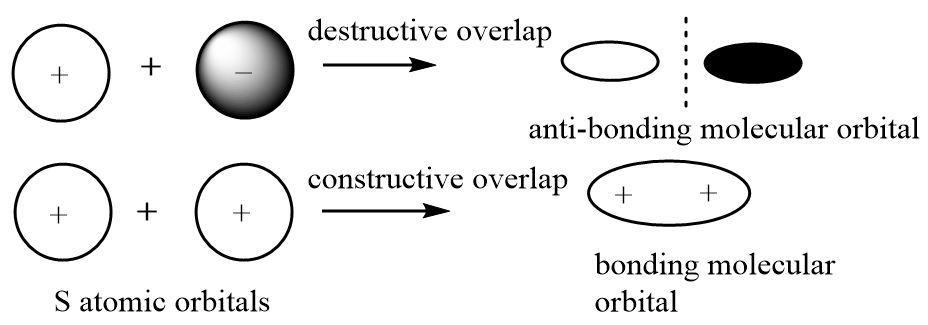
Thus atomic orbitals represent spaces with maximum electron density associated with individual atoms but molecular orbitals represent spaces of high electron density (bonding MO) between the nuclei of two atoms linked through a bond and also spaces where there is zero probability of finding shared pairs of electron in a molecule (non-bonding MO).
Note :
The overlap between two atomic orbitals can result in a variety of bonds. A head-on overlap between two orbitals results in the formation of a sigma \[\sigma \] bond between atoms and the sidewise overlap results in a \[\pi \] bond.
Complete Step By Step Answer:
The orbitals according to Bohr’s atomic model or Schrodinger's model represent the three dimensional spaces around the nucleus where the probability of finding electrons is high. Mathematically, orbitals can be treated as wave functions that help us in doing various quantum mechanical calculations on them.
The atom in a free state has a uniformly distributed electron cloud around its nucleus resulting in its overall symmetry. When two or more atoms approach each other, their electron clouds are pulled by a force of attraction from each other’s nuclei. This pull results in the distortion of electron clouds disturbing the symmetry of the orbitals of the atoms.
When two atoms approach each other, their orbitals also come closer and the wave functions can experience a constructive or destructive overlap when the orbitals overlap to form a bond. The bonded electrons have a high electron density in between the two nuclei rather than a uniformly distributed electron cloud.
Thus atomic orbitals represent spaces with maximum electron density associated with individual atoms but molecular orbitals represent spaces of high electron density (bonding MO) between the nuclei of two atoms linked through a bond and also spaces where there is zero probability of finding shared pairs of electron in a molecule (non-bonding MO).
Note :
The overlap between two atomic orbitals can result in a variety of bonds. A head-on overlap between two orbitals results in the formation of a sigma \[\sigma \] bond between atoms and the sidewise overlap results in a \[\pi \] bond.
Recently Updated Pages
If x a + bt + ct2 where x is in meters and t is in class 11 physics CBSE

A car covers the first half distance between two places class 11 physics CBSE
The resultant of two vectors overrightarrow P and overrightarrow class 11 physics CBSE
Find the value of cos 135 class 11 maths CBSE
A mass M is held in place by an applied force F and class 11 physics CBSE
A solution of glucose in water is labelled as 10 dfracwv class 11 chemistry CBSE
Trending doubts
One Metric ton is equal to kg A 10000 B 1000 C 100 class 11 physics CBSE
Find the value of the expression given below sin 30circ class 11 maths CBSE
What do you mean by retardation What is its SI uni class 11 physics CBSE
Draw a diagram of nephron and explain its structur class 11 biology CBSE
10 examples of friction in our daily life
Difference between physical and chemical change class 11 chemistry CBSE