



Magnitude of earthquake is measured by
A. electroscope
B. Richter scale
C. Seismograph
D. coulomb
Answer
 Verified
609k+ views
Hint: When the plates inside the earth’s crust collide, vibrations are produced. These vibrations travel through the crust to the surface. These vibrations cause an earthquake. We understand the strength of the earthquake by measuring its magnitude by a logarithmic scale.
Complete answer:
Let us first understand what an earthquake is and how it is caused.
An earthquake is the shaking or vibration of the crust of our earth. Beneath the earth’s crust, a hot plasma like substance called magma is present. The plates of crust float on the magma. The magma is in motion continuously. Therefore, sometimes the plates collide with each other. Due to the collision, a vibration is produced inside the earth’s crust.
The vibration on the surface of earth causes an earthquake. Sometimes, the earthquake is not very strong. However, at times the earthquake is so strong that it turns into a disaster.
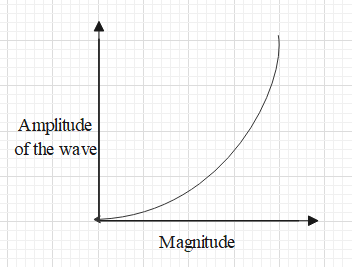
We call the strength of the earthquake as its magnitude. The magnitude of an earthquake is measured by a logarithmic scale called Richter scale. The magnitude of an earthquake is given as M = log$_{10}$x,
where M is the magnitude of the earthquake and x is the amplitude of the wave obtained on a seismograph.
Below is a graph of a Richter scale.
So, the correct answer is “Option B”.
Note:
There can be a confusion between a seismograph and the Richter scale.
A seismograph is a device that detects the vibrations inside the earth’s crust. It draws the wave of the vibrations produced.
Therefore, a seismograph gives the amplitude of vibrations and the magnitude is measured by Richter scale.
Complete answer:
Let us first understand what an earthquake is and how it is caused.
An earthquake is the shaking or vibration of the crust of our earth. Beneath the earth’s crust, a hot plasma like substance called magma is present. The plates of crust float on the magma. The magma is in motion continuously. Therefore, sometimes the plates collide with each other. Due to the collision, a vibration is produced inside the earth’s crust.
The vibration on the surface of earth causes an earthquake. Sometimes, the earthquake is not very strong. However, at times the earthquake is so strong that it turns into a disaster.
We call the strength of the earthquake as its magnitude. The magnitude of an earthquake is measured by a logarithmic scale called Richter scale. The magnitude of an earthquake is given as M = log$_{10}$x,
where M is the magnitude of the earthquake and x is the amplitude of the wave obtained on a seismograph.
Below is a graph of a Richter scale.
So, the correct answer is “Option B”.
Note:
There can be a confusion between a seismograph and the Richter scale.
A seismograph is a device that detects the vibrations inside the earth’s crust. It draws the wave of the vibrations produced.
Therefore, a seismograph gives the amplitude of vibrations and the magnitude is measured by Richter scale.
Recently Updated Pages
Master Class 12 Business Studies: Engaging Questions & Answers for Success

Master Class 12 Biology: Engaging Questions & Answers for Success
Master Class 12 Chemistry: Engaging Questions & Answers for Success
Class 12 Question and Answer - Your Ultimate Solutions Guide
Master Class 11 Social Science: Engaging Questions & Answers for Success
Master Class 11 English: Engaging Questions & Answers for Success
Trending doubts
Find the sum of series 1 + 2 + 3 + 4 + 5 + + 100 class 9 maths CBSE
Name 10 Living and Non living things class 9 biology CBSE
On an outline map of India show its neighbouring c class 9 social science CBSE
Write an Article on Save Earth Save Life
On an outline map of India mark the Karakoram range class 9 social science CBSE
If HCF of 210 and 55 is expressed in the form of 210 class 9 maths CBSE