




Magnification produced by a concave mirror is:
a. Is always less than one
b. Is always more than one
c. Always equal to one
d. May less than or equal to or greater than one
Answer
 Verified
636.6k+ views
Hint: Magnification is defined as the ratio of the size of the image formed by the spherical mirror to the size of the object.Generally magnification is denoted by $m$. Magnification could be positive or negative depending upon the position of the object and the position of the image formed and height measured as negative for downwards and positive for upwards.
Formula for magnification:
$m = \dfrac{I}{O}$, where height of the image is $I$ and height of the object $O$.
Complete answer:
Magnification of the concave mirror depends on the position and erect and inversion of the image and object. We’ll try to understand the concept using two diagrams which can explain us better.
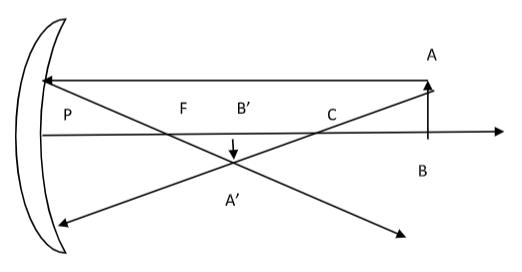
The diagram shows the image formation by concave mirror when the object is placed beyond the centre of curvature C. In this figure the object is AB and the image formed is A’B’. We can observe that the image formed is inverted in nature,therefore the size of the image is taken as negative because of inversion and the size of the object as positive because it is above the principal axis.
So, magnification is:
$m = \dfrac{{ \pm I}}{{ \pm O}}$, sign of the image and object size is based on erection and inversion.
Hence, the correct answer is option (d).
Note: Formula for magnification can also be given as:
$m = \dfrac{f}{{f - u}}$, where f is the focal length and u is the distance of the object measured from pole P.
Some of the uses of concave mirror are:
Used as reflectors in cinema projectors, used to construct reflecting type astronomical telescopes,as parabolic mirrors in search lights.
Formula for magnification:
$m = \dfrac{I}{O}$, where height of the image is $I$ and height of the object $O$.
Complete answer:
Magnification of the concave mirror depends on the position and erect and inversion of the image and object. We’ll try to understand the concept using two diagrams which can explain us better.
The diagram shows the image formation by concave mirror when the object is placed beyond the centre of curvature C. In this figure the object is AB and the image formed is A’B’. We can observe that the image formed is inverted in nature,therefore the size of the image is taken as negative because of inversion and the size of the object as positive because it is above the principal axis.
So, magnification is:
$m = \dfrac{{ \pm I}}{{ \pm O}}$, sign of the image and object size is based on erection and inversion.
Hence, the correct answer is option (d).
Note: Formula for magnification can also be given as:
$m = \dfrac{f}{{f - u}}$, where f is the focal length and u is the distance of the object measured from pole P.
Some of the uses of concave mirror are:
Used as reflectors in cinema projectors, used to construct reflecting type astronomical telescopes,as parabolic mirrors in search lights.
Recently Updated Pages
Which of the following graphs shows the variation of class 12 physics CBSE

Draw a labelled diagram of the human male reproductive class 12 biology CBSE
Describe the experiment to compare the emf of two cells class 12 physics CBSE
What is standard hydrogen electrode
What is conventional current and electric current class 12 physics CBSE
2Bromopentane is treated with an alcoholic KOH solution class 12 chemistry CBSE
Trending doubts
Draw a labelled sketch of the human eye class 12 physics CBSE
Which are the Top 10 Largest Countries of the World?
Differentiate between homogeneous and heterogeneous class 12 chemistry CBSE
Draw ray diagrams each showing i myopic eye and ii class 12 physics CBSE
Which is the correct genotypic ratio of mendel dihybrid class 12 biology CBSE
What is the Full Form of PVC, PET, HDPE, LDPE, PP and PS ?