




Loranthus is a
(a)Commensal
(b)Epiphyte
(c)Parasite
(d)Symbiont
Answer
 Verified
622.2k+ views
Hint: Loranthus is of the family Loranthaceae that grow on the branches of woody trees and produces small, green flowers with four to six parts. Loranthus usually depends on other plants for nutrients and minerals.
Complete answer:
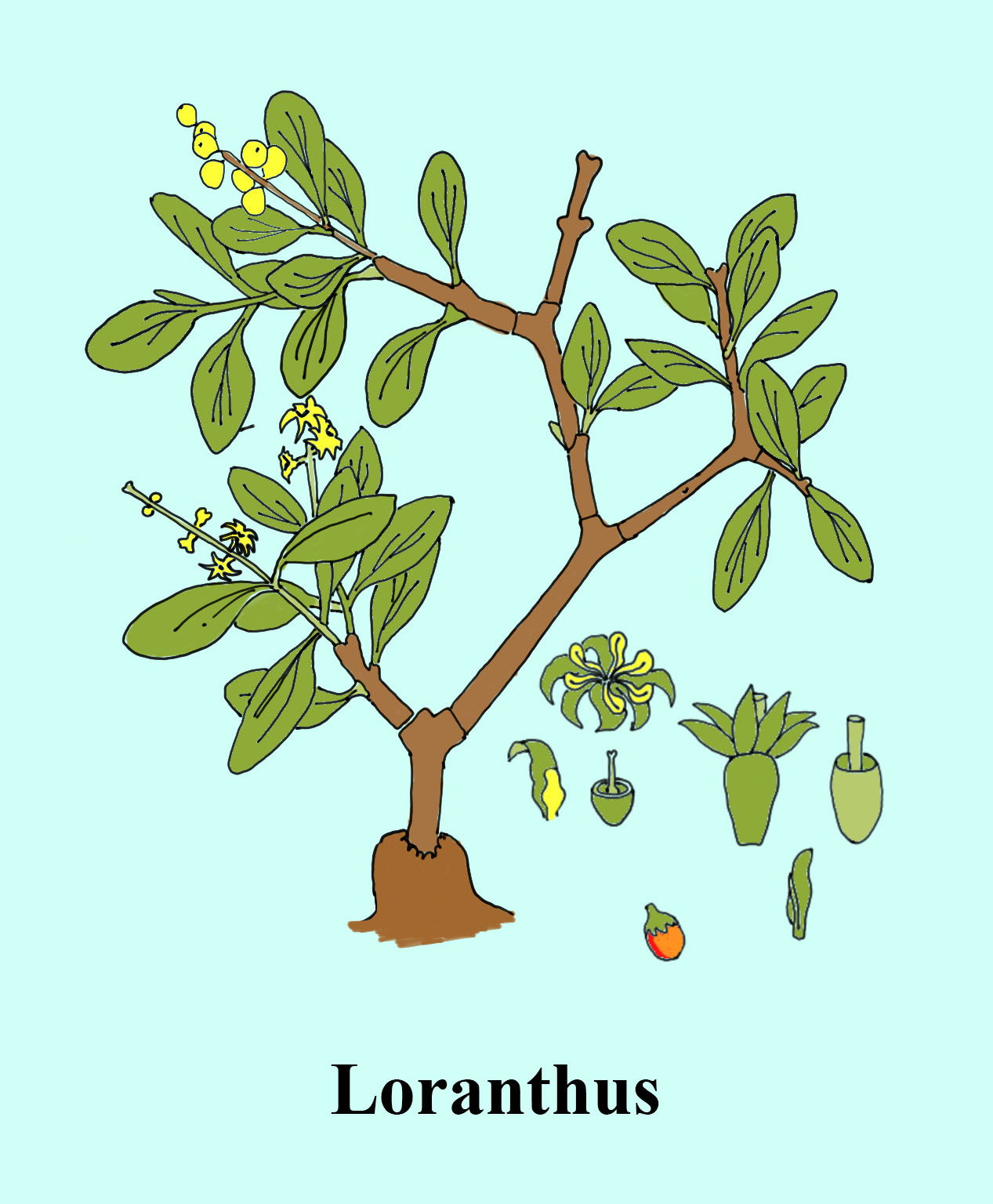
Loranthus is a Parasite. Parasitism is a relationship in which one organism (parasite) is benefitted or gained from the other organism (host) which is harmed. Loranthus grows on the branches and stems of other trees and obtains water and nutrients from the vascular tissues of the host plant. This in turn decreases the host tree's water and mineral content and harms the host while the parasite gets benefitted.
Additional Information:
Commensalism: Commensalism is a relationship between two organisms in which one organism is gained significantly but the other(host) is neutral (neither benefited or harmed). A common example of commensalism is the birds that live in the holes of trees.
Epiphytes: Plants that grow on other plants without benefiting from them ( do not obtain water or nutrients) but produce their own from air and rain. Example: orchids and tillandsias.
Symbiont: Symbiont is a relationship in which one of the two organisms can either be profited or maltreated.
So, the correct answer is Parasite.
Note: -Parasites are of three types, Ectoparasites that live on the outside of an organism, Endoparasites live inside a host organism, and Intracellular parasites live in the spaces between cells.
-A vector is a third party that transmits the parasite to the host organism. For example in malaria, the mosquito is the vector or carrier, the Plasmodium is the parasite and the human is the host. The mosquito is an ectoparasite when it sucks blood for itself as well as a vector for Plasmodium.
Complete answer:
Loranthus is a Parasite. Parasitism is a relationship in which one organism (parasite) is benefitted or gained from the other organism (host) which is harmed. Loranthus grows on the branches and stems of other trees and obtains water and nutrients from the vascular tissues of the host plant. This in turn decreases the host tree's water and mineral content and harms the host while the parasite gets benefitted.
Additional Information:
Commensalism: Commensalism is a relationship between two organisms in which one organism is gained significantly but the other(host) is neutral (neither benefited or harmed). A common example of commensalism is the birds that live in the holes of trees.
Epiphytes: Plants that grow on other plants without benefiting from them ( do not obtain water or nutrients) but produce their own from air and rain. Example: orchids and tillandsias.
Symbiont: Symbiont is a relationship in which one of the two organisms can either be profited or maltreated.
So, the correct answer is Parasite.
Note: -Parasites are of three types, Ectoparasites that live on the outside of an organism, Endoparasites live inside a host organism, and Intracellular parasites live in the spaces between cells.
-A vector is a third party that transmits the parasite to the host organism. For example in malaria, the mosquito is the vector or carrier, the Plasmodium is the parasite and the human is the host. The mosquito is an ectoparasite when it sucks blood for itself as well as a vector for Plasmodium.
Recently Updated Pages
Master Class 11 English: Engaging Questions & Answers for Success

Master Class 11 Social Science: Engaging Questions & Answers for Success
Master Class 11 Maths: Engaging Questions & Answers for Success
Master Class 11 Biology: Engaging Questions & Answers for Success
Master Class 11 Physics: Engaging Questions & Answers for Success
Master Class 11 Chemistry: Engaging Questions & Answers for Success
Trending doubts
One Metric ton is equal to kg A 10000 B 1000 C 100 class 11 physics CBSE
Difference Between Prokaryotic Cells and Eukaryotic Cells
Find the value of the expression given below sin 30circ class 11 maths CBSE
Difference between physical and chemical change class 11 chemistry CBSE
Two of the body parts which do not appear in MRI are class 11 biology CBSE
Draw a diagram of a plant cell and label at least eight class 11 biology CBSE