




Longitudinal strain can be produced in:
$(a)$ glass
$(b)$ water
$(c)$ honey
$(d)$ hydrogen gas
Answer
 Verified
606k+ views
Hint: In this question use the concept that longitudinal strain can be seen in entities in which there can be a change of length or dimension, when an external pressure or force that gives rise to pressure is applied to it. This change in length can either be a decrease in length or an increase in length. This concept will help finding the right option for this problem statement.
Complete step-by-step answer:
Longitudinal Strain – As we know if we applied pressure on anything for example a plastic string it will elongate so the length of the string is changed.
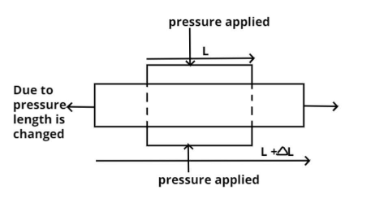
Let the initial length of the plastic string = L,
And after applying pressure its length become = L’
So the change in length = $\Delta L = L' - L$
So the longitudinal strain is known as change in length divided by the actual length.
Therefore, longitudinal strain = $\dfrac{{\Delta L}}{L}$ and it is dimensionless.
Now as we know longitudinal strain is only applicable to solids not in liquid and gases.
As we cannot measure the elongation in the liquid as well as in gases i.e. inability to transfer the deformations in liquid as well as in gases because after applying the pressure and after releasing the pressure the size of the liquid as we as the gases remains same but this is not in the case of solids, when we applied the pressure in solids the size of the solids get permanently deformed so longitudinal strain is only possible in solids.
In the given options only glass is a solid.
So longitudinal strain is only possible in the glass.
So this is the required answer.
Hence option (A) is the correct answer.
Note: Longitudinal strain is accompanied by longitudinal stress as this stress is the primary key for the change in length. It can also be defined as the deformation per unit length, strain itself is the change in the dimensions to the original dimension. When the characterization of the dimension changes then the type of strain too changes.
Complete step-by-step answer:
Longitudinal Strain – As we know if we applied pressure on anything for example a plastic string it will elongate so the length of the string is changed.
Let the initial length of the plastic string = L,
And after applying pressure its length become = L’
So the change in length = $\Delta L = L' - L$
So the longitudinal strain is known as change in length divided by the actual length.
Therefore, longitudinal strain = $\dfrac{{\Delta L}}{L}$ and it is dimensionless.
Now as we know longitudinal strain is only applicable to solids not in liquid and gases.
As we cannot measure the elongation in the liquid as well as in gases i.e. inability to transfer the deformations in liquid as well as in gases because after applying the pressure and after releasing the pressure the size of the liquid as we as the gases remains same but this is not in the case of solids, when we applied the pressure in solids the size of the solids get permanently deformed so longitudinal strain is only possible in solids.
In the given options only glass is a solid.
So longitudinal strain is only possible in the glass.
So this is the required answer.
Hence option (A) is the correct answer.
Note: Longitudinal strain is accompanied by longitudinal stress as this stress is the primary key for the change in length. It can also be defined as the deformation per unit length, strain itself is the change in the dimensions to the original dimension. When the characterization of the dimension changes then the type of strain too changes.
Recently Updated Pages
Master Class 11 Computer Science: Engaging Questions & Answers for Success

Master Class 11 Business Studies: Engaging Questions & Answers for Success
Master Class 11 Economics: Engaging Questions & Answers for Success
Master Class 11 English: Engaging Questions & Answers for Success
Master Class 11 Maths: Engaging Questions & Answers for Success
Master Class 11 Biology: Engaging Questions & Answers for Success
Trending doubts
One Metric ton is equal to kg A 10000 B 1000 C 100 class 11 physics CBSE
There are 720 permutations of the digits 1 2 3 4 5 class 11 maths CBSE
Discuss the various forms of bacteria class 11 biology CBSE
Draw a diagram of a plant cell and label at least eight class 11 biology CBSE
State the laws of reflection of light
Explain zero factorial class 11 maths CBSE