




What is the locomotory organ of Amoeba?
Answer
 Verified
618.9k+ views
Hint: Amoeba lacks a cell wall which helps in free movement by using finger-like projection of cytoplasmic extension of the body. The cytoplasm bulges out which forms false feet and with the correlation of actin microfilaments by pushing the plasma membrane which is present around the amoeba.
Complete answer:
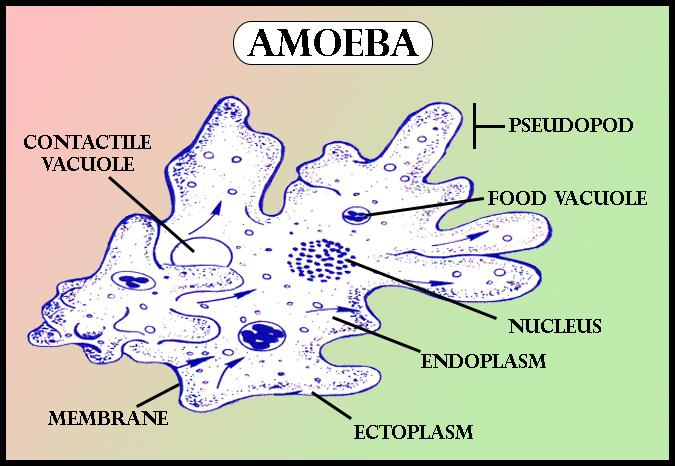
The locomotory organ of Amoeba is Pseudopodia or false feet. That is why the streaming of protoplasm in amoeba is a simple form of movement. Because of the movement of cytoplasm or protoplasm, the surface of the forms of false feet, or pseudopodia. The old pseudopodia are replaced by new pseudopodia, and therefore the formation and withdrawal of the pseudopodia allow the cell to change its shape as per requirements. They do not have a fixed shape.
Additional Information:
Movement is of three types -
Amoeboid or Pseudopodial Movement: Movement as shown by the Amoeba, by forming pseudopodia or false feet, due to streaming cytoplasm or protoplasm.
Ciliary Movement: Cells have short fine hair-like projection called cilia which helps in movement. Cilia creates a water current that helps in the movement of various structures. Like the movement in the respiratory tract, reproductive, renal tubules, etc. of humans.
Muscular Movement: Movements due to rhythmic contraction and relaxation of muscles. Like the movement of the jaw, tongue, arms, legs of humans.
External parts show movement for various reasons like -
-Maintain the equilibrium of the body.
-The movement to capture food.
-Movement for ingestion, defense, locomotion, etc.
-Movement of the internal body part helps the organism to carry out various important processes in the organism's body.
Note: -Movement is the mere change in position or posture whereas locomotion is the movement of an organism from one place to another leading to a change in its position.
-WBC and macrophages also show amoeboid movement. The leukocytes and macrophages reach each and every part of the body and engulf antigens or pathogens through these pseudopodial.
-Spermatozoa and protozoa have flagella for locomotion. Similar to the ciliary movement.
-All locomotions are movements but all movements are not locomotions.
Complete answer:
The locomotory organ of Amoeba is Pseudopodia or false feet. That is why the streaming of protoplasm in amoeba is a simple form of movement. Because of the movement of cytoplasm or protoplasm, the surface of the forms of false feet, or pseudopodia. The old pseudopodia are replaced by new pseudopodia, and therefore the formation and withdrawal of the pseudopodia allow the cell to change its shape as per requirements. They do not have a fixed shape.
Additional Information:
Movement is of three types -
Amoeboid or Pseudopodial Movement: Movement as shown by the Amoeba, by forming pseudopodia or false feet, due to streaming cytoplasm or protoplasm.
Ciliary Movement: Cells have short fine hair-like projection called cilia which helps in movement. Cilia creates a water current that helps in the movement of various structures. Like the movement in the respiratory tract, reproductive, renal tubules, etc. of humans.
Muscular Movement: Movements due to rhythmic contraction and relaxation of muscles. Like the movement of the jaw, tongue, arms, legs of humans.
External parts show movement for various reasons like -
-Maintain the equilibrium of the body.
-The movement to capture food.
-Movement for ingestion, defense, locomotion, etc.
-Movement of the internal body part helps the organism to carry out various important processes in the organism's body.
Note: -Movement is the mere change in position or posture whereas locomotion is the movement of an organism from one place to another leading to a change in its position.
-WBC and macrophages also show amoeboid movement. The leukocytes and macrophages reach each and every part of the body and engulf antigens or pathogens through these pseudopodial.
-Spermatozoa and protozoa have flagella for locomotion. Similar to the ciliary movement.
-All locomotions are movements but all movements are not locomotions.
Recently Updated Pages
Master Class 11 English: Engaging Questions & Answers for Success

Master Class 11 Physics: Engaging Questions & Answers for Success
Master Class 11 Computer Science: Engaging Questions & Answers for Success
Master Class 11 Chemistry: Engaging Questions & Answers for Success
Master Class 11 Social Science: Engaging Questions & Answers for Success
Master Class 11 Accountancy: Engaging Questions & Answers for Success
Trending doubts
Difference Between Prokaryotic Cells and Eukaryotic Cells
Two of the body parts which do not appear in MRI are class 11 biology CBSE
One Metric ton is equal to kg A 10000 B 1000 C 100 class 11 physics CBSE
10 examples of friction in our daily life
Draw a diagram of nephron and explain its structur class 11 biology CBSE
Draw a diagram of a plant cell and label at least eight class 11 biology CBSE