




Locomotion occurs in Earthworm with the help of
(a)Setae
(b)Setae and circular muscles
(c)Parapodia
(d)Setae, circular muscles, and longitudinal muscles
Answer
 Verified
623.7k+ views
Hint: They are the bristles-like structure in the dorsal side of its body. It helps them in attaching their body to the ground and lessens their body when they move and helps them move in various motions.
Complete answer:
-The locomotion in earthworm occurs due to the presence of the brush or bristle-like structures called Seta.
-Along with Setae they use different longitudinal and circular muscles for their movement.
-It helps their body to contract and then move forward.
-These setae are present along with the whole body surface of the earthworm.
-The movement of earthworms includes contraction and relaxation, thus their motion is known as peristalsis.
Additional Information: -Earthworm belongs to the phylum Annelida.
- They are triploblastic and have bilateral symmetry animals.
-Metameric segmentation is observed where the body is segmented, from head to tail.
-The circulatory system of an earthworm is closed.
-They are referred to as segmented worms.
-The coelom is the true body cavity they possess. Breathing takes place through the skin.
-Earthworms are hermaphrodites having both male and female reproductive systems in one individual.
-They have organs called nephridia for excretion.
-Their nervous system consists of paired ganglia (collections of nerve cell bodies) and a double ventral nerve cord connected by lateral nerves.
So, the correct answer is ‘Setae, circular muscles, and longitudinal muscles’.
Note: Earthworms are advantageous in the process of the formation of vermicompost. Vermicompost (vermicompost) is the result of the decomposition process to produce a mixture of decomposing vegetable or food waste, bedding materials, and vermicast using different species of worms, usually red wigglers, white worms, and other earthworms. This method is called vermicomposting, while vermiculture is called the rearing of worms for this reason.
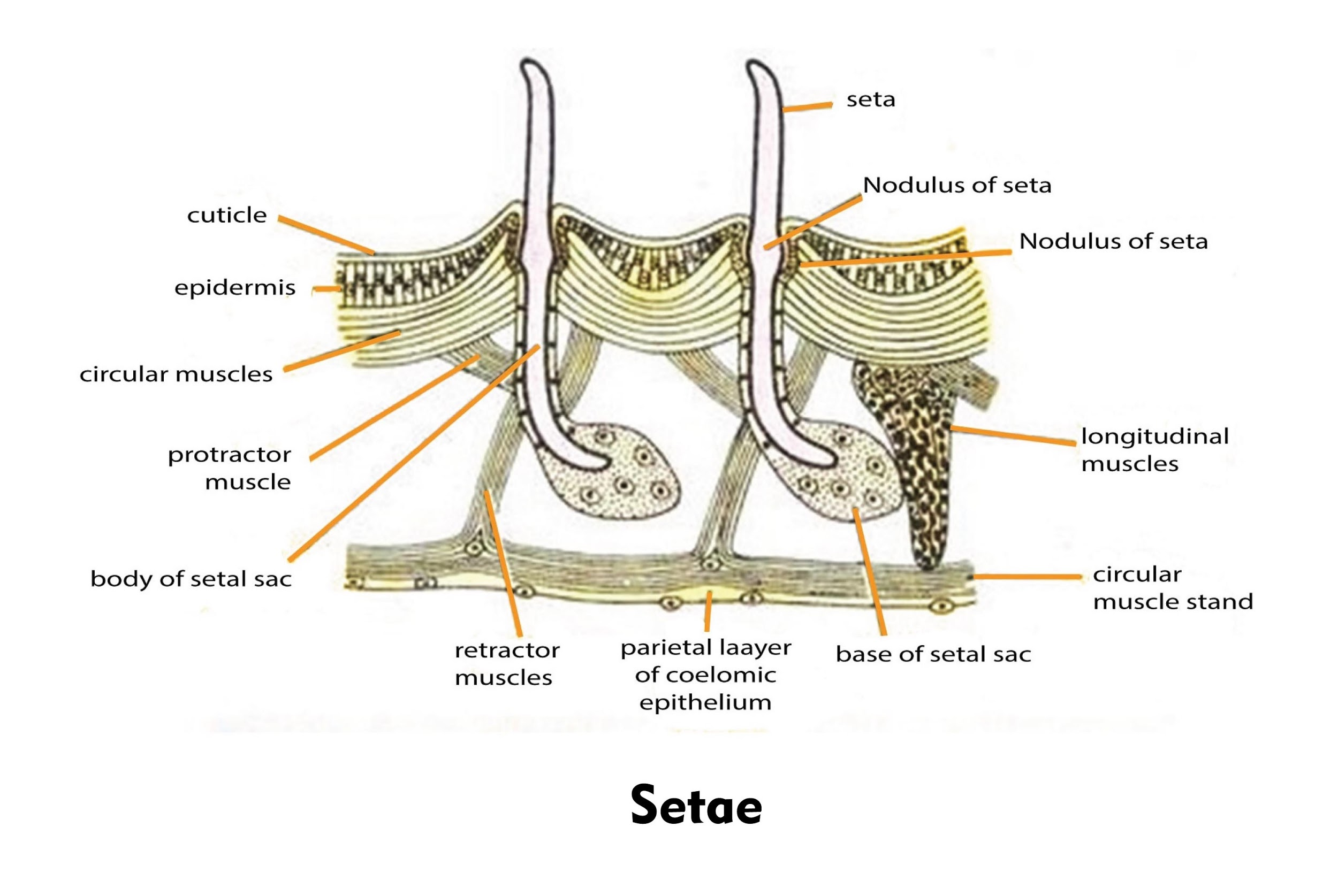
Complete answer:
-The locomotion in earthworm occurs due to the presence of the brush or bristle-like structures called Seta.
-Along with Setae they use different longitudinal and circular muscles for their movement.
-It helps their body to contract and then move forward.
-These setae are present along with the whole body surface of the earthworm.
-The movement of earthworms includes contraction and relaxation, thus their motion is known as peristalsis.
Additional Information: -Earthworm belongs to the phylum Annelida.
- They are triploblastic and have bilateral symmetry animals.
-Metameric segmentation is observed where the body is segmented, from head to tail.
-The circulatory system of an earthworm is closed.
-They are referred to as segmented worms.
-The coelom is the true body cavity they possess. Breathing takes place through the skin.
-Earthworms are hermaphrodites having both male and female reproductive systems in one individual.
-They have organs called nephridia for excretion.
-Their nervous system consists of paired ganglia (collections of nerve cell bodies) and a double ventral nerve cord connected by lateral nerves.
So, the correct answer is ‘Setae, circular muscles, and longitudinal muscles’.
Note: Earthworms are advantageous in the process of the formation of vermicompost. Vermicompost (vermicompost) is the result of the decomposition process to produce a mixture of decomposing vegetable or food waste, bedding materials, and vermicast using different species of worms, usually red wigglers, white worms, and other earthworms. This method is called vermicomposting, while vermiculture is called the rearing of worms for this reason.
Recently Updated Pages
Master Class 11 English: Engaging Questions & Answers for Success

Master Class 11 Social Science: Engaging Questions & Answers for Success
Master Class 11 Maths: Engaging Questions & Answers for Success
Master Class 11 Biology: Engaging Questions & Answers for Success
Master Class 11 Physics: Engaging Questions & Answers for Success
Master Class 11 Chemistry: Engaging Questions & Answers for Success
Trending doubts
One Metric ton is equal to kg A 10000 B 1000 C 100 class 11 physics CBSE
Difference Between Prokaryotic Cells and Eukaryotic Cells
Find the value of the expression given below sin 30circ class 11 maths CBSE
Two of the body parts which do not appear in MRI are class 11 biology CBSE
Draw a diagram of a plant cell and label at least eight class 11 biology CBSE
10 examples of friction in our daily life