




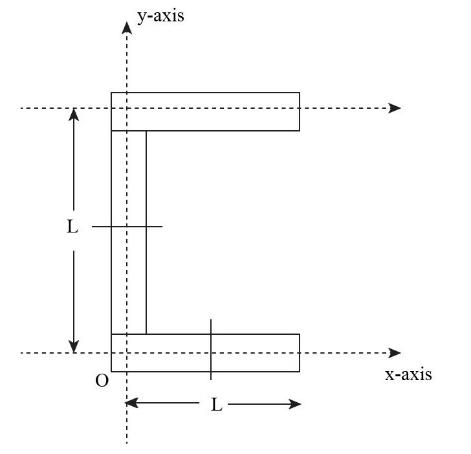
Locate the centre of mass of arrangement shown in figure. The three rods are identical in mass and length.
(1) $\left( {\dfrac{L}{2},\dfrac{L}{2}} \right)$
(2) $\left( {\dfrac{L}{3},0} \right)$
(3) $\left( {\dfrac{L}{3},\dfrac{L}{2}} \right)$
(4) $\left( {\dfrac{L}{3},\dfrac{L}{2}} \right)$
Answer
 Verified
577.5k+ views
Hint: You need to apply the concept of centre of mass in this question in order to solve the question. Firstly, you need to calculate the centre of mass of the individual rods. Later, you need to substitute the values in the formula of centre of mass.
Complete step by step answer:
The system contains three rods which can be seen in the question.
The centre of mass of the first rod that is the rod present along the x-axis is $\left( {\dfrac{L}{2},0} \right)$.
Similarly, the centre of mass of the second rod, that is the rod present along the y-axis is $\left( {0,\dfrac{L}{2}} \right)$.
Further, the centre of mass of the third rod, that is the remaining rod is $\left( {\dfrac{L}{2},L} \right)$.
Let us consider that the mass of each rod is m.
We know that the formula for the x-coordinate of centre of mass of the system is given as,
${x_c} = \dfrac{{{m_1}{x_1} + {m_2}{x_2} + {m_3}{x_3}}}{{{m_1} + {m_2} + {m_3}}}$
Here we know all the values that we require to substitute in the above expression. So, on substituting the values, we get,
$
{x_c} = \dfrac{{\left( {m \times \dfrac{L}{2}} \right) + \left( {m \times 0} \right) + \left( {m \times \dfrac{L}{2}} \right)}}{{m + m + m}}\\
\implies {x_c} = \dfrac{L}{3}
$
Similarly, we can calculate the y-coordinate of the centre of mass of the system.
We know that the formula for the y-coordinate of the centre of mass of the system is given as,
${y_c} = \dfrac{{{m_1}{y_1} + {m_2}{y_2} + {m_3}{y_3}}}{{{m_1} + {m_2} + {m_3}}}$
Here we know all the values that we require to substitute in the above expression. So, on substituting the values, we get,
$
{y_c} = \dfrac{{\left( {m \times 0} \right) + \left( {m \times \dfrac{L}{2}} \right) + \left( {m \times L} \right)}}{{m + m + m}}\\
\implies {y_c} = \dfrac{L}{2}
$
So we have coordinates of the centre of mass of the system, that are ${x_c} = \dfrac{L}{3}$ and ${y_c} = \dfrac{L}{2}$.
Therefore, the centre of mass of the arrangement is $\left( {\dfrac{L}{3},\dfrac{L}{2}} \right)$.
Therefore, the option (C) is the correct answer.
Note:
You can make mistakes while calculating the individual centre of mass of the third rod.
Also you need to take the mass and length of the rod equal, as it is mentioned.
The center of mass is a position defined relative to an object or system of objects. It is the average position of all the parts of the system, weighted according to their masses. For simple rigid objects with uniform density, the center of mass is located at the centroid.
Complete step by step answer:
The system contains three rods which can be seen in the question.
The centre of mass of the first rod that is the rod present along the x-axis is $\left( {\dfrac{L}{2},0} \right)$.
Similarly, the centre of mass of the second rod, that is the rod present along the y-axis is $\left( {0,\dfrac{L}{2}} \right)$.
Further, the centre of mass of the third rod, that is the remaining rod is $\left( {\dfrac{L}{2},L} \right)$.
Let us consider that the mass of each rod is m.
We know that the formula for the x-coordinate of centre of mass of the system is given as,
${x_c} = \dfrac{{{m_1}{x_1} + {m_2}{x_2} + {m_3}{x_3}}}{{{m_1} + {m_2} + {m_3}}}$
Here we know all the values that we require to substitute in the above expression. So, on substituting the values, we get,
$
{x_c} = \dfrac{{\left( {m \times \dfrac{L}{2}} \right) + \left( {m \times 0} \right) + \left( {m \times \dfrac{L}{2}} \right)}}{{m + m + m}}\\
\implies {x_c} = \dfrac{L}{3}
$
Similarly, we can calculate the y-coordinate of the centre of mass of the system.
We know that the formula for the y-coordinate of the centre of mass of the system is given as,
${y_c} = \dfrac{{{m_1}{y_1} + {m_2}{y_2} + {m_3}{y_3}}}{{{m_1} + {m_2} + {m_3}}}$
Here we know all the values that we require to substitute in the above expression. So, on substituting the values, we get,
$
{y_c} = \dfrac{{\left( {m \times 0} \right) + \left( {m \times \dfrac{L}{2}} \right) + \left( {m \times L} \right)}}{{m + m + m}}\\
\implies {y_c} = \dfrac{L}{2}
$
So we have coordinates of the centre of mass of the system, that are ${x_c} = \dfrac{L}{3}$ and ${y_c} = \dfrac{L}{2}$.
Therefore, the centre of mass of the arrangement is $\left( {\dfrac{L}{3},\dfrac{L}{2}} \right)$.
Therefore, the option (C) is the correct answer.
Note:
You can make mistakes while calculating the individual centre of mass of the third rod.
Also you need to take the mass and length of the rod equal, as it is mentioned.
The center of mass is a position defined relative to an object or system of objects. It is the average position of all the parts of the system, weighted according to their masses. For simple rigid objects with uniform density, the center of mass is located at the centroid.
Recently Updated Pages
Master Class 11 Computer Science: Engaging Questions & Answers for Success

Master Class 11 Business Studies: Engaging Questions & Answers for Success
Master Class 11 Economics: Engaging Questions & Answers for Success
Master Class 11 English: Engaging Questions & Answers for Success
Master Class 11 Maths: Engaging Questions & Answers for Success
Master Class 11 Biology: Engaging Questions & Answers for Success
Trending doubts
One Metric ton is equal to kg A 10000 B 1000 C 100 class 11 physics CBSE
There are 720 permutations of the digits 1 2 3 4 5 class 11 maths CBSE
Discuss the various forms of bacteria class 11 biology CBSE
Draw a diagram of a plant cell and label at least eight class 11 biology CBSE
State the laws of reflection of light
10 examples of friction in our daily life