




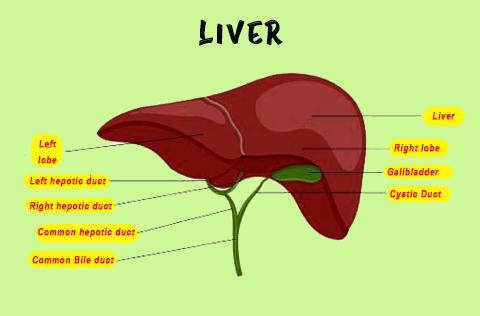
Liver is bilobed in
(a)Chondrichthyes
(b)Osteichthyes
(c)Both A and B
(d)Dipnoi
Answer
 Verified
585.3k+ views
Hint: It is a class that mainly contains the cartilaginous fishes. Their general features include paired fins, paired nares, scales, a heart with its chambers in series, and skeletons made of cartilage rather than bone.
Complete answer:
The main characteristic features of Chondrichthyes include a cartilaginous skeleton but lack a swim bladder, lipid storage that is restricted to the liver, and unique hematopoietic organs. The liver is bi-lobed in these animals. It consists of two subequal lateral lobes disposed longitudinally and confluent anteriorly. Dipnoi does not have any differentiated gastric glands so the secretion of gastric juices is regulated by the epithelium lining of the stomach or intestine. Osteichthyes have trilobed liver.
Additional information:
Some facts about Chondrichthyes:
-The skeleton is generally cartilaginous. -The notochord gradually gets replaced by a vertebral column during development. In some deep-water sharks, the column is reduced.
-RBCs in these animals are produced in the spleen and the epigonal organ(special tissue around the gonads, which is also thought to play a role in the immune system)as they do not contain bone marrow.
Its production can also be seen in the Leydig's organ, which is only found in certain cartilaginous fishes.
-The subclass Holocephali, which is known to be a very specialized group, lacks both the Leydig's and epigonal organs.
-All chondrichthyans have five to seven pairs of gills.
-In chondrichthyans, the nervous system is composed of a small brain with 8-10 pairs of cranial nerves. Their body contains the spinal cord with spinal nerves and also has several sensory organs that provide information to be processed.
Notes: Chondrichthyes use an oil-filled liver to control their buoyancy. This lightens the shark’s heavy body to keep it from sinking and saves the shark’s energy when using its fins to keep itself moving. The oily liver also has additional usage for other daily functions such as digestion. The name for this oil is squalene.
Complete answer:
The main characteristic features of Chondrichthyes include a cartilaginous skeleton but lack a swim bladder, lipid storage that is restricted to the liver, and unique hematopoietic organs. The liver is bi-lobed in these animals. It consists of two subequal lateral lobes disposed longitudinally and confluent anteriorly. Dipnoi does not have any differentiated gastric glands so the secretion of gastric juices is regulated by the epithelium lining of the stomach or intestine. Osteichthyes have trilobed liver.
Additional information:
Some facts about Chondrichthyes:
-The skeleton is generally cartilaginous. -The notochord gradually gets replaced by a vertebral column during development. In some deep-water sharks, the column is reduced.
-RBCs in these animals are produced in the spleen and the epigonal organ(special tissue around the gonads, which is also thought to play a role in the immune system)as they do not contain bone marrow.
Its production can also be seen in the Leydig's organ, which is only found in certain cartilaginous fishes.
-The subclass Holocephali, which is known to be a very specialized group, lacks both the Leydig's and epigonal organs.
-All chondrichthyans have five to seven pairs of gills.
-In chondrichthyans, the nervous system is composed of a small brain with 8-10 pairs of cranial nerves. Their body contains the spinal cord with spinal nerves and also has several sensory organs that provide information to be processed.
Notes: Chondrichthyes use an oil-filled liver to control their buoyancy. This lightens the shark’s heavy body to keep it from sinking and saves the shark’s energy when using its fins to keep itself moving. The oily liver also has additional usage for other daily functions such as digestion. The name for this oil is squalene.
Recently Updated Pages
Master Class 11 Social Science: Engaging Questions & Answers for Success

Master Class 11 English: Engaging Questions & Answers for Success
Master Class 11 Maths: Engaging Questions & Answers for Success
Master Class 11 Chemistry: Engaging Questions & Answers for Success
Master Class 11 Biology: Engaging Questions & Answers for Success
Master Class 11 Physics: Engaging Questions & Answers for Success
Trending doubts
Differentiate between an exothermic and an endothermic class 11 chemistry CBSE
One Metric ton is equal to kg A 10000 B 1000 C 100 class 11 physics CBSE
Difference Between Prokaryotic Cells and Eukaryotic Cells
There are 720 permutations of the digits 1 2 3 4 5 class 11 maths CBSE
Two of the body parts which do not appear in MRI are class 11 biology CBSE
Which gas is abundant in air class 11 chemistry CBSE