




Little leaf disease of Brinjal is caused by a/an
Answer
 Verified
613.2k+ views
Hint: This major plant disease shows symptoms like very small petiole and short leaves. This disease causes major economic losses for brinjal cultivators in India. These organisms are one of the smallest parasites that cause plant diseases.
Complete answer:
Little leaf disease of Brinjal is caused by a Mycoplasma-like organism called Phytoplasma. The name MLO (Mycoplasma-like organisms) was one of the early names provided during the classification. This disease is a vector transmitted disease, where Hishimonus phycitis is the vector.-Hishimonus phycitis (the cotton leafhopper) is a pest insect with green and white distant epidermal colors, and are seen abundantly in tropical and subtropical regions.
-The major symptoms of Little leaf are chlorosis of new leaves intervening, deformation, and negligence of leaves through the midrib to grow and common shortening of plants.
-Eggplant is the common name of brinjal, which is a species of plants that belong to the family Solanaceae. The fruit of Solanum melongena is edible and is cultivated worldwide and commonly looks purple and the soft fruit is a major part of several dishes.
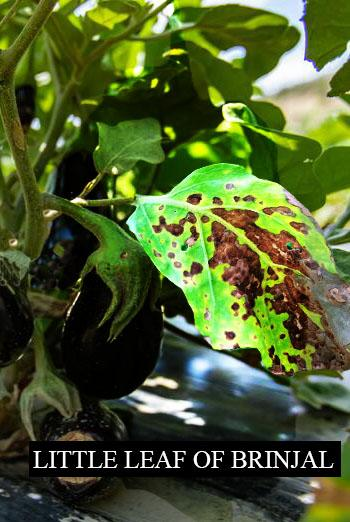
Note: -Some secondary symptoms of little leaf disease contain halting of terminal development, new leaves with deformed and weak midribs, and axillary buds with very small, deformed growth.
-The increased temperature of the soil, the moisture of soil, and the presence of accumulation of bacterial/fungal population in the soil are factors that increase the chance of infections.
-Removing weeds of solanaceous that occupies the vector and spraying insecticides to the infected plant can help minimize pest populations to control the spread of this disease.
Complete answer:
Little leaf disease of Brinjal is caused by a Mycoplasma-like organism called Phytoplasma. The name MLO (Mycoplasma-like organisms) was one of the early names provided during the classification. This disease is a vector transmitted disease, where Hishimonus phycitis is the vector.-Hishimonus phycitis (the cotton leafhopper) is a pest insect with green and white distant epidermal colors, and are seen abundantly in tropical and subtropical regions.
-The major symptoms of Little leaf are chlorosis of new leaves intervening, deformation, and negligence of leaves through the midrib to grow and common shortening of plants.
-Eggplant is the common name of brinjal, which is a species of plants that belong to the family Solanaceae. The fruit of Solanum melongena is edible and is cultivated worldwide and commonly looks purple and the soft fruit is a major part of several dishes.
Note: -Some secondary symptoms of little leaf disease contain halting of terminal development, new leaves with deformed and weak midribs, and axillary buds with very small, deformed growth.
-The increased temperature of the soil, the moisture of soil, and the presence of accumulation of bacterial/fungal population in the soil are factors that increase the chance of infections.
-Removing weeds of solanaceous that occupies the vector and spraying insecticides to the infected plant can help minimize pest populations to control the spread of this disease.
Recently Updated Pages
Master Class 11 English: Engaging Questions & Answers for Success

Master Class 11 Social Science: Engaging Questions & Answers for Success
Master Class 11 Maths: Engaging Questions & Answers for Success
Master Class 11 Biology: Engaging Questions & Answers for Success
Master Class 11 Physics: Engaging Questions & Answers for Success
Master Class 11 Chemistry: Engaging Questions & Answers for Success
Trending doubts
One Metric ton is equal to kg A 10000 B 1000 C 100 class 11 physics CBSE
Difference Between Prokaryotic Cells and Eukaryotic Cells
Two of the body parts which do not appear in MRI are class 11 biology CBSE
Find the value of the expression given below sin 30circ class 11 maths CBSE
Draw a diagram of a plant cell and label at least eight class 11 biology CBSE
10 examples of friction in our daily life