



How many litres of milk can a hemispherical bowl of diameter 10.5 cm hold?
Answer
 Verified
585.3k+ views
Hint: We need to calculate the volume of the bowl as the amount of milk that can be held in the bowl is equal to the bowl's capacity.
And Capacity= Volume of the bowl.
We will use the formula for volume of hemisphere as the bowl is in the shape of a hemisphere (given)
Volume of hemi-sphere = $2/3\pi {r^3}$
Complete step-by-step answer:
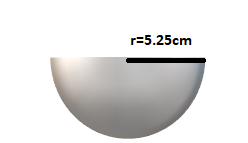
Diameter of the hemisphere= 10.5 cm
Radius ,
$
r = {\text{ }}10.5/2cm \\
= {\text{ }}5.25cm \\
$ (as radius = Diameter/2)
Now,
Volume of Hemispherical bowl= $2/3\pi {r^3}$
Substituting the value of r, we get:
\[2/3\pi {r^3} = (2/3)\pi {(5.25)^3}\]
\[
= (2/3)(22/7) \times 5.25 \times 5.25 \times 5.25 \\
= (2/3)(22/7)(525/100)(525/100)(525/100) \\
\]
\[ = 303.1875\]cm3
Converting into litres:
\[ = 303.1875*(1/1000)\]
\[ = 0.3031875\] (As 1 cm3 = 1 ml, ∴1 cm3= 1/1000 l)
Note: Be Careful of the units, volume is generally measured in litres, this is why we made appropriate conversions so that the unit of volume obtained will be litres. In simple terms volume is nothing but the space that is enclosed by any three dimensional object. Make conversions wherever necessary in any mensuration problem. Remember
1 m3= 1000 l and 1cm3 = 1 ml
And Capacity= Volume of the bowl.
We will use the formula for volume of hemisphere as the bowl is in the shape of a hemisphere (given)
Volume of hemi-sphere = $2/3\pi {r^3}$
Complete step-by-step answer:
Diameter of the hemisphere= 10.5 cm
Radius ,
$
r = {\text{ }}10.5/2cm \\
= {\text{ }}5.25cm \\
$ (as radius = Diameter/2)
Now,
Volume of Hemispherical bowl= $2/3\pi {r^3}$
Substituting the value of r, we get:
\[2/3\pi {r^3} = (2/3)\pi {(5.25)^3}\]
\[
= (2/3)(22/7) \times 5.25 \times 5.25 \times 5.25 \\
= (2/3)(22/7)(525/100)(525/100)(525/100) \\
\]
\[ = 303.1875\]cm3
Converting into litres:
\[ = 303.1875*(1/1000)\]
\[ = 0.3031875\] (As 1 cm3 = 1 ml, ∴1 cm3= 1/1000 l)
Note: Be Careful of the units, volume is generally measured in litres, this is why we made appropriate conversions so that the unit of volume obtained will be litres. In simple terms volume is nothing but the space that is enclosed by any three dimensional object. Make conversions wherever necessary in any mensuration problem. Remember
1 m3= 1000 l and 1cm3 = 1 ml
Recently Updated Pages
Master Class 11 English: Engaging Questions & Answers for Success

Master Class 11 Maths: Engaging Questions & Answers for Success
Master Class 11 Biology: Engaging Questions & Answers for Success
Master Class 11 Social Science: Engaging Questions & Answers for Success
Master Class 11 Physics: Engaging Questions & Answers for Success
Master Class 11 Accountancy: Engaging Questions & Answers for Success
Trending doubts
Difference Between Plant Cell and Animal Cell
Fill the blanks with the suitable prepositions 1 The class 9 english CBSE
Which places in India experience sunrise first and class 9 social science CBSE
Who is eligible for RTE class 9 social science CBSE
What is pollution? How many types of pollution? Define it
Name 10 Living and Non living things class 9 biology CBSE