




List the three important events that occur in photosynthesis. Explain the role of stomata in this process.
Answer
 Verified
559.8k+ views
Hint: The process used by the plants and some other organisms to convert light energy into chemical energy. This chemical energy is later used as fuel for conducting different cellular activities. These are the processes responsible for the production of food in plants.
Complete answer:
The word photosynthesis is derived from the Greek words: ‘phōs’ which means light, and ‘synthesis’ which means to put something together. During photosynthesis, the chemical energy is stored in the form of carbohydrate molecules, such as sugars, which are synthesized from carbon dioxide and water. Mostly, the by-product of this physio-chemical process is oxygen.
The balanced equation for photosynthesis:
${ 6 }{ C }{ O }_{ 2 }\quad +\quad { 6 }{ H }_{ 2 }{ O }\quad \rightarrow \quad { C }_{ 6 }{ H }_{ 12 }{ O }_{ 6 }\quad +\quad { 6 }{ O }_{ 2 }$
At the cellular level, photosynthesis takes place in cell organelles called chloroplasts. These organelles contain a green-colored pigment called chlorophyll, which is responsible for the characteristic green coloration of the leaves. Structurally, a leaf comprises a petiole, epidermis, and a lamina. The lamina is used for the absorption of sunlight and carbon dioxide during photosynthesis.
Photosynthetic processes
Following are the three important events that occur in the process of photosynthesis:
1. Absorption of light energy by chlorophyll:
During the process of photosynthesis, the first event is the absorption of light by a photoreceptor molecule. The principal photoreceptor in the chloroplasts being chlorophyll absorbs energy from sunlight during which an electron in the chlorophyll molecule is excited from a lower to a higher energy state. The excited electron is more easily transferred to another molecule.
2. Conversion of energy: Conversion of light energy to chemical energy and splitting of water molecules into hydrogen and oxygen. By binding water molecules and separating protons and electrons, the catalysts in the chloroplasts of photosynthesizing plants help in splitting water.
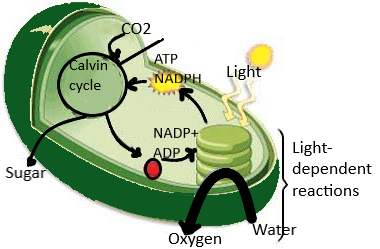
Diagram showing light and dark reactions of photosynthesis
3. Reduction of carbon dioxide to carbohydrates: The hydrogen from water molecules and carbon dioxide absorbed from the air is used in the production of glucose.
Role of stomata: During photosynthesis, oxygen is liberated out into the atmosphere through the leaves as a waste product. Plants capture the carbon dioxide from the atmosphere through tiny openings in the epidermis of tree leaves and needles, called stomata, and proceed to the Calvin photosynthesis cycle. Stomata help in the exchange of gases.
Notes:
1. Guard cells in stomata are responsible for the opening and closing of stomata for gaseous exchange.
2. Some bacteria that perform photosynthesis do not produce oxygen as the by-product of photosynthesis. These bacteria are called anoxygenic photosynthetic bacteria.w
3. Three bacteria that do produce oxygen as a by-product of photosynthesis are called oxygenic photosynthetic bacteria.
4. Green plants, algae, and several prokaryotes such as cyanobacteria, purple bacteria, and green sulfur bacteria perform photosynthesis. Such organisms are called photoautotrophs, or simply phototrophs.
Complete answer:
The word photosynthesis is derived from the Greek words: ‘phōs’ which means light, and ‘synthesis’ which means to put something together. During photosynthesis, the chemical energy is stored in the form of carbohydrate molecules, such as sugars, which are synthesized from carbon dioxide and water. Mostly, the by-product of this physio-chemical process is oxygen.
The balanced equation for photosynthesis:
${ 6 }{ C }{ O }_{ 2 }\quad +\quad { 6 }{ H }_{ 2 }{ O }\quad \rightarrow \quad { C }_{ 6 }{ H }_{ 12 }{ O }_{ 6 }\quad +\quad { 6 }{ O }_{ 2 }$
At the cellular level, photosynthesis takes place in cell organelles called chloroplasts. These organelles contain a green-colored pigment called chlorophyll, which is responsible for the characteristic green coloration of the leaves. Structurally, a leaf comprises a petiole, epidermis, and a lamina. The lamina is used for the absorption of sunlight and carbon dioxide during photosynthesis.
Photosynthetic processes
Following are the three important events that occur in the process of photosynthesis:
1. Absorption of light energy by chlorophyll:
During the process of photosynthesis, the first event is the absorption of light by a photoreceptor molecule. The principal photoreceptor in the chloroplasts being chlorophyll absorbs energy from sunlight during which an electron in the chlorophyll molecule is excited from a lower to a higher energy state. The excited electron is more easily transferred to another molecule.
2. Conversion of energy: Conversion of light energy to chemical energy and splitting of water molecules into hydrogen and oxygen. By binding water molecules and separating protons and electrons, the catalysts in the chloroplasts of photosynthesizing plants help in splitting water.
Diagram showing light and dark reactions of photosynthesis
3. Reduction of carbon dioxide to carbohydrates: The hydrogen from water molecules and carbon dioxide absorbed from the air is used in the production of glucose.
Role of stomata: During photosynthesis, oxygen is liberated out into the atmosphere through the leaves as a waste product. Plants capture the carbon dioxide from the atmosphere through tiny openings in the epidermis of tree leaves and needles, called stomata, and proceed to the Calvin photosynthesis cycle. Stomata help in the exchange of gases.
Notes:
1. Guard cells in stomata are responsible for the opening and closing of stomata for gaseous exchange.
2. Some bacteria that perform photosynthesis do not produce oxygen as the by-product of photosynthesis. These bacteria are called anoxygenic photosynthetic bacteria.w
3. Three bacteria that do produce oxygen as a by-product of photosynthesis are called oxygenic photosynthetic bacteria.
4. Green plants, algae, and several prokaryotes such as cyanobacteria, purple bacteria, and green sulfur bacteria perform photosynthesis. Such organisms are called photoautotrophs, or simply phototrophs.
Recently Updated Pages
Master Class 11 English: Engaging Questions & Answers for Success

Master Class 11 Social Science: Engaging Questions & Answers for Success
Master Class 11 Maths: Engaging Questions & Answers for Success
Master Class 11 Biology: Engaging Questions & Answers for Success
Master Class 11 Physics: Engaging Questions & Answers for Success
Master Class 11 Chemistry: Engaging Questions & Answers for Success
Trending doubts
Explain the Treaty of Vienna of 1815 class 10 social science CBSE
What is the full form of POSCO class 10 social science CBSE
Define Potential, Developed, Stock and Reserved resources
The diagonals of a rhombus are 10cm and 24cm Find the class 10 maths CBSE
Fill the blanks with proper collective nouns 1 A of class 10 english CBSE
What planets have no moons Which one has only one moon class 10 physics CBSE