




List the functions of the nasal cavity.
Answer
 Verified
637.5k+ views
Hint: Nasal cavity is a passage for the exchange of gases in and out of the body.
Complete step-by-step answer:
The nasal cavity is an air-filled, hollow, and larger space that is present above the nose and in the middle of the face. It has two parts: fossa, and nasal passage. The cavities are produced by the extinction of the two nostrils, which is divided by the nasal septum. The nasal cavity is found in the upper region of the respiratory system.
Functions of the nasal cavity
The nasal cavities function is mainly in the respiratory system.
- They act as a passage to pass to enter the inhaled air. The air enters through the nostrils which then goes to the nasal cavity front there to the pharynx and then larynx and finally to the lungs. The exhaled air will move out of the body through the nasal cavity.
- The nasal cavity has mucus which helps in the purification air.
- It acts as a sensory organ that can recognize many different smells as the nasal cavity has an olfactory odor.
- Due to the presence of larynx and pharynx, the nasal cavity is responsible for the production of speech and producing sound. They also sometimes act as barriers between the outer environment and save the cavity from exhaling the foreign particles.
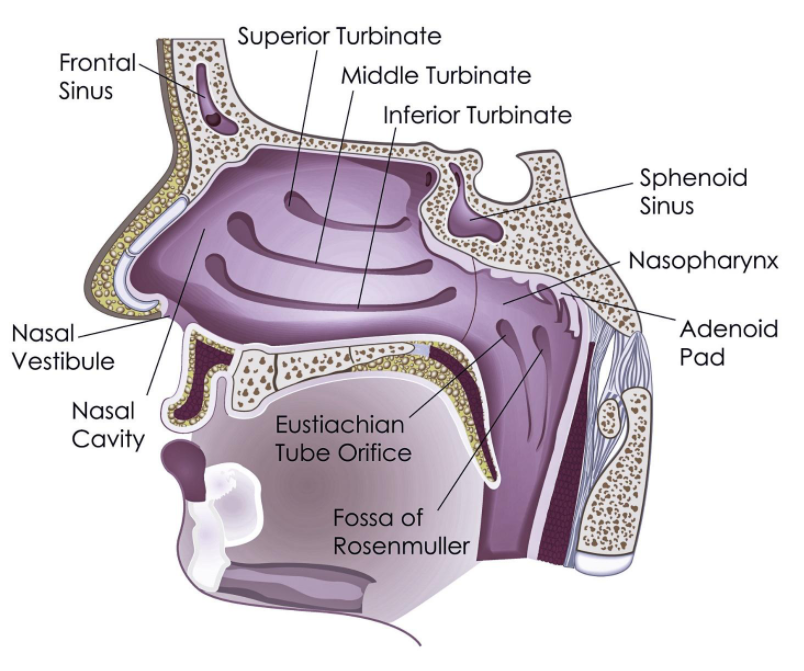
Note: The nasal cavity I surrounded by the paranasal sinuses which are the group of air-filled spaces around the nasal cavity, are four in number. The sinuses which are present below the eye are called maxillary sinuses. The sinuses present between the eyes are ethmoidal sinuses, and which are present behind the eyes are called sphenoidal sinuses.
Complete step-by-step answer:
The nasal cavity is an air-filled, hollow, and larger space that is present above the nose and in the middle of the face. It has two parts: fossa, and nasal passage. The cavities are produced by the extinction of the two nostrils, which is divided by the nasal septum. The nasal cavity is found in the upper region of the respiratory system.
Functions of the nasal cavity
The nasal cavities function is mainly in the respiratory system.
- They act as a passage to pass to enter the inhaled air. The air enters through the nostrils which then goes to the nasal cavity front there to the pharynx and then larynx and finally to the lungs. The exhaled air will move out of the body through the nasal cavity.
- The nasal cavity has mucus which helps in the purification air.
- It acts as a sensory organ that can recognize many different smells as the nasal cavity has an olfactory odor.
- Due to the presence of larynx and pharynx, the nasal cavity is responsible for the production of speech and producing sound. They also sometimes act as barriers between the outer environment and save the cavity from exhaling the foreign particles.
Note: The nasal cavity I surrounded by the paranasal sinuses which are the group of air-filled spaces around the nasal cavity, are four in number. The sinuses which are present below the eye are called maxillary sinuses. The sinuses present between the eyes are ethmoidal sinuses, and which are present behind the eyes are called sphenoidal sinuses.
Recently Updated Pages
Master Class 11 English: Engaging Questions & Answers for Success

Master Class 11 Social Science: Engaging Questions & Answers for Success
Master Class 11 Maths: Engaging Questions & Answers for Success
Master Class 11 Biology: Engaging Questions & Answers for Success
Master Class 11 Physics: Engaging Questions & Answers for Success
Master Class 11 Chemistry: Engaging Questions & Answers for Success
Trending doubts
Explain the Treaty of Vienna of 1815 class 10 social science CBSE
What is the full form of CNG A Complete Natural Gas class 10 social science CBSE
In cricket, what is a "Yorker" designed to do?
What is the full form of POSCO class 10 social science CBSE
Define Potential, Developed, Stock and Reserved resources
What were the majoritarian measures taken in Sri Lanka class 10 social science CBSE