




List out the materials required and the procedure to be followed to prove that "Carbon dioxide is essential for Photosynthesis".
Answer
 Verified
535.2k+ views
Hint: Photosynthesis is the process by which plants make their food in the presence of sunlight to convert light energy into chemical energy. Oxygen is the byproduct of photosynthesis. Sunlight, water, and carbon dioxide are essential to perform photosynthesis. Photosynthesis gives us oxygen which we need to breathe and we, in turn, exhale carbon dioxide which is needed by the plant.
Complete answer:
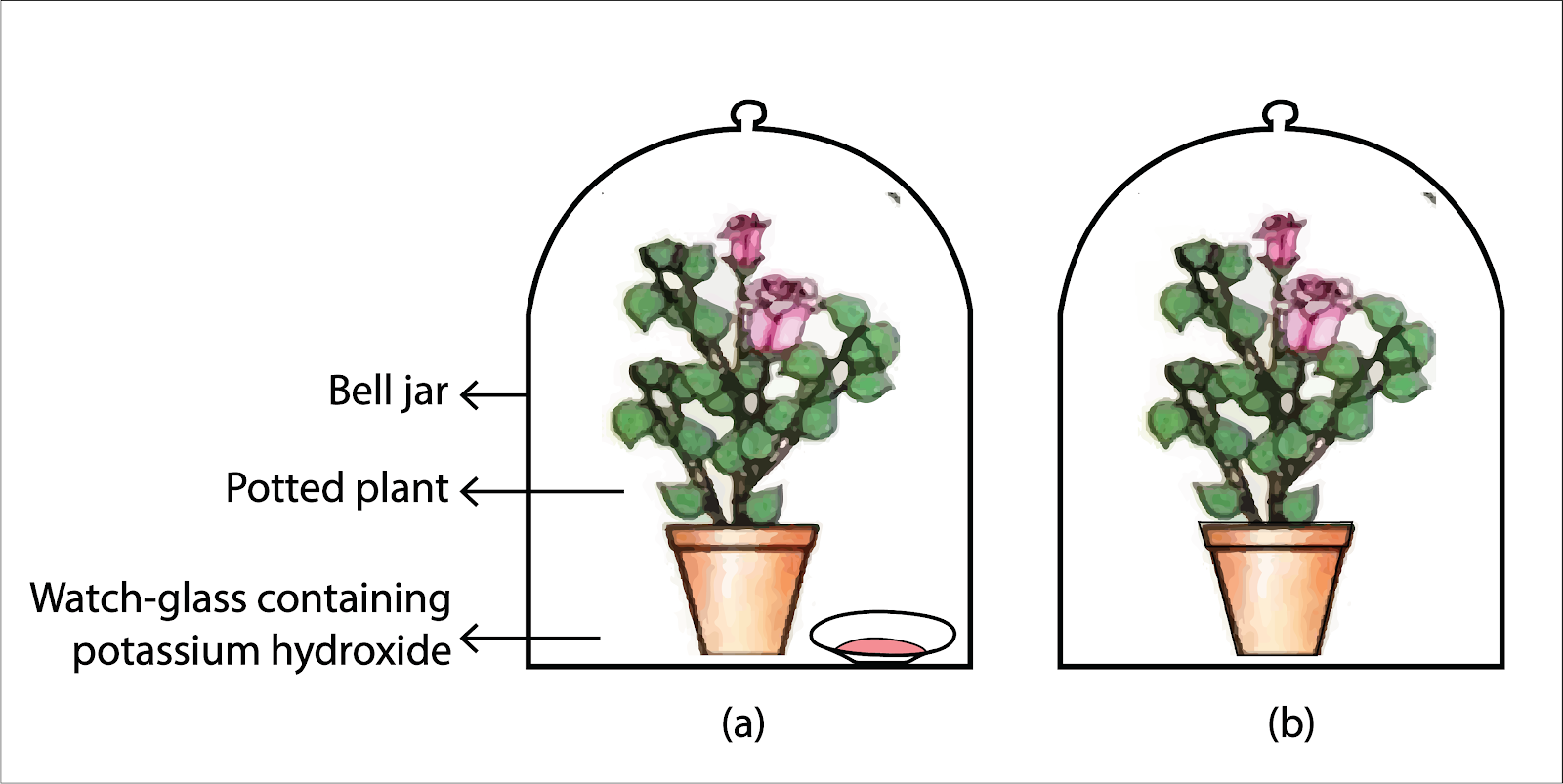
The material required for experimenting includes two potted plants, two bell jars, a dropper, a water bath, potassium hydroxide, alcohol, iodine, glass plates. For experimenting with procedure must be followed:
Take two potted plants and keep them in the dark for 24 hours for the removal of starch from the leaves which get used up.
The potted plants are placed on the glass plates and are covered with bell jars.
Put a small amount of anhydrous potassium hydroxide in a petri dish in one bell jar.
Keep this apparatus in sunlight for 4 hours.
Pluck out one leaf from both the plants and boil them in alcohol using a water bath.
Put a few drops of iodine on the leaves for the test of the presence of starch.
This results in turning the leaf into blue colour which shows that the presence of starch takes place when photosynthesis occurs. On the other hand, the leaf taken from the bell jar consists of potassium hydroxide which does not show any blue colour in it due to the presence of no starch as no photosynthesis occurred. It is due to the absorption of carbon dioxide by potassium hydroxide which shows that carbon dioxide is essential for photosynthesis.
Note:
To make one molecule of glucose during photosynthesis it takes 6 molecules of water and six molecules of carbon dioxide. Plants slow the process of photosynthesis during autumn and as a result, leaves change their colour.
Complete answer:
The material required for experimenting includes two potted plants, two bell jars, a dropper, a water bath, potassium hydroxide, alcohol, iodine, glass plates. For experimenting with procedure must be followed:
Take two potted plants and keep them in the dark for 24 hours for the removal of starch from the leaves which get used up.
The potted plants are placed on the glass plates and are covered with bell jars.
Put a small amount of anhydrous potassium hydroxide in a petri dish in one bell jar.
Keep this apparatus in sunlight for 4 hours.
Pluck out one leaf from both the plants and boil them in alcohol using a water bath.
Put a few drops of iodine on the leaves for the test of the presence of starch.
This results in turning the leaf into blue colour which shows that the presence of starch takes place when photosynthesis occurs. On the other hand, the leaf taken from the bell jar consists of potassium hydroxide which does not show any blue colour in it due to the presence of no starch as no photosynthesis occurred. It is due to the absorption of carbon dioxide by potassium hydroxide which shows that carbon dioxide is essential for photosynthesis.
Note:
To make one molecule of glucose during photosynthesis it takes 6 molecules of water and six molecules of carbon dioxide. Plants slow the process of photosynthesis during autumn and as a result, leaves change their colour.
Recently Updated Pages
Master Class 11 Social Science: Engaging Questions & Answers for Success

Master Class 11 English: Engaging Questions & Answers for Success
Master Class 11 Maths: Engaging Questions & Answers for Success
Master Class 11 Chemistry: Engaging Questions & Answers for Success
Master Class 11 Biology: Engaging Questions & Answers for Success
Master Class 11 Physics: Engaging Questions & Answers for Success
Trending doubts
One Metric ton is equal to kg A 10000 B 1000 C 100 class 11 physics CBSE
Difference Between Prokaryotic Cells and Eukaryotic Cells
Draw a diagram of a plant cell and label at least eight class 11 biology CBSE
Two of the body parts which do not appear in MRI are class 11 biology CBSE
Which gas is abundant in air class 11 chemistry CBSE
10 examples of friction in our daily life