




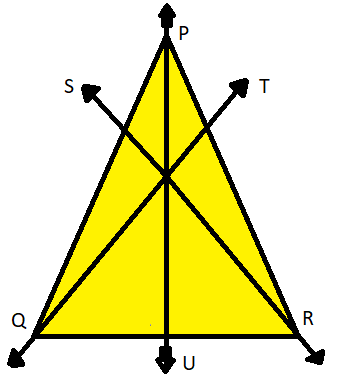
How many lines of symmetry are in this isosceles triangle?
$\left( a \right)$ 1
$\left( b \right)$ 2
$\left( c \right)$ 3
$\left( d \right)$ 4
Answer
 Verified
631.8k+ views
Hint: In this particular question use the concept that line of symmetry divides any shape into two equal halves for example a square has two lines of symmetry, so use these concepts to reach the solution of the question.
Complete step by step answer:
Now as we know that line of symmetry divides any shape into two equal halves.
Isosceles triangle
An isosceles triangle is a triangle in which any of the lengths of two sides are equal and the length of the third side is different from the other two sides.
In an isosceles triangle opposite angles corresponding to similar sides are equal, and the opposite angle corresponding to different sides is different from the other two angles.
But the sum of all the angles remains 180 degrees.
So in an isosceles triangle if we draw the perpendicular from the intersection of sides which have the same length so the triangle is divided into two equal parts.
So in the above given isosceles triangle, draw the perpendicular from P on QR which cuts the QR on point U as shown in the given figure, so PUQ and PUR are two equal half’.
Now as QT and RS are not the perpendicular bisectors, so it does not divide the triangle into two equal halves.
So can say that the given isosceles triangle has one 1 line of symmetry which is PU.
So, the correct answer is “Option a”.
Note: Whenever we face such types of questions the key concept we have to remember that an equilateral triangle has 3 line of symmetry, an isosceles triangle has 1 line of symmetry and a scalene triangle (I.e. length of all sides are unequal) has no line of symmetry.
Complete step by step answer:
Now as we know that line of symmetry divides any shape into two equal halves.
Isosceles triangle
An isosceles triangle is a triangle in which any of the lengths of two sides are equal and the length of the third side is different from the other two sides.
In an isosceles triangle opposite angles corresponding to similar sides are equal, and the opposite angle corresponding to different sides is different from the other two angles.
But the sum of all the angles remains 180 degrees.
So in an isosceles triangle if we draw the perpendicular from the intersection of sides which have the same length so the triangle is divided into two equal parts.
So in the above given isosceles triangle, draw the perpendicular from P on QR which cuts the QR on point U as shown in the given figure, so PUQ and PUR are two equal half’.
Now as QT and RS are not the perpendicular bisectors, so it does not divide the triangle into two equal halves.
So can say that the given isosceles triangle has one 1 line of symmetry which is PU.
So, the correct answer is “Option a”.
Note: Whenever we face such types of questions the key concept we have to remember that an equilateral triangle has 3 line of symmetry, an isosceles triangle has 1 line of symmetry and a scalene triangle (I.e. length of all sides are unequal) has no line of symmetry.
Recently Updated Pages
Master Class 11 English: Engaging Questions & Answers for Success

Master Class 11 Social Science: Engaging Questions & Answers for Success
Master Class 11 Maths: Engaging Questions & Answers for Success
Master Class 11 Biology: Engaging Questions & Answers for Success
Master Class 11 Physics: Engaging Questions & Answers for Success
Master Class 11 Chemistry: Engaging Questions & Answers for Success
Trending doubts
What is the Full Form of ICSE / ISC ?
Dimensional formula of Youngs Modulus is A M1L1T2 B class 9 physics CBSE
What is the color of ferrous sulphate crystals? How does this color change after heating? Name the products formed on strongly heating ferrous sulphate crystals. What type of chemical reaction occurs in this type of change.
Define force and write its SI unit
What is the importance of natural resources? Why is it necessary to conserve them?
Differentiate between the Western and the Eastern class 9 social science CBSE
What is the Full Form of ICSE / ISC ?
Dimensional formula of Youngs Modulus is A M1L1T2 B class 9 physics CBSE
What is the color of ferrous sulphate crystals? How does this color change after heating? Name the products formed on strongly heating ferrous sulphate crystals. What type of chemical reaction occurs in this type of change.