




Like that image what is the rule for $\dfrac{d}{{dx}}(uv)$?
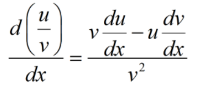
Answer
 Verified
582.3k+ views
Hint:Let us assume u(x) and v(x) are two differentiable function of x and $f(x) = u(x)v(x)$ and then apply the definition of derivative of f(x),
$f'(x) = \mathop {\lim }\limits_{h \to 0} \dfrac{{f(x + h) - f(x)}}{h}$
Complete step by step answer:
As, $f(x) = u(x)v(x)$
Then, $f(x + h) = u(x + h)v(x + h)$
From the definition of derivative of f(x) we get, $
f'(x) = \mathop {\lim }\limits_{h \to 0} \dfrac{{f(x + h) - f(x)}}{h} \\
\Rightarrow f'(x) = \mathop {\lim }\limits_{h \to 0} \dfrac{{u(x + h)v(x + h) - u(x)v(x)}}{h} \\
\Rightarrow f'(x)= \mathop {\lim }\limits_{h \to 0} [\dfrac{{u(x + h)v(x + h) - u(x + h)v(x)}}{h} + \dfrac{{u(x + h)v(x) - u(x)v(x)}}{h}] \\
\Rightarrow f'(x)= \mathop {\lim }\limits_{h \to 0} [u(x + h)\dfrac{{v(x + h) - v(x)}}{h}] + \mathop {\lim }\limits_{h \to 0} [v(x)\dfrac{{u(x + h) - u(x)}}{h}] \\
\Rightarrow f'(x)= u(x)\mathop {\lim }\limits_{h \to 0} [\dfrac{{v(x + h) - v(x)}}{h}] + \mathop {v(x)\lim }\limits_{h \to 0} [\dfrac{{u(x + h) - u(x)}}{h}] \\
\therefore f'(x)= u(x)v'(x) + v(x)u'(x) \\
i.e.,\dfrac{d}{{dx}}[u(x)v(x)] = u\dfrac{{dv}}{{dx}} + v\dfrac{{du}}{{dx}} \\
$
Note:It is true for more than two differentiable functions. If a finite number of functions u, v, w, …….. are differentiable with respect to x, then
$\dfrac{d}{{dx}}(uvw...) = (vw...)\dfrac{{du}}{{dx}} + (uw...)\dfrac{{dv}}{{dx}} + (uv...)\dfrac{{dw}}{{dx}} + ...$
$f'(x) = \mathop {\lim }\limits_{h \to 0} \dfrac{{f(x + h) - f(x)}}{h}$
Complete step by step answer:
As, $f(x) = u(x)v(x)$
Then, $f(x + h) = u(x + h)v(x + h)$
From the definition of derivative of f(x) we get, $
f'(x) = \mathop {\lim }\limits_{h \to 0} \dfrac{{f(x + h) - f(x)}}{h} \\
\Rightarrow f'(x) = \mathop {\lim }\limits_{h \to 0} \dfrac{{u(x + h)v(x + h) - u(x)v(x)}}{h} \\
\Rightarrow f'(x)= \mathop {\lim }\limits_{h \to 0} [\dfrac{{u(x + h)v(x + h) - u(x + h)v(x)}}{h} + \dfrac{{u(x + h)v(x) - u(x)v(x)}}{h}] \\
\Rightarrow f'(x)= \mathop {\lim }\limits_{h \to 0} [u(x + h)\dfrac{{v(x + h) - v(x)}}{h}] + \mathop {\lim }\limits_{h \to 0} [v(x)\dfrac{{u(x + h) - u(x)}}{h}] \\
\Rightarrow f'(x)= u(x)\mathop {\lim }\limits_{h \to 0} [\dfrac{{v(x + h) - v(x)}}{h}] + \mathop {v(x)\lim }\limits_{h \to 0} [\dfrac{{u(x + h) - u(x)}}{h}] \\
\therefore f'(x)= u(x)v'(x) + v(x)u'(x) \\
i.e.,\dfrac{d}{{dx}}[u(x)v(x)] = u\dfrac{{dv}}{{dx}} + v\dfrac{{du}}{{dx}} \\
$
Note:It is true for more than two differentiable functions. If a finite number of functions u, v, w, …….. are differentiable with respect to x, then
$\dfrac{d}{{dx}}(uvw...) = (vw...)\dfrac{{du}}{{dx}} + (uw...)\dfrac{{dv}}{{dx}} + (uv...)\dfrac{{dw}}{{dx}} + ...$
Recently Updated Pages
Master Class 11 Computer Science: Engaging Questions & Answers for Success

Master Class 11 Business Studies: Engaging Questions & Answers for Success
Master Class 11 Economics: Engaging Questions & Answers for Success
Master Class 11 English: Engaging Questions & Answers for Success
Master Class 11 Maths: Engaging Questions & Answers for Success
Master Class 11 Biology: Engaging Questions & Answers for Success
Trending doubts
One Metric ton is equal to kg A 10000 B 1000 C 100 class 11 physics CBSE
There are 720 permutations of the digits 1 2 3 4 5 class 11 maths CBSE
Discuss the various forms of bacteria class 11 biology CBSE
Draw a diagram of a plant cell and label at least eight class 11 biology CBSE
State the laws of reflection of light
Explain zero factorial class 11 maths CBSE