




Lift is accelerated with an acceleration ‘a’. A man in the lift throws the ball upwards with acceleration $ {a_0}\left( {{a_0} < a} \right) $ . then the acceleration of the ball observed by the observer standing on earth is:
(A) $ \left( {{a_0} + a} \right){\text{ }}upwards $
(B) $ \left( {a - {a_0}} \right){\text{ }}downwards $
(C) $ \left( {{a_0} + a} \right){\text{ }}downwards $
(D) $ \left( {a - {a_0}} \right){\text{ }}upwards $
Answer
 Verified
478.8k+ views
Hint: We will start solving this question by first calculating the force in the whole process. For calculating this force we will make a free body diagram (fbd) and using the diagram we will estimate the force value. Then we will find the acceleration with the man standing on earth as a point of reference.
Complete answer:
Look at the following free body diagram:
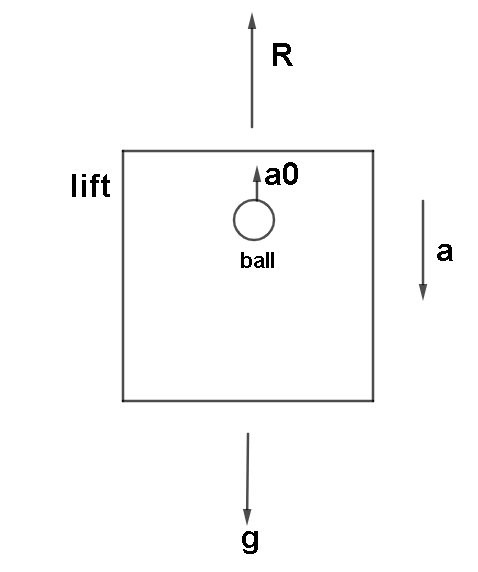
Here g>a where acceleration of the lift g is acceleration due to gravity.
$a_0$ < a where $a_0$ is acceleration of the ball.
Here in the diagram R- force.
Looking at the diagram we get :
$ R = mg - ma $
Because g>a.
$ R = m\left( {g - a} \right) $ . This will be the force of lift.
Now the observer is on the ground . The acceleration of the ball will be acceleration of lift – acceleration of ball. For the observer standing on the ground the lift is moving at all times, even if the ball is thrown up the observer will see a net downward movement . Hence acceleration of the ball in the lift as observed by man on ground is :
$ {a_{bm}} = {a_{lm}} - {a_{bl}} $
where,
$ {a_{bm}} $ = acceleration of the ball with respect to man.
$ {a_{lm}} $ = acceleration of lift with respect to man
$ {a_{bl}} $ = acceleration of ball with respect to lift,
$ {a_{bm}} = a - {a_0} $
And the net acceleration will be downward as observed by man on ground.
Hence the correct answer to this question is option B.
Note:
You can solve this question by eliminating the options. Once you find that the net acceleration is downwards, we can eliminate options A and D. We are left with options B and C. Then only need to find is net acceleration $ a - {a_0} $ .
Complete answer:
Look at the following free body diagram:
Here g>a where acceleration of the lift g is acceleration due to gravity.
$a_0$ < a where $a_0$ is acceleration of the ball.
Here in the diagram R- force.
Looking at the diagram we get :
$ R = mg - ma $
Because g>a.
$ R = m\left( {g - a} \right) $ . This will be the force of lift.
Now the observer is on the ground . The acceleration of the ball will be acceleration of lift – acceleration of ball. For the observer standing on the ground the lift is moving at all times, even if the ball is thrown up the observer will see a net downward movement . Hence acceleration of the ball in the lift as observed by man on ground is :
$ {a_{bm}} = {a_{lm}} - {a_{bl}} $
where,
$ {a_{bm}} $ = acceleration of the ball with respect to man.
$ {a_{lm}} $ = acceleration of lift with respect to man
$ {a_{bl}} $ = acceleration of ball with respect to lift,
$ {a_{bm}} = a - {a_0} $
And the net acceleration will be downward as observed by man on ground.
Hence the correct answer to this question is option B.
Note:
You can solve this question by eliminating the options. Once you find that the net acceleration is downwards, we can eliminate options A and D. We are left with options B and C. Then only need to find is net acceleration $ a - {a_0} $ .
Recently Updated Pages
Master Class 11 Computer Science: Engaging Questions & Answers for Success

Master Class 11 Business Studies: Engaging Questions & Answers for Success
Master Class 11 Economics: Engaging Questions & Answers for Success
Master Class 11 English: Engaging Questions & Answers for Success
Master Class 11 Maths: Engaging Questions & Answers for Success
Master Class 11 Biology: Engaging Questions & Answers for Success
Trending doubts
One Metric ton is equal to kg A 10000 B 1000 C 100 class 11 physics CBSE
There are 720 permutations of the digits 1 2 3 4 5 class 11 maths CBSE
Discuss the various forms of bacteria class 11 biology CBSE
Draw a diagram of a plant cell and label at least eight class 11 biology CBSE
State the laws of reflection of light
Explain zero factorial class 11 maths CBSE