




Liebig's method is used for the estimation of:
A) Nitrogen
B) Sulphur
C) Carbon and hydrogen
D) Halogens
Answer
 Verified
606k+ views
Hint: The Liebig’s Method is used for the estimation of elements in an organic compound. The organic compound is heated in presence of dry cupric oxide. The heating results in the oxidation of elements into $\text{ C}{{\text{O}}_{\text{2}}}\text{ }$ and $\text{ }{{\text{H}}_{\text{2}}}\text{O }$. These obtained oxidised products are then absorbed by the caustic soda $\text{ KOH }$ and anhydrous $\text{ CaC}{{\text{l}}_{\text{2}}}\text{ }$ respectively. The mass adsorbed can be used to calculate the percentage of an element in the given known mass.
Complete step by step answer:
Carbon and hydrogen in the organic compound are estimated by Liebig's Method.
When an organic compound of known mass is strongly heated in presence of dry cupric oxide $\text{ CuO }$ the carbon C and hydrogen H in the organic compound quantitatively oxidize to the carbon dioxide $\text{ C}{{\text{O}}_{\text{2}}}\text{ }$ and $\text{ }{{\text{H}}_{\text{2}}}\text{O }$.
Let consider an organic compound having the molecular formula $\text{ }{{\text{C}}_{\text{x}}}{{\text{H}}_{\text{y}}}\text{ }$.It undergoes the reaction as follows:
${{\text{C}}_{\text{x}}}{{\text{H}}_{\text{y}}}\text{ + }\left( \text{x +}\frac{\text{y}}{\text{4}} \right){{\text{O}}_{\text{2}}}\to \text{ xC}{{\text{O}}_{\text{2}}}\text{ + }\frac{\text{y}}{\text{2}}{{\text{H}}_{\text{2}}}\text{O}$
By knowing the amount of carbon dioxide and water we can determine the weight of the organic compound. The percentage of carbon and hydrogen can be calculated as follows:
$\begin{align}
& \text{Percentage of carbon=}\frac{\text{12}}{\text{44}}\text{ }\!\!\times\!\!\text{ }\frac{\text{weight of C}{{\text{O}}_{\text{2}}}\text{ }\!\!\times\!\!\text{ 100}}{\text{weight of organic substance}} \\
& \\
& \text{Percentage of hydrogen=}\frac{\text{2}}{\text{18}}\text{ }\!\!\times\!\!\text{ }\frac{\text{weight of }{{\text{H}}_{\text{2}}}\text{O }\!\!\times\!\!\text{ 100}}{\text{weight of organic substance}} \\
\end{align}$
The water which is produced during the oxidation is absorbed in anhydrous $\text{CaC}{{\text{l}}_{\text{2}}}$ and the carbon dioxide is absorbed by the concentrated solution of potassium hydroxide $\text{KOH}$.
The apparatus which is used for Liebig’s Method consists of a long glass tube. This is a combustion tube. One end of the tube is fitted with a U-tube containing the calcium chloride and a bottle which contains the concentrated $\text{KOH}$solution. This is attached in series. This is connected to the guard tube which contains the anhydrous calcium chloride.
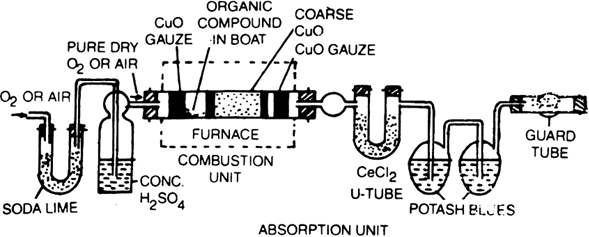
The combustion tube is filled with cupric oxide and copper gauze. The oxygen is allowed to pass through the one end of the tube. The combustion tube is heated in a furnace, the carbon and hydrogen from the compound are oxidized by the oxygen. The U-tube and the $\text{KOH}$bottle are weighed before and after the experiment.
Thus the difference in mass before and after the calcium chloride and caustic soda bottle gives the amount of mass of carbon dioxide and hydrogen dioxide, which can be further rearranged to get the total mass of carbon and hydrogen in the organic compound.
Here, we know that Liebig’s Method is used for the estimation of carbon and hydrogen.
Hence, (C) is the correct option.
Additional information:
Elements other than carbon and hydrogen can be estimated by heating the cupric oxide. The method is as modified as follows:
The oxides of nitrogen like $\text{ NO }$, $\text{ }{{\text{N}}_{\text{2}}}\text{O }$ etc. are absorbed by the caustic soda. These are removed by the use of a bright copper gauge. The reactions are as follows:
$\begin{align}& \text{ 4 Cu + 2N}{{\text{O}}_{\text{2}}}\to \text{4CuO + }{{\text{N}}_{\text{2}}}\text{ } \\ & \text{ Cu + }{{\text{N}}_{\text{2}}}\text{O}\to \text{CuO + }{{\text{N}}_{\text{2}}}\text{ } \\ \end{align}$
Halogen in the organic compound is removed by using a silver gauge which forms the non-volatile silver halide.
Sulphur in the compound is removed by forming a lead sulfate by using fused lead chromate.
Note: Test for carbon and hydrogen: The compound containing carbon and hydrogen is heated in presence of\[\text{ CuO}\] a dry test tube. The carbon is oxidized to $\text{ C}{{\text{O}}_{\text{2}}}\text{ }$ and hydrogen to$\text{ }{{\text{H}}_{\text{2}}}\text{O }$. The $\text{ C}{{\text{O}}_{\text{2}}}\text{ }$ gas turns the lime water milky and the $\text{ }{{\text{H}}_{\text{2}}}\text{O }$ gas turns the anhydrous copper sulfate to blue. This inference confirms the presence of carbon and hydrogen.
Complete step by step answer:
Carbon and hydrogen in the organic compound are estimated by Liebig's Method.
When an organic compound of known mass is strongly heated in presence of dry cupric oxide $\text{ CuO }$ the carbon C and hydrogen H in the organic compound quantitatively oxidize to the carbon dioxide $\text{ C}{{\text{O}}_{\text{2}}}\text{ }$ and $\text{ }{{\text{H}}_{\text{2}}}\text{O }$.
Let consider an organic compound having the molecular formula $\text{ }{{\text{C}}_{\text{x}}}{{\text{H}}_{\text{y}}}\text{ }$.It undergoes the reaction as follows:
${{\text{C}}_{\text{x}}}{{\text{H}}_{\text{y}}}\text{ + }\left( \text{x +}\frac{\text{y}}{\text{4}} \right){{\text{O}}_{\text{2}}}\to \text{ xC}{{\text{O}}_{\text{2}}}\text{ + }\frac{\text{y}}{\text{2}}{{\text{H}}_{\text{2}}}\text{O}$
By knowing the amount of carbon dioxide and water we can determine the weight of the organic compound. The percentage of carbon and hydrogen can be calculated as follows:
$\begin{align}
& \text{Percentage of carbon=}\frac{\text{12}}{\text{44}}\text{ }\!\!\times\!\!\text{ }\frac{\text{weight of C}{{\text{O}}_{\text{2}}}\text{ }\!\!\times\!\!\text{ 100}}{\text{weight of organic substance}} \\
& \\
& \text{Percentage of hydrogen=}\frac{\text{2}}{\text{18}}\text{ }\!\!\times\!\!\text{ }\frac{\text{weight of }{{\text{H}}_{\text{2}}}\text{O }\!\!\times\!\!\text{ 100}}{\text{weight of organic substance}} \\
\end{align}$
The water which is produced during the oxidation is absorbed in anhydrous $\text{CaC}{{\text{l}}_{\text{2}}}$ and the carbon dioxide is absorbed by the concentrated solution of potassium hydroxide $\text{KOH}$.
The apparatus which is used for Liebig’s Method consists of a long glass tube. This is a combustion tube. One end of the tube is fitted with a U-tube containing the calcium chloride and a bottle which contains the concentrated $\text{KOH}$solution. This is attached in series. This is connected to the guard tube which contains the anhydrous calcium chloride.
The combustion tube is filled with cupric oxide and copper gauze. The oxygen is allowed to pass through the one end of the tube. The combustion tube is heated in a furnace, the carbon and hydrogen from the compound are oxidized by the oxygen. The U-tube and the $\text{KOH}$bottle are weighed before and after the experiment.
Thus the difference in mass before and after the calcium chloride and caustic soda bottle gives the amount of mass of carbon dioxide and hydrogen dioxide, which can be further rearranged to get the total mass of carbon and hydrogen in the organic compound.
Here, we know that Liebig’s Method is used for the estimation of carbon and hydrogen.
Hence, (C) is the correct option.
Additional information:
Elements other than carbon and hydrogen can be estimated by heating the cupric oxide. The method is as modified as follows:
The oxides of nitrogen like $\text{ NO }$, $\text{ }{{\text{N}}_{\text{2}}}\text{O }$ etc. are absorbed by the caustic soda. These are removed by the use of a bright copper gauge. The reactions are as follows:
$\begin{align}& \text{ 4 Cu + 2N}{{\text{O}}_{\text{2}}}\to \text{4CuO + }{{\text{N}}_{\text{2}}}\text{ } \\ & \text{ Cu + }{{\text{N}}_{\text{2}}}\text{O}\to \text{CuO + }{{\text{N}}_{\text{2}}}\text{ } \\ \end{align}$
Halogen in the organic compound is removed by using a silver gauge which forms the non-volatile silver halide.
Sulphur in the compound is removed by forming a lead sulfate by using fused lead chromate.
Note: Test for carbon and hydrogen: The compound containing carbon and hydrogen is heated in presence of\[\text{ CuO}\] a dry test tube. The carbon is oxidized to $\text{ C}{{\text{O}}_{\text{2}}}\text{ }$ and hydrogen to$\text{ }{{\text{H}}_{\text{2}}}\text{O }$. The $\text{ C}{{\text{O}}_{\text{2}}}\text{ }$ gas turns the lime water milky and the $\text{ }{{\text{H}}_{\text{2}}}\text{O }$ gas turns the anhydrous copper sulfate to blue. This inference confirms the presence of carbon and hydrogen.
Recently Updated Pages
Master Class 11 Social Science: Engaging Questions & Answers for Success

Master Class 11 Chemistry: Engaging Questions & Answers for Success
Master Class 12 Business Studies: Engaging Questions & Answers for Success
Master Class 12 Chemistry: Engaging Questions & Answers for Success
Master Class 12 Biology: Engaging Questions & Answers for Success
Class 12 Question and Answer - Your Ultimate Solutions Guide
Trending doubts
How many of the following diseases can be studied with class 11 biology CBSE
Which of the following enzymes is used for carboxylation class 11 biology CBSE
Explain zero factorial class 11 maths CBSE
Receptor sites for neurotransmitters are present on class 11 biology CBSE
JGA JuxtaGlomerular Apparatus a sensitive region which class 11 biology CBSE
Root hairs develop from the region of A Meristematic class 11 biology CBSE