




Let \[X=\left\{ a,b,c,d \right\}\] then one-one mapping \[f:X\to X\] such that \[f\left( a \right)=a,f\left( b \right)\ne b,f\left( d \right)\ne d\] are given by
1. \[\left\{ \left( a,a \right),\left( b,c \right),\left( c,d \right),\left( d,b \right) \right\}\]
2. \[\left\{ \left( a,a \right),\left( b,d \right),\left( c,c \right),\left( d,b \right) \right\}\]
3. \[\left\{ \left( a,a \right),\left( b,d \right),\left( c,b \right),\left( d,c \right) \right\}\]
A. Only (1) is true.
B. (1) and (2) is true.
C. (1), (2) and (3) are true.
D. Only (3) is true.
Answer
 Verified
508.5k+ views
Hint: In this problem, we have to find the correct options by mapping in one-one function. We are given a set X, which can be mapped into one-one function as we know that one-one maps distinct elements of its domain to distinct elements of its codomain. We can then check the options which satisfy the given condition and find the required answer.
Complete step by step answer:
We are given that \[X=\left\{ a,b,c,d \right\}\].
We are also given \[f:X\to X\]. We can now map it in one-one function as we know that one-one maps distinct elements of its domain to distinct elements of its codomain.
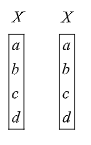
We are given that \[f\left( a \right)=a,f\left( b \right)\ne b,f\left( d \right)\ne d\].
We can now take 1) and check whether the given condition is satisfied.
1. \[\left\{ \left( a,a \right),\left( b,c \right),\left( c,d \right),\left( d,b \right) \right\}\]
2. \[\left\{ \left( a,a \right),\left( b,d \right),\left( c,c \right),\left( d,b \right) \right\}\]
3. \[\left\{ \left( a,a \right),\left( b,d \right),\left( c,b \right),\left( d,c \right) \right\}\]
Here we can see that the first set, second set and the third set satisfy the given condition \[f\left( a \right)=a,f\left( b \right)\ne b,f\left( d \right)\ne d\].
So, the correct answer is “Option C”.
Note: We should always remember that one-one maps distinct elements of its domain to distinct elements of its codomain. We should also know that a one-one function is also called an injective function, where the function’s codomain is the image of at most one element of its domain.
Complete step by step answer:
We are given that \[X=\left\{ a,b,c,d \right\}\].
We are also given \[f:X\to X\]. We can now map it in one-one function as we know that one-one maps distinct elements of its domain to distinct elements of its codomain.
We are given that \[f\left( a \right)=a,f\left( b \right)\ne b,f\left( d \right)\ne d\].
We can now take 1) and check whether the given condition is satisfied.
1. \[\left\{ \left( a,a \right),\left( b,c \right),\left( c,d \right),\left( d,b \right) \right\}\]
2. \[\left\{ \left( a,a \right),\left( b,d \right),\left( c,c \right),\left( d,b \right) \right\}\]
3. \[\left\{ \left( a,a \right),\left( b,d \right),\left( c,b \right),\left( d,c \right) \right\}\]
Here we can see that the first set, second set and the third set satisfy the given condition \[f\left( a \right)=a,f\left( b \right)\ne b,f\left( d \right)\ne d\].
So, the correct answer is “Option C”.
Note: We should always remember that one-one maps distinct elements of its domain to distinct elements of its codomain. We should also know that a one-one function is also called an injective function, where the function’s codomain is the image of at most one element of its domain.
Recently Updated Pages
Master Class 12 Business Studies: Engaging Questions & Answers for Success

Master Class 12 Biology: Engaging Questions & Answers for Success
Master Class 12 Chemistry: Engaging Questions & Answers for Success
Class 12 Question and Answer - Your Ultimate Solutions Guide
Complete reduction of benzene diazonium chloride with class 12 chemistry CBSE
How can you identify optical isomers class 12 chemistry CBSE
Trending doubts
Which are the Top 10 Largest Countries of the World?
What are the major means of transport Explain each class 12 social science CBSE
Draw a labelled sketch of the human eye class 12 physics CBSE
Differentiate between insitu conservation and exsitu class 12 biology CBSE
Draw a neat and well labeled diagram of TS of ovary class 12 biology CBSE
Differentiate between homogeneous and heterogeneous class 12 chemistry CBSE