




Let us denote the point $P\left( a{{t}_{1}}^{2},2a{{t}_{1}} \right)$ on the parabola ${{y}^{2}}=4ax$ on the parabola as $P\left( {{t}_{1}} \right)$. Tangents are drawn from the points $P\left( {{t}_{1}} \right),Q\left( {{t}_{2}} \right),R\left( {{t}_{3}} \right)$ to the parabola. Prove that the orthocenter of the triangle formed by the tangents and the point $S\left( 0,a{{t}_{1}}{{t}_{2}}{{t}_{3}}+a\left( {{t}_{1}}+{{t}_{2}}+{{t}_{3}} \right) \right)$ are equidistant from the axis of the parabola.
Answer
 Verified
609.6k+ views
Hint: Use the parametric form of the equation of a tangent to a parabola. Use the fact that tangents drawn to a parabola at ${{t}_{1}}$ and ${{t}_{2}}$ intersect at $\left( a{{t}_{1}}{{t}_{2}},a\left( {{t}_{1}}+{{t}_{2}} \right) \right)$ and the slope of the tangent drawn at $P\left( t \right)$ has the slope as $\dfrac{1}{t}$. Hence find the coordinates of the orthocenter of the triangle formed. Hence prove that the orthocentre and the point are equidistant from the axis of the parabola.
Complete step-by-step answer:
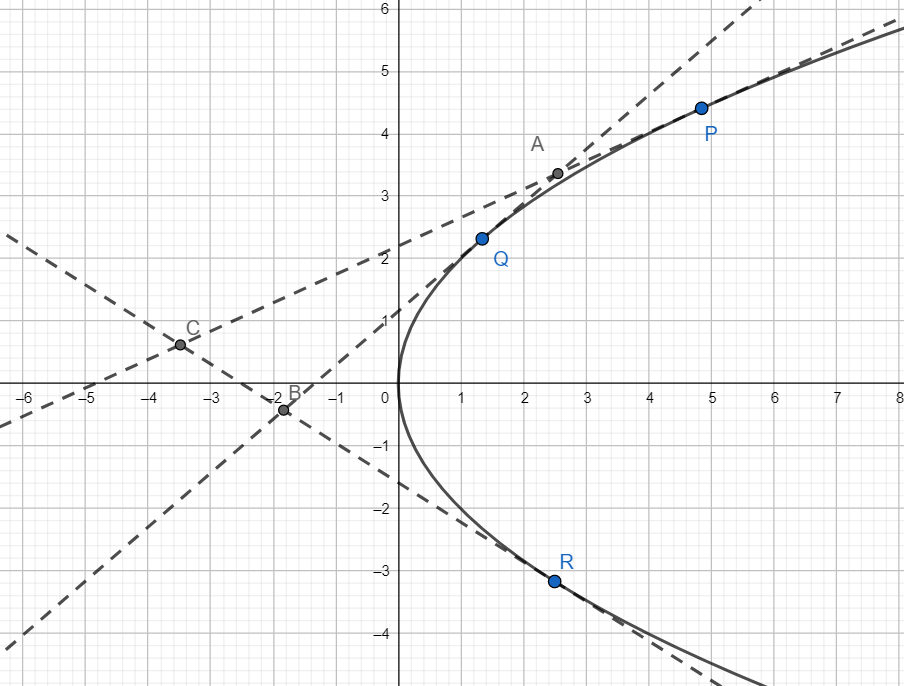
We have the equation of the tangent at $P\left( {{t}_{1}} \right)$ is given by
$y{{t}_{2}}=x+a{{t}_{1}}^{2}\text{ (i)}$
Similarly, the equation of the tangent at $Q\left( {{t}_{2}} \right)$ is given by
$y{{t}_{2}}=x+a{{t}_{2}}^{2}\text{ (ii)}$
And the equation of the tangent at $R\left( {{t}_{3}} \right)$ is given by
$y{{t}_{3}}=x+a{{t}_{3}}^{2}\text{ (iii)}$
We know that the tangents at $P\left( {{t}_{1}} \right)$ and $Q\left( {{t}_{2}} \right)$ intersect at the point $\left( a{{t}_{1}}{{t}_{2}},a\left( {{t}_{1}}+{{t}_{2}} \right) \right)$
Hence we have $A\equiv \left( a{{t}_{1}}{{t}_{2}},a\left( {{t}_{1}}+{{t}_{2}} \right) \right)$ and $B\equiv \left( a{{t}_{2}}{{t}_{3}},a\left( {{t}_{2}}+{{t}_{3}} \right) \right)$
Since the slope of the tangent at R is $\dfrac{1}{{{t}_{3}}}$, we have
The slope of altitude from point A is $\dfrac{-1}{\dfrac{1}{{{t}_{3}}}}=-{{t}_{3}}$
Hence, the equation of altitude from A is given by
$\begin{align}
& y-a\left( {{t}_{1}}+{{t}_{2}} \right)=-{{t}_{3}}\left( x-a{{t}_{1}}{{t}_{2}} \right) \\
& \Rightarrow y-x{{t}_{3}}=a{{t}_{1}}{{t}_{2}}{{t}_{3}}+a\left( {{t}_{1}}+{{t}_{2}}+{{t}_{3}} \right)-a{{t}_{3}} \\
& \Rightarrow y-x{{t}_{3}}+a{{t}_{3}}=C\text{ (iv)} \\
\end{align}$
where $C=a{{t}_{1}}{{t}_{2}}{{t}_{3}}+a\left( {{t}_{1}}+{{t}_{2}}+{{t}_{3}} \right)$
Similarly, the equation of the tangent through B is given by
$y-x{{t}_{1}}+a{{t}_{1}}=C\text{ (v)}$
Multiplying equation (iv) by ${{t}_{1}}$ and equation (v) by ${{t}_{3}}$ and subtracting equation (iv) from equation (v), we get
${{t}_{3}}y-{{t}_{1}}y-x{{t}_{3}}{{t}_{1}}+x{{t}_{3}}{{t}_{1}}+a{{t}_{3}}{{t}_{1}}-a{{t}_{3}}{{t}_{1}}=C{{t}_{3}}-C{{t}_{1}}$
Hence, we have
$y\left( {{t}_{3}}-{{t}_{1}} \right)=C\left( {{t}_{3}}-{{t}_{1}} \right)$
Hence, we have $y=a{{t}_{1}}{{t}_{2}}{{t}_{3}}+a\left( {{t}_{1}}+{{t}_{2}}+{{t}_{3}} \right)$
Hence the distance of orthocentre from the axis of the parabola is $a{{t}_{1}}{{t}_{2}}{{t}_{3}}+a\left( {{t}_{1}}+{{t}_{2}}+{{t}_{3}} \right)$ which is the same as the distance of S from the x-axis.
Note: In these types of questions we need to remember the equations of tangents in parametric form and also the coordinates of the point of intersection of tangents at two points on the parabola. The coordinates of the point of intersection of tangents at points $P\left( {{t}_{1}} \right)$ and $Q\left( {{t}_{2}} \right)$ can be remembered as follows:
G O A rule:
G stands for the geometric mean of the x -coordinates:
A stands for the arithmetic mean of the y-coordinates.
$G={{\left( a{{t}_{1}}^{2}a{{t}_{2}}^{2} \right)}^{\dfrac{1}{2}}}=a{{t}_{1}}{{t}_{2}}$ and $A=\dfrac{2a{{t}_{1}}+2a{{t}_{2}}}{2}=a\left( {{t}_{1}}+{{t}_{2}} \right)$
Hence the coordinates of the point of intersection are $\left( a{{t}_{1}}{{t}_{2}},a\left( {{t}_{1}}+{{t}_{2}} \right) \right)$
Complete step-by-step answer:
We have the equation of the tangent at $P\left( {{t}_{1}} \right)$ is given by
$y{{t}_{2}}=x+a{{t}_{1}}^{2}\text{ (i)}$
Similarly, the equation of the tangent at $Q\left( {{t}_{2}} \right)$ is given by
$y{{t}_{2}}=x+a{{t}_{2}}^{2}\text{ (ii)}$
And the equation of the tangent at $R\left( {{t}_{3}} \right)$ is given by
$y{{t}_{3}}=x+a{{t}_{3}}^{2}\text{ (iii)}$
We know that the tangents at $P\left( {{t}_{1}} \right)$ and $Q\left( {{t}_{2}} \right)$ intersect at the point $\left( a{{t}_{1}}{{t}_{2}},a\left( {{t}_{1}}+{{t}_{2}} \right) \right)$
Hence we have $A\equiv \left( a{{t}_{1}}{{t}_{2}},a\left( {{t}_{1}}+{{t}_{2}} \right) \right)$ and $B\equiv \left( a{{t}_{2}}{{t}_{3}},a\left( {{t}_{2}}+{{t}_{3}} \right) \right)$
Since the slope of the tangent at R is $\dfrac{1}{{{t}_{3}}}$, we have
The slope of altitude from point A is $\dfrac{-1}{\dfrac{1}{{{t}_{3}}}}=-{{t}_{3}}$
Hence, the equation of altitude from A is given by
$\begin{align}
& y-a\left( {{t}_{1}}+{{t}_{2}} \right)=-{{t}_{3}}\left( x-a{{t}_{1}}{{t}_{2}} \right) \\
& \Rightarrow y-x{{t}_{3}}=a{{t}_{1}}{{t}_{2}}{{t}_{3}}+a\left( {{t}_{1}}+{{t}_{2}}+{{t}_{3}} \right)-a{{t}_{3}} \\
& \Rightarrow y-x{{t}_{3}}+a{{t}_{3}}=C\text{ (iv)} \\
\end{align}$
where $C=a{{t}_{1}}{{t}_{2}}{{t}_{3}}+a\left( {{t}_{1}}+{{t}_{2}}+{{t}_{3}} \right)$
Similarly, the equation of the tangent through B is given by
$y-x{{t}_{1}}+a{{t}_{1}}=C\text{ (v)}$
Multiplying equation (iv) by ${{t}_{1}}$ and equation (v) by ${{t}_{3}}$ and subtracting equation (iv) from equation (v), we get
${{t}_{3}}y-{{t}_{1}}y-x{{t}_{3}}{{t}_{1}}+x{{t}_{3}}{{t}_{1}}+a{{t}_{3}}{{t}_{1}}-a{{t}_{3}}{{t}_{1}}=C{{t}_{3}}-C{{t}_{1}}$
Hence, we have
$y\left( {{t}_{3}}-{{t}_{1}} \right)=C\left( {{t}_{3}}-{{t}_{1}} \right)$
Hence, we have $y=a{{t}_{1}}{{t}_{2}}{{t}_{3}}+a\left( {{t}_{1}}+{{t}_{2}}+{{t}_{3}} \right)$
Hence the distance of orthocentre from the axis of the parabola is $a{{t}_{1}}{{t}_{2}}{{t}_{3}}+a\left( {{t}_{1}}+{{t}_{2}}+{{t}_{3}} \right)$ which is the same as the distance of S from the x-axis.
Note: In these types of questions we need to remember the equations of tangents in parametric form and also the coordinates of the point of intersection of tangents at two points on the parabola. The coordinates of the point of intersection of tangents at points $P\left( {{t}_{1}} \right)$ and $Q\left( {{t}_{2}} \right)$ can be remembered as follows:
G O A rule:
G stands for the geometric mean of the x -coordinates:
A stands for the arithmetic mean of the y-coordinates.
$G={{\left( a{{t}_{1}}^{2}a{{t}_{2}}^{2} \right)}^{\dfrac{1}{2}}}=a{{t}_{1}}{{t}_{2}}$ and $A=\dfrac{2a{{t}_{1}}+2a{{t}_{2}}}{2}=a\left( {{t}_{1}}+{{t}_{2}} \right)$
Hence the coordinates of the point of intersection are $\left( a{{t}_{1}}{{t}_{2}},a\left( {{t}_{1}}+{{t}_{2}} \right) \right)$
Recently Updated Pages
Master Class 11 Computer Science: Engaging Questions & Answers for Success

Master Class 11 Business Studies: Engaging Questions & Answers for Success
Master Class 11 Economics: Engaging Questions & Answers for Success
Master Class 11 English: Engaging Questions & Answers for Success
Master Class 11 Maths: Engaging Questions & Answers for Success
Master Class 11 Biology: Engaging Questions & Answers for Success
Trending doubts
One Metric ton is equal to kg A 10000 B 1000 C 100 class 11 physics CBSE
There are 720 permutations of the digits 1 2 3 4 5 class 11 maths CBSE
Discuss the various forms of bacteria class 11 biology CBSE
Draw a diagram of a plant cell and label at least eight class 11 biology CBSE
State the laws of reflection of light
Explain zero factorial class 11 maths CBSE