




Let universal set \[u=\left\{ 1,2,3,4,5,6,7,8,9 \right\},A=\left\{ 1,2,3,4 \right\},B=\left\{ 2,4,6,8 \right\}\ and\ C=\left\{ 3,4,5,6 \right\}\]. Find \[\left( B-C \right)'\].
Answer
 Verified
624.9k+ views
Hint: Subtracting a set B for a set C means removing all the elements which are common in B and C from C.
Complement of a set X denoted by X’ is the set which contains all the elements that occur in the universal set (u) but not in X.
Complete step-by-step answer:
A set is a collection of well – defined objects.
We have to find \[\left( B-C \right)'\].
Set \[\left( B-C \right)'\] is the complement of the set \[\left( B-C \right)\]. For finding the complement of \[\left( B-C \right)\], first we need to find the set \[B-C\].
As we know \[B-C\] will be set B minus all the elements which are present in both B and C.
$i.e.\ \ B-C=B-\left( B\cap C \right)$
$\left( B\cap C \right)=$ Set of the elements which are common in B and C.
Given: \[B=\left\{ 2,4,6,8 \right\}\ and\ C=\left\{ 3,4,5,6 \right\}\]
Elements which are common in B and C are 4 and 6.
$\Rightarrow B\cap C=\left\{ 4,6 \right\}$
By removing these elements (i.e. 4 and 6) from B, we will get \[B-C\].
$\begin{align}
& \Rightarrow B-C=\left\{ 2,4,6,8 \right\}-\left\{ 4,6 \right\} \\
& \Rightarrow B-C=\left\{ 2,8 \right\} \\
\end{align}$
We have found \[\left( B-C \right)\]. Now, we have to find the complement of \[\left( B-C \right)\] i.e. \[\left( B-C \right)'\].
We know, complement of a set X = universal set – X .
We have universal set (u) $=\left\{ 1,2,3,4,5,6,7,8,9 \right\}$
$\left( B-C \right)=\left\{ 2,8 \right\}$
And we have to find \[\left( B-C \right)'\].
And we know, \[\left( B-C \right)'=union-B-C\].
To find \[\left( union-\left( B-C \right) \right)\], we need to find elements which are common in union and \[B-C\].
$\begin{align}
& universal set \left( u \right)=\left\{ 1,2,3,4,5,6,7,8,9 \right\} \\
& B-C=\left\{ 2,8 \right\} \\
\end{align}$
Common elements: 2 and 8
\[\begin{align}
& \Rightarrow u-\left( B-C \right)==\left\{ 1,2,3,4,5,6,7,8,9 \right\}-\left\{ 2,8 \right\} \\
& \Rightarrow \left( B-C \right)'=\left\{ 1,3,5,6,7,9 \right\} \\
\end{align}\]
Hence, the required \[\left( B-C \right)'=\left\{ 1,3,5,6,7,9 \right\}\]
Note: We can also find \[\left( B-C \right)'\] by using Venn diagrams.
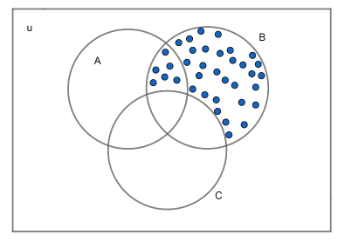
We will get the dotted area if we subtract B from ‘C’ and if we will subtract this dotted area from the union, we will get the entire un-dotted area.
Complement of a set X denoted by X’ is the set which contains all the elements that occur in the universal set (u) but not in X.
Complete step-by-step answer:
A set is a collection of well – defined objects.
We have to find \[\left( B-C \right)'\].
Set \[\left( B-C \right)'\] is the complement of the set \[\left( B-C \right)\]. For finding the complement of \[\left( B-C \right)\], first we need to find the set \[B-C\].
As we know \[B-C\] will be set B minus all the elements which are present in both B and C.
$i.e.\ \ B-C=B-\left( B\cap C \right)$
$\left( B\cap C \right)=$ Set of the elements which are common in B and C.
Given: \[B=\left\{ 2,4,6,8 \right\}\ and\ C=\left\{ 3,4,5,6 \right\}\]
Elements which are common in B and C are 4 and 6.
$\Rightarrow B\cap C=\left\{ 4,6 \right\}$
By removing these elements (i.e. 4 and 6) from B, we will get \[B-C\].
$\begin{align}
& \Rightarrow B-C=\left\{ 2,4,6,8 \right\}-\left\{ 4,6 \right\} \\
& \Rightarrow B-C=\left\{ 2,8 \right\} \\
\end{align}$
We have found \[\left( B-C \right)\]. Now, we have to find the complement of \[\left( B-C \right)\] i.e. \[\left( B-C \right)'\].
We know, complement of a set X = universal set – X .
We have universal set (u) $=\left\{ 1,2,3,4,5,6,7,8,9 \right\}$
$\left( B-C \right)=\left\{ 2,8 \right\}$
And we have to find \[\left( B-C \right)'\].
And we know, \[\left( B-C \right)'=union-B-C\].
To find \[\left( union-\left( B-C \right) \right)\], we need to find elements which are common in union and \[B-C\].
$\begin{align}
& universal set \left( u \right)=\left\{ 1,2,3,4,5,6,7,8,9 \right\} \\
& B-C=\left\{ 2,8 \right\} \\
\end{align}$
Common elements: 2 and 8
\[\begin{align}
& \Rightarrow u-\left( B-C \right)==\left\{ 1,2,3,4,5,6,7,8,9 \right\}-\left\{ 2,8 \right\} \\
& \Rightarrow \left( B-C \right)'=\left\{ 1,3,5,6,7,9 \right\} \\
\end{align}\]
Hence, the required \[\left( B-C \right)'=\left\{ 1,3,5,6,7,9 \right\}\]
Note: We can also find \[\left( B-C \right)'\] by using Venn diagrams.
We will get the dotted area if we subtract B from ‘C’ and if we will subtract this dotted area from the union, we will get the entire un-dotted area.
Recently Updated Pages
Basicity of sulphurous acid and sulphuric acid are

Master Class 11 Business Studies: Engaging Questions & Answers for Success
Master Class 11 Computer Science: Engaging Questions & Answers for Success
Master Class 11 Economics: Engaging Questions & Answers for Success
Master Class 11 Social Science: Engaging Questions & Answers for Success
Master Class 11 English: Engaging Questions & Answers for Success
Trending doubts
One Metric ton is equal to kg A 10000 B 1000 C 100 class 11 physics CBSE
Explain zero factorial class 11 maths CBSE
State and prove Bernoullis theorem class 11 physics CBSE
What steps did the French revolutionaries take to create class 11 social science CBSE
The transition element that has lowest enthalpy of class 11 chemistry CBSE
Can anyone list 10 advantages and disadvantages of friction