




Let three points A (2, 3, 4) B (3, 4, 2) and C (4, 2, 3) in space are given. A point D in space is such that it is at a distance of $\sqrt 6 $ units from 3 given points. Then volume of tetrahedron ABCD is:
A) 1
B) $\sqrt 3 $
C) $\sqrt {13} $
D) 2
Answer
 Verified
628.8k+ views
Hint: Given the point D is equidistant from all points A, B and C. So the distance AD=BD=CD=$\sqrt 6 $units. So using this find the coordinates of D. To calculate the volume of tetrahedron find the absolute value of the triple product and divide it by 6.
Complete step-by-step answer:
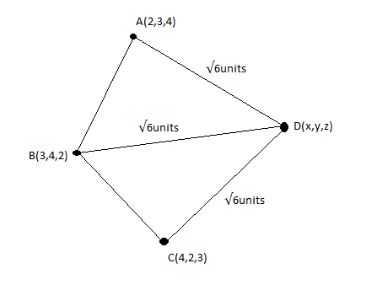
We are given that three points A (2, 3, 4) B (3, 4, 2) and C (4, 2, 3) are in space and a point D in space is equidistant from A, B, C and the distance between D and these three points is $\sqrt 6 $units.
Therefore, AD=BD=CD=$\sqrt 6 $units.
Distance between two points with three coordinates x, y, z is $\sqrt {{{\left( {{x_2} - {x_1}} \right)}^2} + {{\left( {{y_2} - {y_1}} \right)}^2} + {{\left( {{z_2} - {z_1}} \right)}^2}} $
Let the coordinates of D be (x, y, z)
AD=BD
$\sqrt {{{\left( {2 - x} \right)}^2} + {{\left( {3 - y} \right)}^2} + {{\left( {4 - z} \right)}^2}} = \sqrt {{{\left( {3 - x} \right)}^2} + {{\left( {4 - y} \right)}^2} + {{\left( {2 - z} \right)}^2}} $
Cancel the square root on both sides.
$
{\left( {2 - x} \right)^2} + {\left( {3 - y} \right)^2} + {\left( {4 - z} \right)^2} = {\left( {3 - x} \right)^2} + {\left( {4 - y} \right)^2} + {\left( {2 - z} \right)^2} \\
4 - 4x + {x^2} + 9 - 6y + {y^2} + 16 - 8z + {z^2} = 9 - 6x + {x^2} + 16 - 8y + {y^2} + 4 - 4z + {z^2} \\
- 4x - 6y - 8z = - 6x - 8y - 4z \\
4x + 6y + 8z = 6x + 8y + 4z \\
2x + 3y + 4z = 3x + 4y + 2z \\
x + y = 2z \\
$
BD=CD
$\sqrt {{{\left( {3 - x} \right)}^2} + {{\left( {4 - y} \right)}^2} + {{\left( {2 - z} \right)}^2}} = \sqrt {{{\left( {4 - x} \right)}^2} + {{\left( {2 - y} \right)}^2} + {{\left( {3 - z} \right)}^2}} $
Cancel the square root on both sides.
$
{\left( {3 - x} \right)^2} + {\left( {4 - y} \right)^2} + {\left( {2 - z} \right)^2} = {\left( {4 - x} \right)^2} + {\left( {2 - y} \right)^2} + {\left( {3 - z} \right)^2} \\
9 - 6x + {x^2} + 16 - 8y + {y^2} + 4 - 4z + {z^2} = 16 - 8x + {x^2} + 4 - 4y + {y^2} + 9 - 6z + {z^2} \\
- 6x - 8y - 4z = - 8x - 4y - 6z \\
6x + 8y + 4z = 8x + 4y + 6z \\
3x + 4y + 2z = 4x + 2y + 3z \\
x + z = 2y \\
$
AD=CD
$\sqrt {{{\left( {2 - x} \right)}^2} + {{\left( {3 - y} \right)}^2} + {{\left( {4 - z} \right)}^2}} = \sqrt {{{\left( {4 - x} \right)}^2} + {{\left( {2 - y} \right)}^2} + {{\left( {3 - z} \right)}^2}} $
Cancel the square root on both sides.
\[
{\left( {2 - x} \right)^2} + {\left( {3 - y} \right)^2} + {\left( {4 - z} \right)^2} = {\left( {4 - x} \right)^2} + {\left( {2 - y} \right)^2} + {\left( {3 - z} \right)^2} \\
4 - 4x + {x^2} + 9 - 6y + {y^2} + 16 - 8z + {z^2} = 16 - 8x + {x^2} + 4 - 4y + {y^2} + 9 - 6z + {z^2} \\
- 4x - 6y - 8z = - 8x - 4y - 6z \\
4x + 6y + 8z = 8x + 4y + 6z \\
2x + 3y + 4z = 4x + 2y + 3z \\
y + z = 2y \\
\]
$
x + y = 2z \\
x + z = 2y \\
y + z = 2x \\
$
Solving the above equations we get D(x, y, z) = (2, 2, 2)
A(2, 3, 4), B(3, 4, 2), C(4, 2, 3), D(2, 2, 2) form a tetrahedron.
Volume of tetrahedron ABCD is \[\dfrac{1}{6}\left| {\begin{array}{*{20}{c}}
{{u_1}}&{{u_2}}&{{u_3}} \\
{{v_1}}&{{v_2}}&{{v_3}} \\
{{w_1}}&{{w_2}}&{{w_3}}
\end{array}} \right|\]
\[
\left( {{u_1},{u_2},{u_3}} \right) = \left( {1,1, - 2} \right) \\
\left( {{v_1},{v_2},{v_3}} \right) = \left( {2, - 1, - 1} \right) \\
\left( {{w_1},{w_2},{w_3}} \right) = \left( {0, - 1, - 2} \right) \\
\]
Volume of the tetrahedron is \[\dfrac{1}{6}\left| {\begin{array}{*{20}{c}}
{{u_1}}&{{u_2}}&{{u_3}} \\
{{v_1}}&{{v_2}}&{{v_3}} \\
{{w_1}}&{{w_2}}&{{w_3}}
\end{array}} \right|\]
\[
= \dfrac{1}{6}\left| {\begin{array}{*{20}{c}}
1&1&{ - 2} \\
2&{ - 1}&{ - 1} \\
0&{ - 1}&{ - 2}
\end{array}} \right| \\
= \dfrac{1}{6}\left[ {1 - \left( { - 4} \right) - 2\left( { - 2} \right)} \right] \\
= \dfrac{1}{6}\left( {4 + 4 + 4} \right) \\
= \dfrac{{12}}{6} = 2 \\
\]
Volume of the tetrahedron is 2 cube units, Option D is correct.
So, the correct answer is “Option D”.
Note: In geometry, a tetrahedron also known as a triangular pyramid is a polyhedron with four triangular faces, six straight edges, and four vertices. Prism and Pyramids of Egypt are examples of tetrahedrons.
Complete step-by-step answer:
We are given that three points A (2, 3, 4) B (3, 4, 2) and C (4, 2, 3) are in space and a point D in space is equidistant from A, B, C and the distance between D and these three points is $\sqrt 6 $units.
Therefore, AD=BD=CD=$\sqrt 6 $units.
Distance between two points with three coordinates x, y, z is $\sqrt {{{\left( {{x_2} - {x_1}} \right)}^2} + {{\left( {{y_2} - {y_1}} \right)}^2} + {{\left( {{z_2} - {z_1}} \right)}^2}} $
Let the coordinates of D be (x, y, z)
AD=BD
$\sqrt {{{\left( {2 - x} \right)}^2} + {{\left( {3 - y} \right)}^2} + {{\left( {4 - z} \right)}^2}} = \sqrt {{{\left( {3 - x} \right)}^2} + {{\left( {4 - y} \right)}^2} + {{\left( {2 - z} \right)}^2}} $
Cancel the square root on both sides.
$
{\left( {2 - x} \right)^2} + {\left( {3 - y} \right)^2} + {\left( {4 - z} \right)^2} = {\left( {3 - x} \right)^2} + {\left( {4 - y} \right)^2} + {\left( {2 - z} \right)^2} \\
4 - 4x + {x^2} + 9 - 6y + {y^2} + 16 - 8z + {z^2} = 9 - 6x + {x^2} + 16 - 8y + {y^2} + 4 - 4z + {z^2} \\
- 4x - 6y - 8z = - 6x - 8y - 4z \\
4x + 6y + 8z = 6x + 8y + 4z \\
2x + 3y + 4z = 3x + 4y + 2z \\
x + y = 2z \\
$
BD=CD
$\sqrt {{{\left( {3 - x} \right)}^2} + {{\left( {4 - y} \right)}^2} + {{\left( {2 - z} \right)}^2}} = \sqrt {{{\left( {4 - x} \right)}^2} + {{\left( {2 - y} \right)}^2} + {{\left( {3 - z} \right)}^2}} $
Cancel the square root on both sides.
$
{\left( {3 - x} \right)^2} + {\left( {4 - y} \right)^2} + {\left( {2 - z} \right)^2} = {\left( {4 - x} \right)^2} + {\left( {2 - y} \right)^2} + {\left( {3 - z} \right)^2} \\
9 - 6x + {x^2} + 16 - 8y + {y^2} + 4 - 4z + {z^2} = 16 - 8x + {x^2} + 4 - 4y + {y^2} + 9 - 6z + {z^2} \\
- 6x - 8y - 4z = - 8x - 4y - 6z \\
6x + 8y + 4z = 8x + 4y + 6z \\
3x + 4y + 2z = 4x + 2y + 3z \\
x + z = 2y \\
$
AD=CD
$\sqrt {{{\left( {2 - x} \right)}^2} + {{\left( {3 - y} \right)}^2} + {{\left( {4 - z} \right)}^2}} = \sqrt {{{\left( {4 - x} \right)}^2} + {{\left( {2 - y} \right)}^2} + {{\left( {3 - z} \right)}^2}} $
Cancel the square root on both sides.
\[
{\left( {2 - x} \right)^2} + {\left( {3 - y} \right)^2} + {\left( {4 - z} \right)^2} = {\left( {4 - x} \right)^2} + {\left( {2 - y} \right)^2} + {\left( {3 - z} \right)^2} \\
4 - 4x + {x^2} + 9 - 6y + {y^2} + 16 - 8z + {z^2} = 16 - 8x + {x^2} + 4 - 4y + {y^2} + 9 - 6z + {z^2} \\
- 4x - 6y - 8z = - 8x - 4y - 6z \\
4x + 6y + 8z = 8x + 4y + 6z \\
2x + 3y + 4z = 4x + 2y + 3z \\
y + z = 2y \\
\]
$
x + y = 2z \\
x + z = 2y \\
y + z = 2x \\
$
Solving the above equations we get D(x, y, z) = (2, 2, 2)
A(2, 3, 4), B(3, 4, 2), C(4, 2, 3), D(2, 2, 2) form a tetrahedron.
Volume of tetrahedron ABCD is \[\dfrac{1}{6}\left| {\begin{array}{*{20}{c}}
{{u_1}}&{{u_2}}&{{u_3}} \\
{{v_1}}&{{v_2}}&{{v_3}} \\
{{w_1}}&{{w_2}}&{{w_3}}
\end{array}} \right|\]
\[
\left( {{u_1},{u_2},{u_3}} \right) = \left( {1,1, - 2} \right) \\
\left( {{v_1},{v_2},{v_3}} \right) = \left( {2, - 1, - 1} \right) \\
\left( {{w_1},{w_2},{w_3}} \right) = \left( {0, - 1, - 2} \right) \\
\]
Volume of the tetrahedron is \[\dfrac{1}{6}\left| {\begin{array}{*{20}{c}}
{{u_1}}&{{u_2}}&{{u_3}} \\
{{v_1}}&{{v_2}}&{{v_3}} \\
{{w_1}}&{{w_2}}&{{w_3}}
\end{array}} \right|\]
\[
= \dfrac{1}{6}\left| {\begin{array}{*{20}{c}}
1&1&{ - 2} \\
2&{ - 1}&{ - 1} \\
0&{ - 1}&{ - 2}
\end{array}} \right| \\
= \dfrac{1}{6}\left[ {1 - \left( { - 4} \right) - 2\left( { - 2} \right)} \right] \\
= \dfrac{1}{6}\left( {4 + 4 + 4} \right) \\
= \dfrac{{12}}{6} = 2 \\
\]
Volume of the tetrahedron is 2 cube units, Option D is correct.
So, the correct answer is “Option D”.
Note: In geometry, a tetrahedron also known as a triangular pyramid is a polyhedron with four triangular faces, six straight edges, and four vertices. Prism and Pyramids of Egypt are examples of tetrahedrons.
Recently Updated Pages
Master Class 11 English: Engaging Questions & Answers for Success

Master Class 11 Social Science: Engaging Questions & Answers for Success
Master Class 11 Maths: Engaging Questions & Answers for Success
Master Class 11 Biology: Engaging Questions & Answers for Success
Master Class 11 Physics: Engaging Questions & Answers for Success
Master Class 11 Chemistry: Engaging Questions & Answers for Success
Trending doubts
One Metric ton is equal to kg A 10000 B 1000 C 100 class 11 physics CBSE
Difference Between Prokaryotic Cells and Eukaryotic Cells
Find the value of the expression given below sin 30circ class 11 maths CBSE
Difference between physical and chemical change class 11 chemistry CBSE
Two of the body parts which do not appear in MRI are class 11 biology CBSE
Draw a diagram of a plant cell and label at least eight class 11 biology CBSE