




Let the vertex of an angle ABC be located outside a circle and let the sides of the angle intersect equal chords AD and CE with the circle. Prove that \[\angle ABC\] is equal to half the difference of the angles subtended by the chord’s AC and DE at the centre.
Answer
 Verified
637.5k+ views
Hint: First of all, draw the figure of the circle which will give us an idea of what we have to find and join the lines AC and DE. Then solve the problem by angle sum property of the triangle and the quadrilateral formed. So, use this concept to reach the solution of the given problem.
Complete step-by-step answer:
Given chords AD and CE are equal.
Here we have to prove \[\angle ABC = \dfrac{1}{2}\left( {\angle AOC - \angle DOE} \right)\].
Join AC and DE as shown in the below figure:
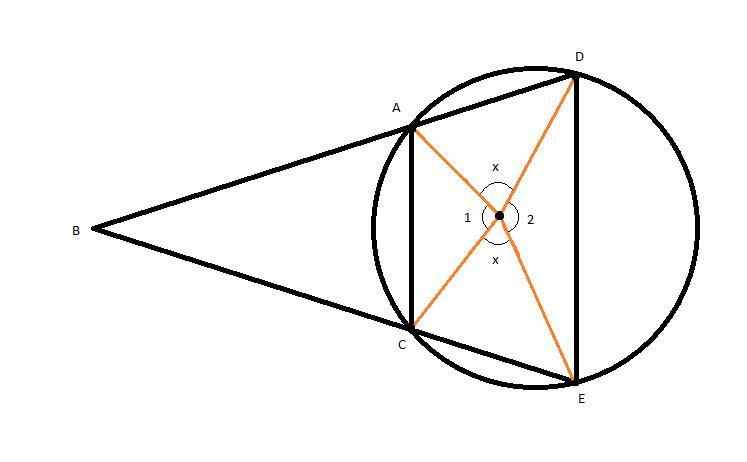
Given
AD = CE
\[\therefore \angle AOD = \angle COE{\text{ }}\left( {{\text{Equal chords subtend equal angle at the center}}} \right)\]
Let \[\angle AOD = \angle COE = x\]
Now, around point O,
Sum of angles around a point \[ = {360^0}\]
\[
\angle 1 + \angle 2 + \angle AOD + \angle COE = {360^0} \\
\left( {\angle 1 + \angle 2} \right) + x + x = {360^0} \\
2x = {360^0} - \left( {\angle 1 + \angle 2} \right) \\
x = \dfrac{{{{360}^0}}}{2} - \dfrac{{\left( {\angle 1 + \angle 2} \right)}}{2} \\
\therefore x = {180^0} - \dfrac{{\left( {\angle 1 + \angle 2}
\right)}}{2}............................................................\left( 1 \right) \\
\]
Now, in \[\Delta COE\]
\[
OC = OE{\text{ }}\left( {{\text{Both are radius}}} \right) \\
\angle OEC = \angle OCE{\text{ }}\left( {{\text{Angles opposite to equal sides of a triangle are equal}}} \right) \\
\]
In \[\Delta COE\],
\[
\angle COE + \angle OCE + \angle OEC = {180^0}{\text{ }}\left( {{\text{Angle sum property}}} \right) \\
x + \angle OCE + \angle OCE = {180^0}{\text{ }}\left( {{\text{As }}\angle OCE = \angle OEC} \right) \\
x + 2\angle OCE = {180^0} \\
\angle OCE = \dfrac{{{{180}^0}}}{2} - \dfrac{x}{2} \\
\angle OCE = {90^0} - \dfrac{x}{2} \\
\]
Similarly, we have
\[\angle OAD = {90^0} - \dfrac{x}{2}\]
Now, for line BE
\[
\angle BCO + \angle OCE = {180^0}{\text{ }}\left( {{\text{Linear pair}}}
\right) \\
\angle BCO = {180^0} - \angle OCE \\
\angle BCO = {180^0} - \left( {{{90}^0} - \dfrac{x}{2}} \right) \\
\angle BCO = {90^0} + \dfrac{x}{2} \\
\]
Similarly, we have
\[\angle BAO = {90^0} + \dfrac{x}{2}\]
Now, in quadrilateral ABCO,
\[
\angle B + \angle BCO + \angle BAO + \angle 1 = {360^0} \\
\angle B + {90^0} + \dfrac{x}{2} + {90^0} + \dfrac{x}{2} + \angle 1 = {360^0} \\
\angle B + {180^0} + {180^0} - \dfrac{1}{2}\left( {\angle 1 + \angle 2} \right) + \angle 1 =
{360^0}{\text{ }}\left( {{\text{From }}\left( 1 \right)} \right) \\
\angle B + {360^0} - \dfrac{1}{2}\angle 1 - \dfrac{1}{2}\angle 2 + \angle 1 = {360^0} \\
\angle B + \dfrac{1}{2}\angle 1 - \dfrac{1}{2}\angle 2 = {360^0} - {360^0} = 0 \\
\angle B = \dfrac{1}{2}\angle 1 - \dfrac{1}{2}\angle 2 \\
\angle B = \dfrac{1}{2}\left( {\angle 1 - \angle 2} \right) \\
\]
As \[\angle ABC = \angle B,\angle AOC = \angle 1{\text{ and }}\angle DOE = \angle 2\], we
have
\[\therefore \angle ABC = \dfrac{1}{2}\left( {\angle AOC - \angle DOE} \right)\]
Hence proved.
Note: The sum of the angles in a triangle is equal to \[{180^0}\] and the sum of angles in a quadrilateral is equal to \[{360^0}\]. Equal chords in a circle subtends equal angles at the centre of the circle. Angles opposite to equal sides of a triangle are equal.
Complete step-by-step answer:
Given chords AD and CE are equal.
Here we have to prove \[\angle ABC = \dfrac{1}{2}\left( {\angle AOC - \angle DOE} \right)\].
Join AC and DE as shown in the below figure:
Given
AD = CE
\[\therefore \angle AOD = \angle COE{\text{ }}\left( {{\text{Equal chords subtend equal angle at the center}}} \right)\]
Let \[\angle AOD = \angle COE = x\]
Now, around point O,
Sum of angles around a point \[ = {360^0}\]
\[
\angle 1 + \angle 2 + \angle AOD + \angle COE = {360^0} \\
\left( {\angle 1 + \angle 2} \right) + x + x = {360^0} \\
2x = {360^0} - \left( {\angle 1 + \angle 2} \right) \\
x = \dfrac{{{{360}^0}}}{2} - \dfrac{{\left( {\angle 1 + \angle 2} \right)}}{2} \\
\therefore x = {180^0} - \dfrac{{\left( {\angle 1 + \angle 2}
\right)}}{2}............................................................\left( 1 \right) \\
\]
Now, in \[\Delta COE\]
\[
OC = OE{\text{ }}\left( {{\text{Both are radius}}} \right) \\
\angle OEC = \angle OCE{\text{ }}\left( {{\text{Angles opposite to equal sides of a triangle are equal}}} \right) \\
\]
In \[\Delta COE\],
\[
\angle COE + \angle OCE + \angle OEC = {180^0}{\text{ }}\left( {{\text{Angle sum property}}} \right) \\
x + \angle OCE + \angle OCE = {180^0}{\text{ }}\left( {{\text{As }}\angle OCE = \angle OEC} \right) \\
x + 2\angle OCE = {180^0} \\
\angle OCE = \dfrac{{{{180}^0}}}{2} - \dfrac{x}{2} \\
\angle OCE = {90^0} - \dfrac{x}{2} \\
\]
Similarly, we have
\[\angle OAD = {90^0} - \dfrac{x}{2}\]
Now, for line BE
\[
\angle BCO + \angle OCE = {180^0}{\text{ }}\left( {{\text{Linear pair}}}
\right) \\
\angle BCO = {180^0} - \angle OCE \\
\angle BCO = {180^0} - \left( {{{90}^0} - \dfrac{x}{2}} \right) \\
\angle BCO = {90^0} + \dfrac{x}{2} \\
\]
Similarly, we have
\[\angle BAO = {90^0} + \dfrac{x}{2}\]
Now, in quadrilateral ABCO,
\[
\angle B + \angle BCO + \angle BAO + \angle 1 = {360^0} \\
\angle B + {90^0} + \dfrac{x}{2} + {90^0} + \dfrac{x}{2} + \angle 1 = {360^0} \\
\angle B + {180^0} + {180^0} - \dfrac{1}{2}\left( {\angle 1 + \angle 2} \right) + \angle 1 =
{360^0}{\text{ }}\left( {{\text{From }}\left( 1 \right)} \right) \\
\angle B + {360^0} - \dfrac{1}{2}\angle 1 - \dfrac{1}{2}\angle 2 + \angle 1 = {360^0} \\
\angle B + \dfrac{1}{2}\angle 1 - \dfrac{1}{2}\angle 2 = {360^0} - {360^0} = 0 \\
\angle B = \dfrac{1}{2}\angle 1 - \dfrac{1}{2}\angle 2 \\
\angle B = \dfrac{1}{2}\left( {\angle 1 - \angle 2} \right) \\
\]
As \[\angle ABC = \angle B,\angle AOC = \angle 1{\text{ and }}\angle DOE = \angle 2\], we
have
\[\therefore \angle ABC = \dfrac{1}{2}\left( {\angle AOC - \angle DOE} \right)\]
Hence proved.
Note: The sum of the angles in a triangle is equal to \[{180^0}\] and the sum of angles in a quadrilateral is equal to \[{360^0}\]. Equal chords in a circle subtends equal angles at the centre of the circle. Angles opposite to equal sides of a triangle are equal.
Recently Updated Pages
Master Class 10 Computer Science: Engaging Questions & Answers for Success

Master Class 10 General Knowledge: Engaging Questions & Answers for Success
Master Class 10 English: Engaging Questions & Answers for Success
Master Class 10 Social Science: Engaging Questions & Answers for Success
Master Class 10 Maths: Engaging Questions & Answers for Success
Master Class 10 Science: Engaging Questions & Answers for Success
Trending doubts
Explain the Treaty of Vienna of 1815 class 10 social science CBSE
Who Won 36 Oscar Awards? Record Holder Revealed
What is the median of the first 10 natural numbers class 10 maths CBSE
What is the name of Japan Parliament?
Why is it 530 pm in india when it is 1200 afternoon class 10 social science CBSE
Select the word that is correctly spelled a Twelveth class 10 english CBSE