




Let \[{{S}_{1}}=0\] and \[{{S}_{2}}=0\] be two circles intersecting at P(6,4) and both arc tangent to x-axis and y=mx (where m>0). If product of radii of the circles \[{{S}_{1}}=0\] and \[{{S}_{2}}=0\] is \[\dfrac{52}{3}\]. Then find the value of m.
Answer
 Verified
640.2k+ views
Hint: To solve this question where two circles \[{{S}_{1}}=0\] and \[{{S}_{2}}=0\] are involved we will go for assuming the coordinates of the centre of the circle and similarly the radius of the circle. And after doing so we will go for the necessary calculations to find the result.
Complete step-by-step solution -
Consider the first circle \[{{S}_{1}}=0\].
Because the circle \[{{S}_{1}}=0\] touches the x axis therefore the coordinate of the centre of the circle would be given by x coordinate as some number h and the y coordinate would be equal to the radius of the circle.
We will now draw the figure of the situation. The figure is given as,
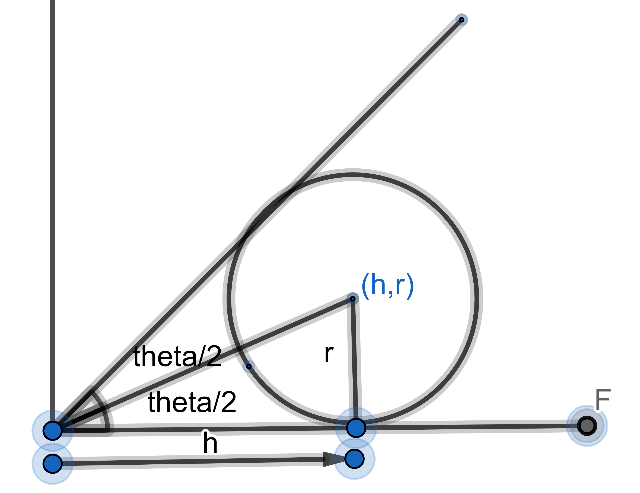
On the similar argument let the centre of the circle be (h,r), where r is the radius of the first circle \[{{S}_{1}}=0\] as it touches the x-axis.
Therefore, the equation of circle \[{{S}_{1}}=0\] is given by,
\[{{\left( x-h \right)}^{2}}+{{\left( y-r \right)}^{2}}={{r}^{2}}.........(i)\]
This circle also touches y=mx.
Let \[m=tan\theta \] (where \[\theta \] is an angle made with x-axis).
Now observing the figure, we get that,
\[\begin{align}
& tan\left( \dfrac{\theta }{2} \right)=\dfrac{r}{h} \\
& \Rightarrow r=h\tan\left( \dfrac{\theta }{2} \right) \\
& \Rightarrow h=r\cot \left( \dfrac{\theta }{2} \right) \\
\end{align}\]
Putting the above obtained value of h in equation (i) we get,
\[\Rightarrow {{(x-rcot\dfrac{\theta }{2})}^{2}}+{{(y-r)}^{2}}={{r}^{2}}\].
Now as both circles pass through (6,4).
Therefore, putting value of x as 6 and y as 4 in above equation we get,
\[\Rightarrow {{(6-rcot\dfrac{\theta }{2})}^{2}}+{{(4-r)}^{2}}={{r}^{2}}\]
The above obtained equation is a quadratic equation in r, hence gives two values of the radius r.
Two values of r give the radius of two possible circles whose product is given to be \[\dfrac{52}{3}\].
Solving the above we get,
\[\begin{align}
& 36+{{r}^{2}}co{{t}^{2}}\left( \dfrac{\theta }{2} \right)-12rcot\left( \dfrac{\theta }{2} \right)+16{{r}^{2}}-8r={{r}^{2}} \\
& \Rightarrow {{r}^{2}}co{{t}^{2}}\left( \dfrac{\theta }{2} \right)+r(-12cot\left( \dfrac{\theta }{2} \right)-8)+52=0 \\
\end{align}\]
Product of two roots of the above equation is given as \[\dfrac{52}{3}\].
Product of the roots is given by \[\dfrac{c}{a}\],
Here we have \[a=co{{t}^{2}}\left( \dfrac{\theta }{2} \right)\] and c = 52.
\[\begin{array}{*{35}{l}}
\dfrac{c}{a}=\dfrac{52}{3} \\
\Rightarrow 52co{{t}^{2}}\left( \dfrac{\theta }{2} \right)=\dfrac{52}{3} \\
\Rightarrow co{{t}^{2}}\left( \dfrac{\theta }{2} \right)=3 \\
\Rightarrow ta{{n}^{2}}\left( \dfrac{\theta }{2} \right)=\dfrac{1}{3} \\
tan\left( \dfrac{\theta }{2} \right)=\pm \dfrac{1}{\sqrt{3}} \\
\Rightarrow tan\left( \dfrac{\theta }{2} \right)=\dfrac{1}{\sqrt{3}} \\
\end{array}\]
Since the Circle is in the first quadrant therefore tan is positive.
(∵ Taking x-axis and passing through (6,4))
\[\begin{align}
& \Rightarrow \dfrac{\theta }{2}=\dfrac{\pi }{6} \\
& \Rightarrow \theta =\dfrac{\pi }{3} \\
\end{align}\]
Therefore, we got,
\[\begin{align}
& \tan \theta =\sqrt{3} \\
& \Rightarrow m=\sqrt{3} \\
\end{align}\]
Hence, we obtain the value of m as \[\sqrt{3}\]
Note: The possibility of error in these types of question can be at a point where you can mistakenly take the value of tan as negative. Always first check for the quadrant in which calculations are done and then go for taking positive or negative signs of trigonometric functions.
Complete step-by-step solution -
Consider the first circle \[{{S}_{1}}=0\].
Because the circle \[{{S}_{1}}=0\] touches the x axis therefore the coordinate of the centre of the circle would be given by x coordinate as some number h and the y coordinate would be equal to the radius of the circle.
We will now draw the figure of the situation. The figure is given as,
On the similar argument let the centre of the circle be (h,r), where r is the radius of the first circle \[{{S}_{1}}=0\] as it touches the x-axis.
Therefore, the equation of circle \[{{S}_{1}}=0\] is given by,
\[{{\left( x-h \right)}^{2}}+{{\left( y-r \right)}^{2}}={{r}^{2}}.........(i)\]
This circle also touches y=mx.
Let \[m=tan\theta \] (where \[\theta \] is an angle made with x-axis).
Now observing the figure, we get that,
\[\begin{align}
& tan\left( \dfrac{\theta }{2} \right)=\dfrac{r}{h} \\
& \Rightarrow r=h\tan\left( \dfrac{\theta }{2} \right) \\
& \Rightarrow h=r\cot \left( \dfrac{\theta }{2} \right) \\
\end{align}\]
Putting the above obtained value of h in equation (i) we get,
\[\Rightarrow {{(x-rcot\dfrac{\theta }{2})}^{2}}+{{(y-r)}^{2}}={{r}^{2}}\].
Now as both circles pass through (6,4).
Therefore, putting value of x as 6 and y as 4 in above equation we get,
\[\Rightarrow {{(6-rcot\dfrac{\theta }{2})}^{2}}+{{(4-r)}^{2}}={{r}^{2}}\]
The above obtained equation is a quadratic equation in r, hence gives two values of the radius r.
Two values of r give the radius of two possible circles whose product is given to be \[\dfrac{52}{3}\].
Solving the above we get,
\[\begin{align}
& 36+{{r}^{2}}co{{t}^{2}}\left( \dfrac{\theta }{2} \right)-12rcot\left( \dfrac{\theta }{2} \right)+16{{r}^{2}}-8r={{r}^{2}} \\
& \Rightarrow {{r}^{2}}co{{t}^{2}}\left( \dfrac{\theta }{2} \right)+r(-12cot\left( \dfrac{\theta }{2} \right)-8)+52=0 \\
\end{align}\]
Product of two roots of the above equation is given as \[\dfrac{52}{3}\].
Product of the roots is given by \[\dfrac{c}{a}\],
Here we have \[a=co{{t}^{2}}\left( \dfrac{\theta }{2} \right)\] and c = 52.
\[\begin{array}{*{35}{l}}
\dfrac{c}{a}=\dfrac{52}{3} \\
\Rightarrow 52co{{t}^{2}}\left( \dfrac{\theta }{2} \right)=\dfrac{52}{3} \\
\Rightarrow co{{t}^{2}}\left( \dfrac{\theta }{2} \right)=3 \\
\Rightarrow ta{{n}^{2}}\left( \dfrac{\theta }{2} \right)=\dfrac{1}{3} \\
tan\left( \dfrac{\theta }{2} \right)=\pm \dfrac{1}{\sqrt{3}} \\
\Rightarrow tan\left( \dfrac{\theta }{2} \right)=\dfrac{1}{\sqrt{3}} \\
\end{array}\]
Since the Circle is in the first quadrant therefore tan is positive.
(∵ Taking x-axis and passing through (6,4))
\[\begin{align}
& \Rightarrow \dfrac{\theta }{2}=\dfrac{\pi }{6} \\
& \Rightarrow \theta =\dfrac{\pi }{3} \\
\end{align}\]
Therefore, we got,
\[\begin{align}
& \tan \theta =\sqrt{3} \\
& \Rightarrow m=\sqrt{3} \\
\end{align}\]
Hence, we obtain the value of m as \[\sqrt{3}\]
Note: The possibility of error in these types of question can be at a point where you can mistakenly take the value of tan as negative. Always first check for the quadrant in which calculations are done and then go for taking positive or negative signs of trigonometric functions.
Recently Updated Pages
Master Class 11 Social Science: Engaging Questions & Answers for Success

Master Class 11 English: Engaging Questions & Answers for Success
Master Class 11 Maths: Engaging Questions & Answers for Success
Master Class 11 Chemistry: Engaging Questions & Answers for Success
Master Class 11 Biology: Engaging Questions & Answers for Success
Master Class 11 Physics: Engaging Questions & Answers for Success
Trending doubts
Differentiate between an exothermic and an endothermic class 11 chemistry CBSE
One Metric ton is equal to kg A 10000 B 1000 C 100 class 11 physics CBSE
Difference Between Prokaryotic Cells and Eukaryotic Cells
There are 720 permutations of the digits 1 2 3 4 5 class 11 maths CBSE
Two of the body parts which do not appear in MRI are class 11 biology CBSE
Which gas is abundant in air class 11 chemistry CBSE