




Let $G$ and $G'$ be the centroids of the triangles $ABC$ and $A'B'C'$ respectively, the $AA' + BB' + CC'$ is equal to which of the following
A) $2GG'$
B) $3G'G$
C) $3GG'$
D) $\dfrac{3}{2}GG'$
Answer
 Verified
558k+ views
Hint: Calculate the Point Vectors for every side of the triangle. Since we know that the centroid of a triangle is the sum of its sides divided by three, find the point vectors for both the centroids. Using these values find the value of the given expression in terms of the centroids $G$ and $G'$.
Complete step by step answer:
Given to us are two triangles $ABC$ and $A'B'C'$
For the triangle $ABC$, the sides are $A,B,C$ . Now let us assume that the point vectors for these sides to be $A\left( {\overrightarrow a } \right),B\left( {\overrightarrow b } \right),C\left( {\overrightarrow c } \right)$
Similarly, for the triangle $A'B'C'$, the sides are $A',B',C'$ . Let us assume the point vectors to be $A'\left( {\overrightarrow {{a_1}} } \right),B'\left( {\overrightarrow {{b_1}} } \right),C'\left( {\overrightarrow {{c_1}} } \right)$
Now, we can find the centroid of the first triangle $ABC$ as follows:
$Centroid = \dfrac{{\overrightarrow a + \overrightarrow b + \overrightarrow c }}{3}$ and it is already given to us that the centroid for this triangle is $G$
Therefore $G = \dfrac{{\overrightarrow a + \overrightarrow b + \overrightarrow c }}{3}$
Similarly for the triangle $A'B'C'$ the centroid would be $G' = \dfrac{{{{\overrightarrow a }_1} + \overrightarrow {{b_1}} + \overrightarrow {{c_1}} }}{3}$
The centroids of these triangles can be given as follows:
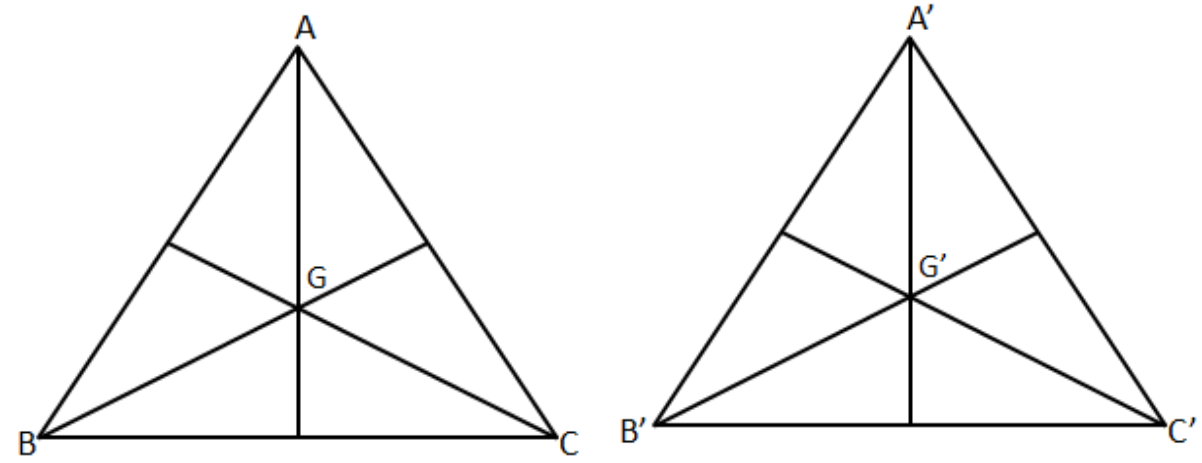
We are asked to find the value of $AA' + BB' + CC'$ . In order to find this, let us find the value of $AA',BB',CC'$ separately.
$AA' = \overrightarrow {{a_1}} - \overrightarrow a $ , $BB' = \overrightarrow {{b_1}} - \overrightarrow b $ and $CC' = \overrightarrow {{c_1}} - \overrightarrow c $
Now we can write $AA' + BB' + CC' = \overrightarrow {{a_1}} + \overrightarrow {{b_1}} + \overrightarrow {{c_1}} - \left( {\overrightarrow a + \overrightarrow b + \overrightarrow c } \right)$
By dividing and multiplying the left side of this equation with three, we get $AA' + BB' + CC' = 3 \times \left( {\dfrac{{\overrightarrow {{a_1}} + \overrightarrow {{b_1}} + \overrightarrow {{c_1}} }}{3}} \right) - 3 \times \left( {\dfrac{{\overrightarrow a + \overrightarrow b + \overrightarrow c }}{3}} \right)$
By solving this, we get $AA' + BB' + CC' = 3G' - 3G = 3(G - G')$
This equation can be written as $AA' + BB' + CC' = 3G'G$
Therefore, the value of the given expression is $3G'G$ i.e. option B.
Note: It should be noted that the distance between two point vectors is always the send point vector minus the first point vector and never the other way around. For example, if two point vectors are $R\left( {\overrightarrow r } \right),G\left( {\overrightarrow g } \right)$ the value of $RG$ will be $\overrightarrow g - \overrightarrow r $ and not $\overrightarrow r - \overrightarrow g $.
Complete step by step answer:
Given to us are two triangles $ABC$ and $A'B'C'$
For the triangle $ABC$, the sides are $A,B,C$ . Now let us assume that the point vectors for these sides to be $A\left( {\overrightarrow a } \right),B\left( {\overrightarrow b } \right),C\left( {\overrightarrow c } \right)$
Similarly, for the triangle $A'B'C'$, the sides are $A',B',C'$ . Let us assume the point vectors to be $A'\left( {\overrightarrow {{a_1}} } \right),B'\left( {\overrightarrow {{b_1}} } \right),C'\left( {\overrightarrow {{c_1}} } \right)$
Now, we can find the centroid of the first triangle $ABC$ as follows:
$Centroid = \dfrac{{\overrightarrow a + \overrightarrow b + \overrightarrow c }}{3}$ and it is already given to us that the centroid for this triangle is $G$
Therefore $G = \dfrac{{\overrightarrow a + \overrightarrow b + \overrightarrow c }}{3}$
Similarly for the triangle $A'B'C'$ the centroid would be $G' = \dfrac{{{{\overrightarrow a }_1} + \overrightarrow {{b_1}} + \overrightarrow {{c_1}} }}{3}$
The centroids of these triangles can be given as follows:
We are asked to find the value of $AA' + BB' + CC'$ . In order to find this, let us find the value of $AA',BB',CC'$ separately.
$AA' = \overrightarrow {{a_1}} - \overrightarrow a $ , $BB' = \overrightarrow {{b_1}} - \overrightarrow b $ and $CC' = \overrightarrow {{c_1}} - \overrightarrow c $
Now we can write $AA' + BB' + CC' = \overrightarrow {{a_1}} + \overrightarrow {{b_1}} + \overrightarrow {{c_1}} - \left( {\overrightarrow a + \overrightarrow b + \overrightarrow c } \right)$
By dividing and multiplying the left side of this equation with three, we get $AA' + BB' + CC' = 3 \times \left( {\dfrac{{\overrightarrow {{a_1}} + \overrightarrow {{b_1}} + \overrightarrow {{c_1}} }}{3}} \right) - 3 \times \left( {\dfrac{{\overrightarrow a + \overrightarrow b + \overrightarrow c }}{3}} \right)$
By solving this, we get $AA' + BB' + CC' = 3G' - 3G = 3(G - G')$
This equation can be written as $AA' + BB' + CC' = 3G'G$
Therefore, the value of the given expression is $3G'G$ i.e. option B.
Note: It should be noted that the distance between two point vectors is always the send point vector minus the first point vector and never the other way around. For example, if two point vectors are $R\left( {\overrightarrow r } \right),G\left( {\overrightarrow g } \right)$ the value of $RG$ will be $\overrightarrow g - \overrightarrow r $ and not $\overrightarrow r - \overrightarrow g $.
Recently Updated Pages
Master Class 11 Computer Science: Engaging Questions & Answers for Success

Master Class 11 Business Studies: Engaging Questions & Answers for Success
Master Class 11 Economics: Engaging Questions & Answers for Success
Master Class 11 English: Engaging Questions & Answers for Success
Master Class 11 Maths: Engaging Questions & Answers for Success
Master Class 11 Biology: Engaging Questions & Answers for Success
Trending doubts
One Metric ton is equal to kg A 10000 B 1000 C 100 class 11 physics CBSE
There are 720 permutations of the digits 1 2 3 4 5 class 11 maths CBSE
Discuss the various forms of bacteria class 11 biology CBSE
Draw a diagram of a plant cell and label at least eight class 11 biology CBSE
State the laws of reflection of light
Explain zero factorial class 11 maths CBSE