




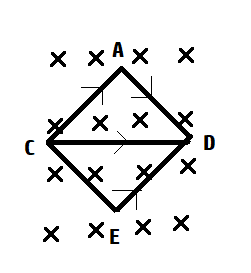
Let current i = 2 A be flowing in each part of a wire frame as shown in fig. The frame is a combination of two equilateral triangles ACD and CDE of side 1 m. It is placed in uniform magnetic field B = 4 T acting perpendicular to the plane of frame. The magnitude of magnetic force acting on the frame is?
1. 24 N
2. 0 N
3. 16 N
4. 8 N
Answer
 Verified
620.7k+ views
Hint: The figure shows a metallic frame of a conductor in a magnetic field directed into the page. The current is flowing in the conductor and the direction of current is shown by the arrows. The frame can be divided into two triangles- upper half and lower half. We can use the concept of a current conductor placed in a magnetic field.
Complete step by step answer:
The applied magnetic field is directed perpendicular to the plane of the frame, it will make an angle (\[{{90}^{0}}\] ) with each edge of the conductor. We know force on a current carrying conductor is given by,
$
\overrightarrow{F}=i(\overrightarrow{l}\times \overrightarrow{B}) \\
\implies F=ilB\sin 90 \\
\implies F=ilb \\
$
Given length of each edge is 1 m and the value of current in each edge is 2 A. Hence, the force on each edge comes out to be \[F=ilB=2\times 4=N\]
The point to keep is that the direction of magnetic force will be the cross product of length and the field. Fleming’s left-hand rule is used here to find out the direction of force on each edge. The arrow represents the force on each edge in the figure below:
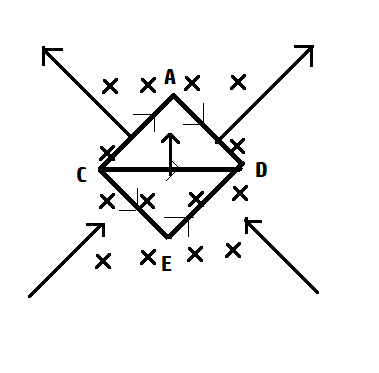
The forces on edge AC and AD are inclined at \[{{120}^{0}}\], so their resultant will be calculated using parallelogram law,
\[\begin{align}
& =\sqrt{{{F}^{2}}+{{F}^{2}}+2{{F}^{2}}\operatorname{Cos}120} \\
& =F \\
& =8N \\
\end{align}\]
Similarly, resultant forces on EC & EA will also be 8N.
So, net force will be 8+8+8= 24 N
So, the correct answer is “Option A”.
Note:
This is an example of how to use the vector addition and what are the special cases when the vectors are perpendicular to each other or parallel to each other, here force is a vector quantity. While adding or subtracting the two or more vectors we have to keep in mind what is the angle between them. This explains the vector law of addition.
Complete step by step answer:
The applied magnetic field is directed perpendicular to the plane of the frame, it will make an angle (\[{{90}^{0}}\] ) with each edge of the conductor. We know force on a current carrying conductor is given by,
$
\overrightarrow{F}=i(\overrightarrow{l}\times \overrightarrow{B}) \\
\implies F=ilB\sin 90 \\
\implies F=ilb \\
$
Given length of each edge is 1 m and the value of current in each edge is 2 A. Hence, the force on each edge comes out to be \[F=ilB=2\times 4=N\]
The point to keep is that the direction of magnetic force will be the cross product of length and the field. Fleming’s left-hand rule is used here to find out the direction of force on each edge. The arrow represents the force on each edge in the figure below:
The forces on edge AC and AD are inclined at \[{{120}^{0}}\], so their resultant will be calculated using parallelogram law,
\[\begin{align}
& =\sqrt{{{F}^{2}}+{{F}^{2}}+2{{F}^{2}}\operatorname{Cos}120} \\
& =F \\
& =8N \\
\end{align}\]
Similarly, resultant forces on EC & EA will also be 8N.
So, net force will be 8+8+8= 24 N
So, the correct answer is “Option A”.
Note:
This is an example of how to use the vector addition and what are the special cases when the vectors are perpendicular to each other or parallel to each other, here force is a vector quantity. While adding or subtracting the two or more vectors we have to keep in mind what is the angle between them. This explains the vector law of addition.
Recently Updated Pages
Master Class 12 Business Studies: Engaging Questions & Answers for Success

Master Class 12 Chemistry: Engaging Questions & Answers for Success
Master Class 12 Biology: Engaging Questions & Answers for Success
Class 12 Question and Answer - Your Ultimate Solutions Guide
Master Class 11 English: Engaging Questions & Answers for Success
Master Class 11 Social Science: Engaging Questions & Answers for Success
Trending doubts
Which are the Top 10 Largest Countries of the World?
Draw a labelled sketch of the human eye class 12 physics CBSE
Differentiate between homogeneous and heterogeneous class 12 chemistry CBSE
Differentiate between Pyramid of energy and pyramid class 12 biology CBSE
Why is the cell called the structural and functional class 12 biology CBSE
Draw the diagram of the pyramid of energy Explain In class 12 biology CBSE