




Let ABCD be a square of side length 2 units. A line $m$ through A is drawn parallel to BD. Point S moves such that its distances from the line BD and the vertex A are equal. If locus of S cuts $m$ at ${{T}_{2}}$ and ${{T}_{3}}$ and AC at ${{T}_{1}}$, then area of $\Delta {{T}_{1}}{{T}_{2}}{{T}_{3}}$ in square unit is – \[\]
A. $\dfrac{1}{2}$\[\]
B. $\dfrac{2}{3}$\[\]
C. $1$\[\]
D. $2$\[\]
Answer
 Verified
609.3k+ views
Hint: We know that when a point moves such that its distance from a fixed point is equal to its distance from a fixed line, then its locus is a parabola whose directrix is the fixed-line and the fixed point is the focus. Here the locus of S is a parabola with focus A, directrix BD, ${{T}_{1}}$ is the vertex, ${{T}_{2}}{{T}_{3}}$. We find the distance between focus and vertex $a=A{{T}_{1}}$ which also the height of $\Delta {{T}_{1}}{{T}_{2}}{{T}_{3}}$ and then latus rectum ${{T}_{2}}{{T}_{3}}=4a$ which is the base of $\Delta {{T}_{1}}{{T}_{2}}{{T}_{3}}$. We use the formula of the area with base and height. \[\]
Complete step-by-step solution
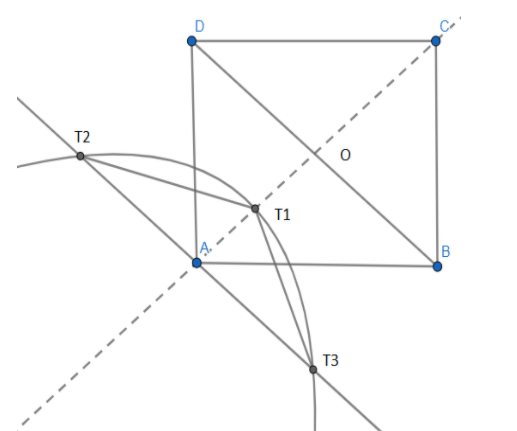
We have drawn the required figure as given in the question. The square is ABCD with length 2 units which mean $AB=BC=CD=DA=2$units. We denote the point of intersection of the diagonals BD and AC as O. We use the Pythagoras theorem in the triangle BAO and find the length of semi-diagonal as
\[\begin{align}
& A{{O}^{2}}+O{{B}^{2}}=A{{B}^{2}} \\
& \Rightarrow 2A{{O}^{2}}={{2}^{2}}\left( \because AO=OB \right) \\
& \Rightarrow AO=\sqrt{2} \\
\end{align}\]
The line $m$ is drawn parallel to BD. The point S moves in a way such that its distances from the line BD and the vertex A are equal.
We know that when a point moves such that its distance from a fixed point is equal to its distance from a fixed line, then its locus is a parabola whose directrix is the fixed-line and the fixed point is the focus. So here the fixed point A is the focus, the fixed-line BD is the directrix, and the locus of is the parabola. The line through focus and perpendicular to directrix called axis which here is OA .\[\]
We are further given that the locus of S cuts $m$ at ${{T}_{2}}$ and ${{T}_{3}}$ and AC at ${{T}_{1}}$. As ${{T}_{1}}$ a point on the parabola is equidistant from A and BD we have $A{{T}_{1}}={{T}_{1}}O$
\[\begin{align}
& A{{T}_{1}}+{{T}_{1}}O=AO \\
& \Rightarrow 2A{{T}_{1}}=\sqrt{2}\left( \because A{{T}_{1}}={{T}_{1}}O \right) \\
& \Rightarrow A{{T}_{1}}=\dfrac{1}{\sqrt{2}} \\
\end{align}\]
The point of intersection of parabola and axis is called vertex which here is ${{T}_{1}}.$We know from the standard equation of parabola in vertex form ${{y}^{2}}=4ax$ that $a$ is the distance between focus and vertex. So we have
\[a=A{{T}_{1}}=\dfrac{1}{\sqrt{2}}\]
We also know that ${{T}_{2}}{{T}_{3}}$ is called the latus rectum of the parabola whose length is given by
\[{{T}_{2}}{{T}_{3}}=4a=4\left( \dfrac{1}{\sqrt{2}} \right)\]
So the area $\Delta $ of the triangle ${{T}_{1}}{{T}_{2}}{{T}_{3}}$ with base ${{T}_{2}}{{T}_{3}}$ and height $A{{T}_{1}}$ is
\[\Delta =\dfrac{1}{2}\times {{T}_{2}}{{T}_{3}}\times A{{T}_{1}}=\dfrac{1}{2}\times 4\left( \dfrac{1}{\sqrt{2}} \right)\times \dfrac{1}{\sqrt{2}}=1\]
So area of the triangle ${{T}_{1}}{{T}_{2}}{{T}_{3}}$ is 1 square unit and hence correct option is C.
Note: We note that we can also find ${{T}_{2}}{{T}_{3}}$ using the coordinates of endpoints of latus rectum $\left( a,2a \right),\left( a,-2a \right)$. Circle does not have a latus rectum. The length of latus rectum of the ellipse $\dfrac{{{x}^{2}}}{{{a}^{2}}}+\dfrac{{{y}^{2}}}{{{b}^{2}}}=1$ is $\dfrac{2{{b}^{2}}}{a}$ if $a>b$ and $\dfrac{2{{a}^{2}}}{b}$ if $b>a.$ The length of latus rectum of hyperbola $\dfrac{{{x}^{2}}}{{{a}^{2}}}-\dfrac{{{y}^{2}}}{{{b}^{2}}}=1$ is $\dfrac{2{{b}^{2}}}{a}$.
Complete step-by-step solution
We have drawn the required figure as given in the question. The square is ABCD with length 2 units which mean $AB=BC=CD=DA=2$units. We denote the point of intersection of the diagonals BD and AC as O. We use the Pythagoras theorem in the triangle BAO and find the length of semi-diagonal as
\[\begin{align}
& A{{O}^{2}}+O{{B}^{2}}=A{{B}^{2}} \\
& \Rightarrow 2A{{O}^{2}}={{2}^{2}}\left( \because AO=OB \right) \\
& \Rightarrow AO=\sqrt{2} \\
\end{align}\]
The line $m$ is drawn parallel to BD. The point S moves in a way such that its distances from the line BD and the vertex A are equal.
We know that when a point moves such that its distance from a fixed point is equal to its distance from a fixed line, then its locus is a parabola whose directrix is the fixed-line and the fixed point is the focus. So here the fixed point A is the focus, the fixed-line BD is the directrix, and the locus of is the parabola. The line through focus and perpendicular to directrix called axis which here is OA .\[\]
We are further given that the locus of S cuts $m$ at ${{T}_{2}}$ and ${{T}_{3}}$ and AC at ${{T}_{1}}$. As ${{T}_{1}}$ a point on the parabola is equidistant from A and BD we have $A{{T}_{1}}={{T}_{1}}O$
\[\begin{align}
& A{{T}_{1}}+{{T}_{1}}O=AO \\
& \Rightarrow 2A{{T}_{1}}=\sqrt{2}\left( \because A{{T}_{1}}={{T}_{1}}O \right) \\
& \Rightarrow A{{T}_{1}}=\dfrac{1}{\sqrt{2}} \\
\end{align}\]
The point of intersection of parabola and axis is called vertex which here is ${{T}_{1}}.$We know from the standard equation of parabola in vertex form ${{y}^{2}}=4ax$ that $a$ is the distance between focus and vertex. So we have
\[a=A{{T}_{1}}=\dfrac{1}{\sqrt{2}}\]
We also know that ${{T}_{2}}{{T}_{3}}$ is called the latus rectum of the parabola whose length is given by
\[{{T}_{2}}{{T}_{3}}=4a=4\left( \dfrac{1}{\sqrt{2}} \right)\]
So the area $\Delta $ of the triangle ${{T}_{1}}{{T}_{2}}{{T}_{3}}$ with base ${{T}_{2}}{{T}_{3}}$ and height $A{{T}_{1}}$ is
\[\Delta =\dfrac{1}{2}\times {{T}_{2}}{{T}_{3}}\times A{{T}_{1}}=\dfrac{1}{2}\times 4\left( \dfrac{1}{\sqrt{2}} \right)\times \dfrac{1}{\sqrt{2}}=1\]
So area of the triangle ${{T}_{1}}{{T}_{2}}{{T}_{3}}$ is 1 square unit and hence correct option is C.
Note: We note that we can also find ${{T}_{2}}{{T}_{3}}$ using the coordinates of endpoints of latus rectum $\left( a,2a \right),\left( a,-2a \right)$. Circle does not have a latus rectum. The length of latus rectum of the ellipse $\dfrac{{{x}^{2}}}{{{a}^{2}}}+\dfrac{{{y}^{2}}}{{{b}^{2}}}=1$ is $\dfrac{2{{b}^{2}}}{a}$ if $a>b$ and $\dfrac{2{{a}^{2}}}{b}$ if $b>a.$ The length of latus rectum of hyperbola $\dfrac{{{x}^{2}}}{{{a}^{2}}}-\dfrac{{{y}^{2}}}{{{b}^{2}}}=1$ is $\dfrac{2{{b}^{2}}}{a}$.
Recently Updated Pages
Master Class 11 Social Science: Engaging Questions & Answers for Success

Master Class 11 Chemistry: Engaging Questions & Answers for Success
Master Class 12 Business Studies: Engaging Questions & Answers for Success
Master Class 12 Chemistry: Engaging Questions & Answers for Success
Master Class 12 Biology: Engaging Questions & Answers for Success
Class 12 Question and Answer - Your Ultimate Solutions Guide
Trending doubts
One Metric ton is equal to kg A 10000 B 1000 C 100 class 11 physics CBSE
Difference Between Prokaryotic Cells and Eukaryotic Cells
How many of the following diseases can be studied with class 11 biology CBSE
Two of the body parts which do not appear in MRI are class 11 biology CBSE
Which of the following enzymes is used for carboxylation class 11 biology CBSE
Explain zero factorial class 11 maths CBSE