




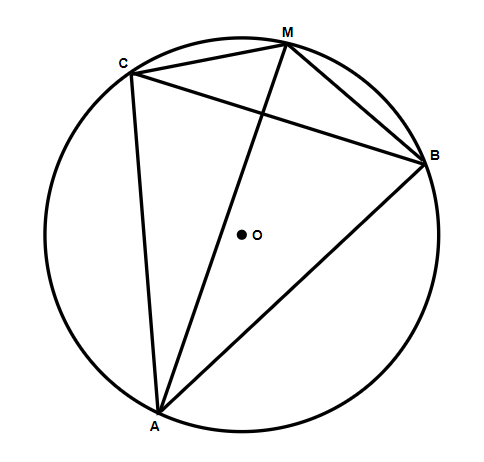
Let $ABC$ be an equilateral triangle inscribed in a circle $O$ . $M$ is a point on the arc $BC$ . Lines $AM,BM$ and $CM$ are drawn. Then $\mathop {AM}\limits^{\_\_\_\_\_} $ is:
$\left( a \right){\text{ equal to }}\mathop {BM}\limits^{\_\_\_\_\_} + \mathop {CM}\limits^{\_\_\_\_\_} $
$\left( b \right){\text{ less than }}\mathop {BM}\limits^{\_\_\_\_\_} + \mathop {CM}\limits^{\_\_\_\_\_} $
$\left( c \right){\text{ greater than }}\mathop {BM}\limits^{\_\_\_\_\_} + \mathop {CM}\limits^{\_\_\_\_\_} $
$\left( d \right){\text{ equal, less than, or greater than }}\mathop {BM}\limits^{\_\_\_\_\_} + \mathop {CM}\limits^{\_\_\_\_\_} ,{\text{ depending upon position upon M}}$
Answer
 Verified
598.8k+ views
Hint: For proving this type of question, all we can do is proceed with the information and figure provided. So we can see that since the $O$ is the center which lies on $AM$ hence, $AM$ will be equal to $2R$. And also $AM$ is perpendicular to $BC$ and also $AD$ is perpendicular to the same. So by using this we will equate both of them and get the value. And on solving it we will be able to find the required equation.
Complete answer:
First of all, we will assume this is an ideal case. And since, from the information provided, we can say that $O$ is the center which lies on $AM$ .
Therefore, $AM = 2R$ and here $R$ will be the radius of the circle.
Also, we can see that $AM \bot BC$ , so from this $O$ will be the point which lies on $AM$ and $BC$ .
Here, $AD \bot BC$ , so from the figure we can write it in fraction as
$ \Rightarrow \dfrac{{BD}}{{OB}} = \dfrac{{\sqrt 3 }}{2}$
Now let us assume $AB = BC = CA = a{\text{ , OA = OB = OC = R}}$
Therefore, on substituting the values, we will get the relation as
$ \Rightarrow \dfrac{a}{{2R}} = \dfrac{{\sqrt 3 }}{2}$
And by doing the cross multiplication and solving the above equation, we get the equation as
$ \Rightarrow a = \sqrt 3 R$
Since, we have $AM = 2R$ ,
So by using the trigonometric properties, we have
$ \Rightarrow BM = CM = \dfrac{{BD}}{{\cos {{30}^ \circ }}}$
And on solving the above line, we get the equation as
$ \Rightarrow \dfrac{a}{{\sqrt 3 }}$
So from this now we can have the sum of $BM\& CM$
On adding the sum, we will get $\dfrac{{2a}}{{\sqrt 3 }}$
Now on substituting the value of $a$ , we get the equation as
$ \Rightarrow \dfrac{{2 \times \sqrt 3 R}}{{\sqrt 3 }}$
And on solving the above line we get
$ \Rightarrow 2R = AM$
Therefore, from this, we can say \[\mathop {AM}\limits^{\_\_\_\_\_} = \mathop {BM}\limits^{\_\_\_\_\_} + \mathop {CM}\limits^{\_\_\_\_\_} \] .
Hence, the option $\left( a \right)$ is correct.
Note: For solving this type of question we need to know the geometry and its properties ideas so that we can equate the equation. Also, the use of trigonometry should be known to us as they are used sometimes. So by using the relation we will expand the equation and solve it then we can easily get to the solution.
Complete answer:
First of all, we will assume this is an ideal case. And since, from the information provided, we can say that $O$ is the center which lies on $AM$ .
Therefore, $AM = 2R$ and here $R$ will be the radius of the circle.
Also, we can see that $AM \bot BC$ , so from this $O$ will be the point which lies on $AM$ and $BC$ .
Here, $AD \bot BC$ , so from the figure we can write it in fraction as
$ \Rightarrow \dfrac{{BD}}{{OB}} = \dfrac{{\sqrt 3 }}{2}$
Now let us assume $AB = BC = CA = a{\text{ , OA = OB = OC = R}}$
Therefore, on substituting the values, we will get the relation as
$ \Rightarrow \dfrac{a}{{2R}} = \dfrac{{\sqrt 3 }}{2}$
And by doing the cross multiplication and solving the above equation, we get the equation as
$ \Rightarrow a = \sqrt 3 R$
Since, we have $AM = 2R$ ,
So by using the trigonometric properties, we have
$ \Rightarrow BM = CM = \dfrac{{BD}}{{\cos {{30}^ \circ }}}$
And on solving the above line, we get the equation as
$ \Rightarrow \dfrac{a}{{\sqrt 3 }}$
So from this now we can have the sum of $BM\& CM$
On adding the sum, we will get $\dfrac{{2a}}{{\sqrt 3 }}$
Now on substituting the value of $a$ , we get the equation as
$ \Rightarrow \dfrac{{2 \times \sqrt 3 R}}{{\sqrt 3 }}$
And on solving the above line we get
$ \Rightarrow 2R = AM$
Therefore, from this, we can say \[\mathop {AM}\limits^{\_\_\_\_\_} = \mathop {BM}\limits^{\_\_\_\_\_} + \mathop {CM}\limits^{\_\_\_\_\_} \] .
Hence, the option $\left( a \right)$ is correct.
Note: For solving this type of question we need to know the geometry and its properties ideas so that we can equate the equation. Also, the use of trigonometry should be known to us as they are used sometimes. So by using the relation we will expand the equation and solve it then we can easily get to the solution.
Recently Updated Pages
Master Class 12 Business Studies: Engaging Questions & Answers for Success

Master Class 12 Biology: Engaging Questions & Answers for Success
Master Class 12 Chemistry: Engaging Questions & Answers for Success
Class 12 Question and Answer - Your Ultimate Solutions Guide
Master Class 11 English: Engaging Questions & Answers for Success
Master Class 11 Social Science: Engaging Questions & Answers for Success
Trending doubts
Which are the Top 10 Largest Countries of the World?
Draw a labelled sketch of the human eye class 12 physics CBSE
Differentiate between homogeneous and heterogeneous class 12 chemistry CBSE
Why is the cell called the structural and functional class 12 biology CBSE
Draw ray diagrams each showing i myopic eye and ii class 12 physics CBSE
Which is the correct genotypic ratio of mendel dihybrid class 12 biology CBSE