




Let ABC be an acute scalene triangle, O and H be its circumcentre and orthocentre respectively. Further, let N be the midpoint of OH. Find the value of the vector sum $\overrightarrow{NA}+\overrightarrow{NB}+\overrightarrow{NC}$?
(a) $\overrightarrow{0}$ (zero vector)
(b) $\overrightarrow{HO}$,
(c) $\dfrac{1}{2}\overrightarrow{HO}$,
(d) $\dfrac{1}{2}\overrightarrow{OH}$.
Answer
 Verified
608.1k+ views
Hint: We start solving the problem by assigning a variable vector for the origin vector. We then use the formula of the vector of line segments in the given sum. We then find the point N in terms of O and H using the midpoint formula. We recall the definition of centroid and use the fact that the centroid divides circumcentre and orthocentre in a ratio of $2:1$ to find the centroid in terms of O and H. We substitute all the obtained relations in the vector sum and make necessary calculations to get the required result.
Complete step-by-step solution
According to the problem, we have an acute scalene triangle ABC and O, H be its circumcentre and orthocentre. We need to find the value of the $\overrightarrow{NA}+\overrightarrow{NB}+\overrightarrow{NC}$ if N is the midpoint of OH.
Let us draw the given information to get a better view.
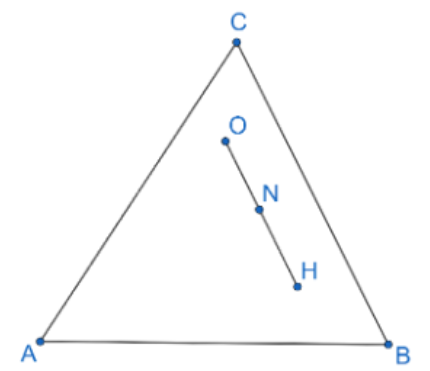
Let us assume $\overrightarrow{E}$ be the origin vector. We know that the vector equation of the segment $\overrightarrow{AB}$ is defined as $\overrightarrow{EB}-\overrightarrow{EA}$.
Let us consider the vector sum $\overrightarrow{NA}+\overrightarrow{NB}+\overrightarrow{NC}$.
So, we have $\overrightarrow{NA}+\overrightarrow{NB}+\overrightarrow{NC}=\left( \overrightarrow{EA}-\overrightarrow{EN} \right)+\left( \overrightarrow{EB}-\overrightarrow{EN} \right)+\left( \overrightarrow{EC}-\overrightarrow{EN} \right)$.
$\overrightarrow{NA}+\overrightarrow{NB}+\overrightarrow{NC}=\overrightarrow{EA}+\overrightarrow{EB}+\overrightarrow{EC}-3\overrightarrow{EN}$ ---(1).
According to the problem we have given that N is the midpoint of OH i.e., the vector $\overrightarrow{EN}$ is the mid-point of the vectors $\overrightarrow{EO}$ and $\overrightarrow{EH}$.
We know that the midpoint of the two vectors $\overrightarrow{a}$ and $\overrightarrow{b}$ is given as $\dfrac{1}{2}\times \left( \overrightarrow{a}+\overrightarrow{b} \right)$. We use this to find the vector $\overrightarrow{EN}$.
So, we have $\overrightarrow{EN}=\dfrac{1}{2}\times \left( \overrightarrow{EO}+\overrightarrow{EH} \right)$. Let us use this in equation (1).
$\Rightarrow \overrightarrow{NA}+\overrightarrow{NB}+\overrightarrow{NC}=\overrightarrow{EA}+\overrightarrow{EB}+\overrightarrow{EC}-\left( 3\times \dfrac{1}{2}\times \left( \overrightarrow{EO}+\overrightarrow{EH} \right) \right)$.
$\Rightarrow \overrightarrow{NA}+\overrightarrow{NB}+\overrightarrow{NC}=\overrightarrow{EA}+\overrightarrow{EB}+\overrightarrow{EC}-\dfrac{3}{2}\times \left( \overrightarrow{EO}+\overrightarrow{EH} \right)$.
$\Rightarrow \overrightarrow{NA}+\overrightarrow{NB}+\overrightarrow{NC}=\overrightarrow{EA}+\overrightarrow{EB}+\overrightarrow{EC}-\dfrac{3}{2}\overrightarrow{EO}-\dfrac{3}{2}\overrightarrow{EH}$ ---(2).
We know that the centroid of the triangle ABC is defined as $\overrightarrow{EG}=\dfrac{\overrightarrow{EA}+\overrightarrow{EB}+\overrightarrow{EC}}{3}$.
$\Rightarrow \overrightarrow{EA}+\overrightarrow{EB}+\overrightarrow{EC}=3\overrightarrow{EG}$. We substitute this in equation (2).
$\Rightarrow \overrightarrow{NA}+\overrightarrow{NB}+\overrightarrow{NC}=3\overrightarrow{EG}-\dfrac{3}{2}\overrightarrow{EO}-\dfrac{3}{2}\overrightarrow{EH}$ ---(3).
We know that the centroid divides the orthocentre and circumcentre in the ratio $1:2$.
From section formula, we know that if the point divides the points A and B in the ratio $m:n$ is \[\dfrac{mB+nA}{m+n}\].
So, we get $\overrightarrow{EG}=\dfrac{2\overrightarrow{EH}+\overrightarrow{EO}}{2+1}$.
$\Rightarrow \overrightarrow{EG}=\dfrac{2\overrightarrow{EH}+\overrightarrow{EO}}{3}$.
$\Rightarrow 3\overrightarrow{EG}=2\overrightarrow{EH}+\overrightarrow{EO}$. We substitute this in equation (3).
$\Rightarrow \overrightarrow{NA}+\overrightarrow{NB}+\overrightarrow{NC}=2\overrightarrow{EH}+\overrightarrow{EO}-\dfrac{3}{2}\overrightarrow{EO}-\dfrac{3}{2}\overrightarrow{EH}$.
$\Rightarrow \overrightarrow{NA}+\overrightarrow{NB}+\overrightarrow{NC}=\dfrac{1}{2}\overrightarrow{EH}-\dfrac{1}{2}\overrightarrow{EO}$.
$\Rightarrow \overrightarrow{NA}+\overrightarrow{NB}+\overrightarrow{NC}=\dfrac{1}{2}\left( \overrightarrow{EH}-\overrightarrow{EO} \right)$.
$\Rightarrow \overrightarrow{NA}+\overrightarrow{NB}+\overrightarrow{NC}=\dfrac{1}{2}\overrightarrow{OH}$.
So, we have found the value of the vector sum $\overrightarrow{NA}+\overrightarrow{NB}+\overrightarrow{NC}$ as $\dfrac{1}{2}\overrightarrow{OH}$.
∴ The correct option for the given problem is (c).
Note: We can also assume orthocentre as the origin in order to reduce the calculation time. We should not write the answer as $\dfrac{1}{2}\overrightarrow{HO}$ as we need to take care of the direction of the vector while calculating the sum of the vectors. We should keep in mind that the vector sum is different from the scalar sum and should not be confused between both. We can also find the magnitude of the vector $\dfrac{1}{2}\overrightarrow{OH}$ if the vector points of the vertices are given.
Complete step-by-step solution
According to the problem, we have an acute scalene triangle ABC and O, H be its circumcentre and orthocentre. We need to find the value of the $\overrightarrow{NA}+\overrightarrow{NB}+\overrightarrow{NC}$ if N is the midpoint of OH.
Let us draw the given information to get a better view.
Let us assume $\overrightarrow{E}$ be the origin vector. We know that the vector equation of the segment $\overrightarrow{AB}$ is defined as $\overrightarrow{EB}-\overrightarrow{EA}$.
Let us consider the vector sum $\overrightarrow{NA}+\overrightarrow{NB}+\overrightarrow{NC}$.
So, we have $\overrightarrow{NA}+\overrightarrow{NB}+\overrightarrow{NC}=\left( \overrightarrow{EA}-\overrightarrow{EN} \right)+\left( \overrightarrow{EB}-\overrightarrow{EN} \right)+\left( \overrightarrow{EC}-\overrightarrow{EN} \right)$.
$\overrightarrow{NA}+\overrightarrow{NB}+\overrightarrow{NC}=\overrightarrow{EA}+\overrightarrow{EB}+\overrightarrow{EC}-3\overrightarrow{EN}$ ---(1).
According to the problem we have given that N is the midpoint of OH i.e., the vector $\overrightarrow{EN}$ is the mid-point of the vectors $\overrightarrow{EO}$ and $\overrightarrow{EH}$.
We know that the midpoint of the two vectors $\overrightarrow{a}$ and $\overrightarrow{b}$ is given as $\dfrac{1}{2}\times \left( \overrightarrow{a}+\overrightarrow{b} \right)$. We use this to find the vector $\overrightarrow{EN}$.
So, we have $\overrightarrow{EN}=\dfrac{1}{2}\times \left( \overrightarrow{EO}+\overrightarrow{EH} \right)$. Let us use this in equation (1).
$\Rightarrow \overrightarrow{NA}+\overrightarrow{NB}+\overrightarrow{NC}=\overrightarrow{EA}+\overrightarrow{EB}+\overrightarrow{EC}-\left( 3\times \dfrac{1}{2}\times \left( \overrightarrow{EO}+\overrightarrow{EH} \right) \right)$.
$\Rightarrow \overrightarrow{NA}+\overrightarrow{NB}+\overrightarrow{NC}=\overrightarrow{EA}+\overrightarrow{EB}+\overrightarrow{EC}-\dfrac{3}{2}\times \left( \overrightarrow{EO}+\overrightarrow{EH} \right)$.
$\Rightarrow \overrightarrow{NA}+\overrightarrow{NB}+\overrightarrow{NC}=\overrightarrow{EA}+\overrightarrow{EB}+\overrightarrow{EC}-\dfrac{3}{2}\overrightarrow{EO}-\dfrac{3}{2}\overrightarrow{EH}$ ---(2).
We know that the centroid of the triangle ABC is defined as $\overrightarrow{EG}=\dfrac{\overrightarrow{EA}+\overrightarrow{EB}+\overrightarrow{EC}}{3}$.
$\Rightarrow \overrightarrow{EA}+\overrightarrow{EB}+\overrightarrow{EC}=3\overrightarrow{EG}$. We substitute this in equation (2).
$\Rightarrow \overrightarrow{NA}+\overrightarrow{NB}+\overrightarrow{NC}=3\overrightarrow{EG}-\dfrac{3}{2}\overrightarrow{EO}-\dfrac{3}{2}\overrightarrow{EH}$ ---(3).
We know that the centroid divides the orthocentre and circumcentre in the ratio $1:2$.
From section formula, we know that if the point divides the points A and B in the ratio $m:n$ is \[\dfrac{mB+nA}{m+n}\].
So, we get $\overrightarrow{EG}=\dfrac{2\overrightarrow{EH}+\overrightarrow{EO}}{2+1}$.
$\Rightarrow \overrightarrow{EG}=\dfrac{2\overrightarrow{EH}+\overrightarrow{EO}}{3}$.
$\Rightarrow 3\overrightarrow{EG}=2\overrightarrow{EH}+\overrightarrow{EO}$. We substitute this in equation (3).
$\Rightarrow \overrightarrow{NA}+\overrightarrow{NB}+\overrightarrow{NC}=2\overrightarrow{EH}+\overrightarrow{EO}-\dfrac{3}{2}\overrightarrow{EO}-\dfrac{3}{2}\overrightarrow{EH}$.
$\Rightarrow \overrightarrow{NA}+\overrightarrow{NB}+\overrightarrow{NC}=\dfrac{1}{2}\overrightarrow{EH}-\dfrac{1}{2}\overrightarrow{EO}$.
$\Rightarrow \overrightarrow{NA}+\overrightarrow{NB}+\overrightarrow{NC}=\dfrac{1}{2}\left( \overrightarrow{EH}-\overrightarrow{EO} \right)$.
$\Rightarrow \overrightarrow{NA}+\overrightarrow{NB}+\overrightarrow{NC}=\dfrac{1}{2}\overrightarrow{OH}$.
So, we have found the value of the vector sum $\overrightarrow{NA}+\overrightarrow{NB}+\overrightarrow{NC}$ as $\dfrac{1}{2}\overrightarrow{OH}$.
∴ The correct option for the given problem is (c).
Note: We can also assume orthocentre as the origin in order to reduce the calculation time. We should not write the answer as $\dfrac{1}{2}\overrightarrow{HO}$ as we need to take care of the direction of the vector while calculating the sum of the vectors. We should keep in mind that the vector sum is different from the scalar sum and should not be confused between both. We can also find the magnitude of the vector $\dfrac{1}{2}\overrightarrow{OH}$ if the vector points of the vertices are given.
Recently Updated Pages
Master Class 12 Business Studies: Engaging Questions & Answers for Success

Master Class 12 Biology: Engaging Questions & Answers for Success
Master Class 12 Chemistry: Engaging Questions & Answers for Success
Class 12 Question and Answer - Your Ultimate Solutions Guide
Master Class 11 Social Science: Engaging Questions & Answers for Success
Master Class 11 English: Engaging Questions & Answers for Success
Trending doubts
What is the full form of NDA a National Democratic class 10 social science CBSE
Explain the Treaty of Vienna of 1815 class 10 social science CBSE
Who Won 36 Oscar Awards? Record Holder Revealed
Bharatiya Janata Party was founded in the year A 1979 class 10 social science CBSE
What is the median of the first 10 natural numbers class 10 maths CBSE
Why is it 530 pm in india when it is 1200 afternoon class 10 social science CBSE