




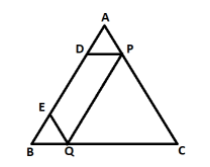
Let ABC be a triangle and D and E be two points on side AB such that AD = BE. If $DP\parallel BC$ and $EQ\parallel AC$, then prove that $PQ\parallel AB$.
Answer
 Verified
587.4k+ views
Hint: Let’s recall the theorem of basic proportionality, also known as Thales theorem. The theorem states that, if a line is drawn parallel to one side of the triangle intersecting the other two sides, then the line cuts the sides of a triangle in the same ratio. Here, ABC is a triangle with two points D and E on side AB. Given that, $DP\parallel BC$ and $EQ\parallel AC$. Therefore, by theorem of basic proportionality, $\dfrac{{AD}}{{DB}} = \dfrac{{AP}}{{PC}}$ and $\dfrac{{BE}}{{EA}} = \dfrac{{BQ}}{{QC}}$. Now, AD = BE , given. Therefore equate these relations and proceed.
Complete step-by-step solution:
Let us recall the theorem of basic proportionality, also known as Thales theorem. The theorem states that, if a line is drawn parallel to one side of the triangle intersecting the other two sides, then the line cuts the sides of a triangle in the same ratio.
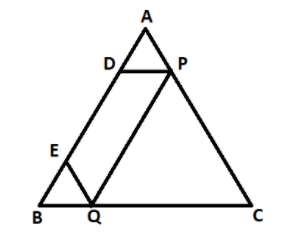
Now, given that ABC is a triangle with two points D and E on side AB.
Also, $DP\parallel BC$
Therefore, by theorem of basic proportionality, we have $\dfrac{{AD}}{{DB}} = \dfrac{{AP}}{{PC}}$ ……….…(1)
Again, $EQ\parallel AC$
Therefore, $\dfrac{{BE}}{{EA}} = \dfrac{{BQ}}{{QC}}$ ……….…(2)
Now, AD = BE , given.
$\Rightarrow$ AD + DE = BE + DE
$\Rightarrow$ EA = BD
Now, substituting AD with BE and BD with EA in equation (1), we get
$\dfrac{{AD}}{{DB}} = \dfrac{{BE}}{{EA}} = \dfrac{{AP}}{{PC}} = \dfrac{{BQ}}{{QC}}$
$\Rightarrow$ $\dfrac{{AP}}{{PC}} = \dfrac{{BQ}}{{QC}}$
$\Rightarrow$ P and Q divide the sides of the triangle ABC in the same ratio.
Therefore, by the converse of the theorem of basic proportionality, we have $PQ\parallel AB$.
Note: The theorem of basic proportionality is also known as Thales theorem. The theorem states that, if a line is drawn parallel to one side of the triangle intersecting the other two sides, then the line cuts the sides of a triangle in the same ratio.
Complete step-by-step solution:
Let us recall the theorem of basic proportionality, also known as Thales theorem. The theorem states that, if a line is drawn parallel to one side of the triangle intersecting the other two sides, then the line cuts the sides of a triangle in the same ratio.
Now, given that ABC is a triangle with two points D and E on side AB.
Also, $DP\parallel BC$
Therefore, by theorem of basic proportionality, we have $\dfrac{{AD}}{{DB}} = \dfrac{{AP}}{{PC}}$ ……….…(1)
Again, $EQ\parallel AC$
Therefore, $\dfrac{{BE}}{{EA}} = \dfrac{{BQ}}{{QC}}$ ……….…(2)
Now, AD = BE , given.
$\Rightarrow$ AD + DE = BE + DE
$\Rightarrow$ EA = BD
Now, substituting AD with BE and BD with EA in equation (1), we get
$\dfrac{{AD}}{{DB}} = \dfrac{{BE}}{{EA}} = \dfrac{{AP}}{{PC}} = \dfrac{{BQ}}{{QC}}$
$\Rightarrow$ $\dfrac{{AP}}{{PC}} = \dfrac{{BQ}}{{QC}}$
$\Rightarrow$ P and Q divide the sides of the triangle ABC in the same ratio.
Therefore, by the converse of the theorem of basic proportionality, we have $PQ\parallel AB$.
Note: The theorem of basic proportionality is also known as Thales theorem. The theorem states that, if a line is drawn parallel to one side of the triangle intersecting the other two sides, then the line cuts the sides of a triangle in the same ratio.
Recently Updated Pages
Master Class 11 English: Engaging Questions & Answers for Success

Master Class 11 Maths: Engaging Questions & Answers for Success
Class 11 Question and Answer - Your Ultimate Solutions Guide
Master Class 11 Biology: Engaging Questions & Answers for Success
Master Class 11 Physics: Engaging Questions & Answers for Success
Master Class 11 Accountancy: Engaging Questions & Answers for Success
Trending doubts
Find the sum of series 1 + 2 + 3 + 4 + 5 + + 100 class 9 maths CBSE
Fill the blanks with the suitable prepositions 1 The class 9 english CBSE
Difference Between Plant Cell and Animal Cell
How many hours before the closure of election must class 9 social science CBSE
What is the Full Form of ICSE / ISC ?
What is pollution? How many types of pollution? Define it