




What is the length of the shortest side of the \[{30^ \circ } - {60^ \circ } - {90^ \circ }\] triangle if its hypotenuse is $6$?
(a) $3$
(b) $5$
(c) Cannot be determined
(d) None of these
Answer
 Verified
525.6k+ views
Hint: The given problem revolves around the concepts of geometry of finding the lengths (also, known as mensuration). We will find the required length(s) of the triangle ‘ABC’ by using the trigonometric terms, say, ‘$\sin $’ as we have given the respective hypotenuse of the triangle, to obtain the desired solution.
Complete step-by-step answer:
Since, we have given that
The given triangle is \[{30^ \circ } - {60^ \circ } - {90^ \circ }\] respectively.
As a result, we will consider the figure ABC which resembles the given condition that is given below,
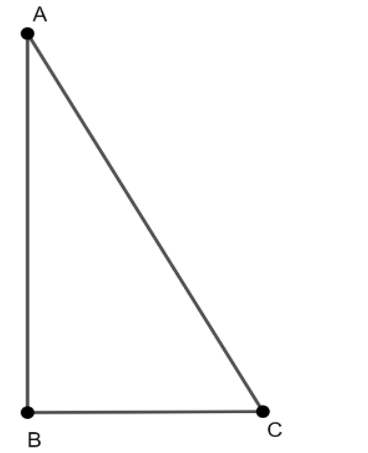
Hence, angle ‘B’ is \[\angle B = {90^ \circ }\] respectively,
So, let us assume that (any)
Remaining angles become (that is ‘A’ and ‘C’ respectively),
$\angle A = {30^ \circ }$
And,
$\angle C = {60^ \circ }$
From figure,
$\therefore $AC is the hypotenuse of the \[{30^ \circ } - {60^ \circ } - {90^ \circ }\] right-angled triangle ‘ABC’ respectively.
But, since we have given that
Hypotenuse, AC $ = 6$ (units)
Hence, we can find the remaining lengths that are ‘AB’ and ‘BC’ respectively by using the Pythagorean Theorem (as the triangle is right angled triangle) which states that “square of hypotenuse is equal to the square of remaining two that is opposite and adjacent sides.”
Mathematically, it is expressed as
$A{C^2} = A{B^2} + B{C^2}$
Also, we can find required lengths or side(s) of the right angled triangle by using the certain trigonometric terms such as ‘$\sin $’, ‘$\cos $’, ‘$\tan $’, etc.
In this case, we will use the second condition to find both the sides (since, we know only one side out of three)
As a result, using ‘$\sin $’ term that is
\[\sin \theta = \dfrac{{opposite{\text{ }}side}}{{hypotenuse}}\]
Say, for angle ${30^ \circ }$
Considering $\angle BAC = {30^ \circ }$ i.e. $\theta = {30^ \circ }$,
$\sin {30^ \circ } = \dfrac{{BC}}{{AC}}$
We know that,
Trigonometric formulae for standard angles ${0^ \circ },{30^ \circ },{45^ \circ },{60^ \circ },{90^ \circ },{180^ \circ },{270^ \circ },{360^ \circ }$ such as, $\sin {30^ \circ } = \dfrac{1}{2}$, etc.
Substituting the values in the above equation, we get
$\therefore \dfrac{1}{2} = \dfrac{{BC}}{6}$
Solving the equation mathematically, we get
$\dfrac{6}{2} = BC$
$BC = 3$ units … (i)
Now, hence we can find the other side i.e. ‘AB’ by using the Pythagoras Theorem $A{C^2} = A{B^2} + B{C^2}$, we get
${6^2} = A{B^2} + {3^2}$
$36 = A{B^2} + 9$
Solving the equation algebraically, we get
$36 - 9 = A{B^2}$
$25 = A{B^2}$
Taking the square roots on the above equation, we get
$AB = 5$ units … (ii)
$\therefore $From (i) and (ii), we have all the lengths for the triangle ABC $\vartriangle ABC$ when hypotenuse, $AC = 6{\text{ }}units$ i.e.
$AB = 5{\text{ }}units$
$BC = 3{\text{ }}units$
Hence, from the above calculations it seems that
The shortest side of the given \[{30^ \circ } - {60^ \circ } - {90^ \circ }\] triangle is $3{\text{ }}units$ respectively.
$\therefore \Rightarrow $Option (a) is correct.
So, the correct answer is “Option a”.
Note: In these cases, we can find the required values by using different methods such as Pythagoras Theorem i.e. $A{C^2} = A{B^2} + B{C^2}$ having its hypotenuse and other means of solving with the help of trigonometric terms such as ‘$\sin $’, ‘$\cos $’, ‘$\tan $’, etc. for the various standard angles such as \[{0^ \circ },{30^ \circ },{45^ \circ },{60^ \circ },{90^ \circ },{180^ \circ },{270^ \circ },{360^ \circ }\] respectively, so as to be sure of our final answer.
Complete step-by-step answer:
Since, we have given that
The given triangle is \[{30^ \circ } - {60^ \circ } - {90^ \circ }\] respectively.
As a result, we will consider the figure ABC which resembles the given condition that is given below,
Hence, angle ‘B’ is \[\angle B = {90^ \circ }\] respectively,
So, let us assume that (any)
Remaining angles become (that is ‘A’ and ‘C’ respectively),
$\angle A = {30^ \circ }$
And,
$\angle C = {60^ \circ }$
From figure,
$\therefore $AC is the hypotenuse of the \[{30^ \circ } - {60^ \circ } - {90^ \circ }\] right-angled triangle ‘ABC’ respectively.
But, since we have given that
Hypotenuse, AC $ = 6$ (units)
Hence, we can find the remaining lengths that are ‘AB’ and ‘BC’ respectively by using the Pythagorean Theorem (as the triangle is right angled triangle) which states that “square of hypotenuse is equal to the square of remaining two that is opposite and adjacent sides.”
Mathematically, it is expressed as
$A{C^2} = A{B^2} + B{C^2}$
Also, we can find required lengths or side(s) of the right angled triangle by using the certain trigonometric terms such as ‘$\sin $’, ‘$\cos $’, ‘$\tan $’, etc.
In this case, we will use the second condition to find both the sides (since, we know only one side out of three)
As a result, using ‘$\sin $’ term that is
\[\sin \theta = \dfrac{{opposite{\text{ }}side}}{{hypotenuse}}\]
Say, for angle ${30^ \circ }$
Considering $\angle BAC = {30^ \circ }$ i.e. $\theta = {30^ \circ }$,
$\sin {30^ \circ } = \dfrac{{BC}}{{AC}}$
We know that,
Trigonometric formulae for standard angles ${0^ \circ },{30^ \circ },{45^ \circ },{60^ \circ },{90^ \circ },{180^ \circ },{270^ \circ },{360^ \circ }$ such as, $\sin {30^ \circ } = \dfrac{1}{2}$, etc.
Substituting the values in the above equation, we get
$\therefore \dfrac{1}{2} = \dfrac{{BC}}{6}$
Solving the equation mathematically, we get
$\dfrac{6}{2} = BC$
$BC = 3$ units … (i)
Now, hence we can find the other side i.e. ‘AB’ by using the Pythagoras Theorem $A{C^2} = A{B^2} + B{C^2}$, we get
${6^2} = A{B^2} + {3^2}$
$36 = A{B^2} + 9$
Solving the equation algebraically, we get
$36 - 9 = A{B^2}$
$25 = A{B^2}$
Taking the square roots on the above equation, we get
$AB = 5$ units … (ii)
$\therefore $From (i) and (ii), we have all the lengths for the triangle ABC $\vartriangle ABC$ when hypotenuse, $AC = 6{\text{ }}units$ i.e.
$AB = 5{\text{ }}units$
$BC = 3{\text{ }}units$
Hence, from the above calculations it seems that
The shortest side of the given \[{30^ \circ } - {60^ \circ } - {90^ \circ }\] triangle is $3{\text{ }}units$ respectively.
$\therefore \Rightarrow $Option (a) is correct.
So, the correct answer is “Option a”.
Note: In these cases, we can find the required values by using different methods such as Pythagoras Theorem i.e. $A{C^2} = A{B^2} + B{C^2}$ having its hypotenuse and other means of solving with the help of trigonometric terms such as ‘$\sin $’, ‘$\cos $’, ‘$\tan $’, etc. for the various standard angles such as \[{0^ \circ },{30^ \circ },{45^ \circ },{60^ \circ },{90^ \circ },{180^ \circ },{270^ \circ },{360^ \circ }\] respectively, so as to be sure of our final answer.

Recently Updated Pages
Master Class 11 English: Engaging Questions & Answers for Success

Master Class 11 Maths: Engaging Questions & Answers for Success
Class 11 Question and Answer - Your Ultimate Solutions Guide
Master Class 11 Biology: Engaging Questions & Answers for Success
Master Class 11 Physics: Engaging Questions & Answers for Success
Master Class 11 Accountancy: Engaging Questions & Answers for Success
Trending doubts
What is BLO What is the full form of BLO class 8 social science CBSE
What are the 12 elements of nature class 8 chemistry CBSE
Citizens of India can vote at the age of A 18 years class 8 social science CBSE
Name the states through which the Tropic of Cancer class 8 social science CBSE
Advantages and disadvantages of science
Right to vote is a AFundamental Right BFundamental class 8 social science CBSE