




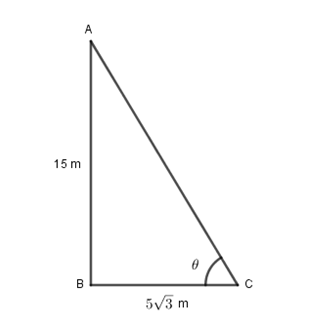
Length of the shadow of a 15 meters high pole is $ 5\sqrt 3 $ meters at 7’O clock in the morning. Then what is the angle of elevation of the Sun rays with the ground at that time?
Answer
 Verified
635.4k+ views
Hint: Here, draw a figure based on the statements given in question. Assume θ as the angle of elevation, and apply the ratio of tan θ. Compare the value of tan θ obtained with standard angle, and find the angle of elevation.
Complete step-by-step answer:
For applying trigonometric methods and standard values one angle of the triangle must be equal to 90°. Also the perpendicular and base of a triangle depends on angle, but hypotenuse remains fixed as this is the side opposite to 90°. In above problem, for ∠ C, base is BC and perpendicular is AB; but for ∠ A, base is AB and perpendicular is BC.
Let AB be the pole of height 15 m and BC be the shadow of the pole of length $ 5\sqrt 3 $ m.
Let θ be the angle of elevation of the Sun rays with the ground.
In triangle ABC,
For ∠ θ, Base = BC and Height = AB.
$ \tan \theta = \dfrac{{AB}}{{BC}} = \dfrac{{15m}}{{5\sqrt 3 m}} = \dfrac{3}{{\sqrt 3 }} = \sqrt 3 $
$ \Rightarrow $ tan θ = tan 60°
$\Rightarrow θ = 60° $ [tan 60° = √3]
Hence, the angle of elevation of the Sun rays with the ground is 60°.
Note: In these types of questions, always draw the rough figure to understand the question geometrically. Use trigonometric ratio as per convenience, i.e., first see which sides are given in question and use that trigonometric tool which includes both the sides. Here in this question, we can see that base and perpendicular are given with respect to angle; so we use here tan θ or cot θ.
Complete step-by-step answer:
For applying trigonometric methods and standard values one angle of the triangle must be equal to 90°. Also the perpendicular and base of a triangle depends on angle, but hypotenuse remains fixed as this is the side opposite to 90°. In above problem, for ∠ C, base is BC and perpendicular is AB; but for ∠ A, base is AB and perpendicular is BC.
Let AB be the pole of height 15 m and BC be the shadow of the pole of length $ 5\sqrt 3 $ m.
Let θ be the angle of elevation of the Sun rays with the ground.
In triangle ABC,
For ∠ θ, Base = BC and Height = AB.
$ \tan \theta = \dfrac{{AB}}{{BC}} = \dfrac{{15m}}{{5\sqrt 3 m}} = \dfrac{3}{{\sqrt 3 }} = \sqrt 3 $
$ \Rightarrow $ tan θ = tan 60°
$\Rightarrow θ = 60° $ [tan 60° = √3]
Hence, the angle of elevation of the Sun rays with the ground is 60°.
Note: In these types of questions, always draw the rough figure to understand the question geometrically. Use trigonometric ratio as per convenience, i.e., first see which sides are given in question and use that trigonometric tool which includes both the sides. Here in this question, we can see that base and perpendicular are given with respect to angle; so we use here tan θ or cot θ.
Recently Updated Pages
Find the greatest six digit number that is exactly class 8 maths CBSE

What is the time difference between India and Cana class 8 social science CBSE
Compare LPG and wood as fuels class 8 chemistry CBSE
In Indian rupees 1 trillion is equal to how many c class 8 maths CBSE
30 opposite words in English from a to z class 8 english CBSE
How many cubic feet equals to 1 unit sand class 8 maths CBSE
Trending doubts
What is BLO What is the full form of BLO class 8 social science CBSE
Citizens of India can vote at the age of A 18 years class 8 social science CBSE
Full form of STD, ISD and PCO
One cusec is equal to how many liters class 8 maths CBSE
What are the methods of reducing friction. Explain
What is the difference between rai and mustard see class 8 biology CBSE