




Length of the focal chords of the parabola ${{y}^{2}}=4ax$ at a distance p from the vertex is
A. $\dfrac{2{{a}^{2}}}{p}$
B. $\dfrac{{{a}^{2}}}{{{p}^{2}}}$
C. $\dfrac{4{{a}^{3}}}{{{p}^{2}}}$
D. $\dfrac{{{p}^{2}}}{a}$
Answer
 Verified
560.1k+ views
Hint: To solve this question, we Firstly derive the general coordinates for any ends of the focal chord on a parabola and then find the length of this line segment using the distance formula. Then we find the equation of the focal chord and then find its distance from the vertex and equate it to P. Now simplify the expression to derive the correct option.
Complete step-by-step solution:
The first step to solve this question is by deriving the general coordinates for any end of the focal chords.
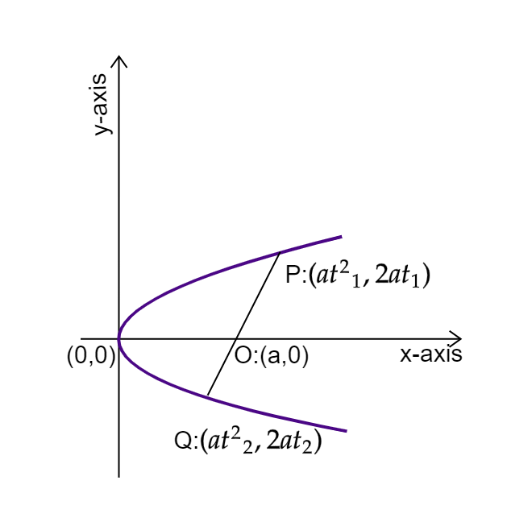
For the parabola, ${{y}^{2}}=4ax$
The general coordinates for the end of the focal chord are given by,
$P\left( a{{t}^{2}}_{1},2a{{t}_{1}} \right);Q\left( a{{t}^{2}}_{2},2a{{t}_{2}} \right)$
We also know that the slope of OP is equal to the slope of OQ.
And the relation between ${{t}_{1}},{{t}_{2}}$ is given by, ${{t}_{2}}=-\dfrac{1}{{{t}_{1}}}$
After substituting this relation, the coordinates will change accordingly as,
$P\left( a{{t}^{2}},2at \right);Q\left( \dfrac{a}{{{t}^{2}}},\dfrac{-2a}{t} \right)$
Now let us find the distance between these two points PQ which is also the length of the focal chord.
Let us denote it with F.
Upon substituting in the distance formula, we get,
$\Rightarrow F=\sqrt{{{\left( a{{t}^{2}}-\dfrac{a}{{{t}^{2}}} \right)}^{2}}+{{\left( 2at+\dfrac{2a}{t} \right)}^{2}}}$
Now let us simplify.
$\Rightarrow F=\sqrt{{{a}^{2}}{{\left( {{t}^{2}}-\dfrac{1}{{{t}^{2}}} \right)}^{2}}+{{\left( 2a \right)}^{2}}{{\left( t+\dfrac{1}{t} \right)}^{2}}}$
$\Rightarrow F=\sqrt{{{a}^{2}}{{\left( t-\dfrac{1}{t} \right)}^{2}}{{\left( t+\dfrac{1}{t} \right)}^{2}}+{{\left( 2a \right)}^{2}}{{\left( t+\dfrac{1}{t} \right)}^{2}}}$
Now take the common factors out.
$\Rightarrow F=\sqrt{{{a}^{2}}{{\left( t+\dfrac{1}{t} \right)}^{2}}\left[ {{\left( t-\dfrac{1}{t} \right)}^{2}}+4 \right]}$
Now cancel the square and the roots.
$\Rightarrow F=a\left( t+\dfrac{1}{t} \right)\sqrt{{{t}^{2}}+\dfrac{1}{{{t}^{2}}}-2+4}$
$\Rightarrow F=a\left( t+\dfrac{1}{t} \right)\sqrt{{{t}^{2}}+\dfrac{1}{{{t}^{2}}}+2}$
Now group the terms inside the square root.
$\Rightarrow F=a\left( t+\dfrac{1}{t} \right)\sqrt{{{\left( t+\dfrac{1}{t} \right)}^{2}}}$
$\Rightarrow F=a\left( t+\dfrac{1}{t} \right)\left( t+\dfrac{1}{t} \right)$
$\Rightarrow F=a{{\left( t+\dfrac{1}{t} \right)}^{2}}$
Now let us keep this aside for simplification purposes.
We have to find the line equation for the focal chord PQ.
It is given by,
$\Rightarrow y+\dfrac{2a}{t}=\dfrac{2at+\dfrac{2a}{t}}{a{{t}^{2}}-\dfrac{a}{{{t}^{2}}}}\left( x-\dfrac{a}{{{t}^{2}}} \right)$
Now simplify this further by canceling the common factors in the numerator and the denominator.
$\Rightarrow y+\dfrac{2a}{t}=\dfrac{2t+\dfrac{2}{t}}{{{t}^{2}}-\dfrac{1}{{{t}^{2}}}}\left( x-\dfrac{a}{{{t}^{2}}} \right)$
$\Rightarrow y+\dfrac{2a}{t}=\dfrac{\dfrac{2{{t}^{2}}+2}{t}}{\dfrac{{{t}^{4}}-1}{{{t}^{2}}}}\left( x-\dfrac{a}{{{t}^{2}}} \right)$
Now,
Rearrange the terms.
$\Rightarrow y+\dfrac{2a}{t}=\dfrac{2{{t}^{2}}+2}{\dfrac{{{t}^{4}}-1}{t}}\left( x-\dfrac{a}{{{t}^{2}}} \right)$
$\Rightarrow y\left( {{t}^{4}}-1 \right)+\dfrac{2a}{t}\left( {{t}^{4}}-1 \right)=2t\left( {{t}^{2}}+1 \right)\left( x-\dfrac{a}{{{t}^{2}}} \right)$
Now expand the terms.
$\Rightarrow y\left( {{t}^{2}}-1 \right)\left( {{t}^{2}}+1 \right)+\dfrac{2a}{t}\left( {{t}^{2}}-1 \right)\left( {{t}^{2}}+1 \right)=2t\left( {{t}^{2}}+1 \right)\left( x-\dfrac{a}{{{t}^{2}}} \right)$
Now cancel common terms on both sides of the equation.
$\Rightarrow y\left( {{t}^{2}}-1 \right)+\dfrac{2a}{t}\left( {{t}^{2}}-1 \right)=2t\left( x-\dfrac{a}{{{t}^{2}}} \right)$
$\Rightarrow y\left( {{t}^{2}}-1 \right)+\dfrac{2a}{t}\left( {{t}^{2}}-1 \right)=\left( 2tx-\dfrac{2a}{t} \right)$
Now open brackets.
$\Rightarrow 2tx-y\left( {{t}^{2}}-1 \right)-\dfrac{2at}{{{t}^{2}}}-\dfrac{2a{{t}^{2}}}{t}+\dfrac{2a}{t}=0$
$\Rightarrow 2tx-y\left( {{t}^{2}}-1 \right)-2at=0$
This is the equation of the focal chord.
It is given in the question that the distance from the vertex (0,0) to this line is P.
Now let us write this in the distance between point line formulas.
$\Rightarrow p=\left| \dfrac{-2at}{\sqrt{{{\left( 2t \right)}^{2}}+{{\left( {{t}^{2}}-1 \right)}^{2}}}} \right|$
Now,
$\Rightarrow p=\dfrac{2at}{\sqrt{4{{t}^{2}}+{{t}^{4}}-2{{t}^{2}}+1}}$
$\Rightarrow p=\dfrac{2at}{\sqrt{{{t}^{4}}+2{{t}^{2}}+1}}$
Now regroup the terms in the denominator.
$\Rightarrow p=\dfrac{2at}{\sqrt{{{\left( {{t}^{2}}+1 \right)}^{2}}}}$
$\Rightarrow p=\dfrac{2at}{\left( {{t}^{2}}+1 \right)}$
Now let us rearrange the terms.
$\Rightarrow \left( {{t}^{2}}+1 \right)=\dfrac{2at}{p}$
$\Rightarrow \dfrac{\left( {{t}^{2}}+1 \right)}{t}=\dfrac{2a}{p}$
$\Rightarrow t+\dfrac{1}{t}=\dfrac{2a}{p}$
Now substitute this in $F=a{{\left( t+\dfrac{1}{t} \right)}^{2}}$
$\Rightarrow F=a{{\left( \dfrac{2a}{p} \right)}^{2}}$
$\Rightarrow F=\dfrac{4{{a}^{3}}}{{{p}^{2}}}$
Hence, option C is correct.
Note: The given quadratic function is denoted by a parabola. Whenever there are any squares or roots in the expression, never solve them in the primary steps itself. Solve them in the end because there are most likely chances that they get cancelled out or simplified in the further processes.
Complete step-by-step solution:
The first step to solve this question is by deriving the general coordinates for any end of the focal chords.
For the parabola, ${{y}^{2}}=4ax$
The general coordinates for the end of the focal chord are given by,
$P\left( a{{t}^{2}}_{1},2a{{t}_{1}} \right);Q\left( a{{t}^{2}}_{2},2a{{t}_{2}} \right)$
We also know that the slope of OP is equal to the slope of OQ.
And the relation between ${{t}_{1}},{{t}_{2}}$ is given by, ${{t}_{2}}=-\dfrac{1}{{{t}_{1}}}$
After substituting this relation, the coordinates will change accordingly as,
$P\left( a{{t}^{2}},2at \right);Q\left( \dfrac{a}{{{t}^{2}}},\dfrac{-2a}{t} \right)$
Now let us find the distance between these two points PQ which is also the length of the focal chord.
Let us denote it with F.
Upon substituting in the distance formula, we get,
$\Rightarrow F=\sqrt{{{\left( a{{t}^{2}}-\dfrac{a}{{{t}^{2}}} \right)}^{2}}+{{\left( 2at+\dfrac{2a}{t} \right)}^{2}}}$
Now let us simplify.
$\Rightarrow F=\sqrt{{{a}^{2}}{{\left( {{t}^{2}}-\dfrac{1}{{{t}^{2}}} \right)}^{2}}+{{\left( 2a \right)}^{2}}{{\left( t+\dfrac{1}{t} \right)}^{2}}}$
$\Rightarrow F=\sqrt{{{a}^{2}}{{\left( t-\dfrac{1}{t} \right)}^{2}}{{\left( t+\dfrac{1}{t} \right)}^{2}}+{{\left( 2a \right)}^{2}}{{\left( t+\dfrac{1}{t} \right)}^{2}}}$
Now take the common factors out.
$\Rightarrow F=\sqrt{{{a}^{2}}{{\left( t+\dfrac{1}{t} \right)}^{2}}\left[ {{\left( t-\dfrac{1}{t} \right)}^{2}}+4 \right]}$
Now cancel the square and the roots.
$\Rightarrow F=a\left( t+\dfrac{1}{t} \right)\sqrt{{{t}^{2}}+\dfrac{1}{{{t}^{2}}}-2+4}$
$\Rightarrow F=a\left( t+\dfrac{1}{t} \right)\sqrt{{{t}^{2}}+\dfrac{1}{{{t}^{2}}}+2}$
Now group the terms inside the square root.
$\Rightarrow F=a\left( t+\dfrac{1}{t} \right)\sqrt{{{\left( t+\dfrac{1}{t} \right)}^{2}}}$
$\Rightarrow F=a\left( t+\dfrac{1}{t} \right)\left( t+\dfrac{1}{t} \right)$
$\Rightarrow F=a{{\left( t+\dfrac{1}{t} \right)}^{2}}$
Now let us keep this aside for simplification purposes.
We have to find the line equation for the focal chord PQ.
It is given by,
$\Rightarrow y+\dfrac{2a}{t}=\dfrac{2at+\dfrac{2a}{t}}{a{{t}^{2}}-\dfrac{a}{{{t}^{2}}}}\left( x-\dfrac{a}{{{t}^{2}}} \right)$
Now simplify this further by canceling the common factors in the numerator and the denominator.
$\Rightarrow y+\dfrac{2a}{t}=\dfrac{2t+\dfrac{2}{t}}{{{t}^{2}}-\dfrac{1}{{{t}^{2}}}}\left( x-\dfrac{a}{{{t}^{2}}} \right)$
$\Rightarrow y+\dfrac{2a}{t}=\dfrac{\dfrac{2{{t}^{2}}+2}{t}}{\dfrac{{{t}^{4}}-1}{{{t}^{2}}}}\left( x-\dfrac{a}{{{t}^{2}}} \right)$
Now,
Rearrange the terms.
$\Rightarrow y+\dfrac{2a}{t}=\dfrac{2{{t}^{2}}+2}{\dfrac{{{t}^{4}}-1}{t}}\left( x-\dfrac{a}{{{t}^{2}}} \right)$
$\Rightarrow y\left( {{t}^{4}}-1 \right)+\dfrac{2a}{t}\left( {{t}^{4}}-1 \right)=2t\left( {{t}^{2}}+1 \right)\left( x-\dfrac{a}{{{t}^{2}}} \right)$
Now expand the terms.
$\Rightarrow y\left( {{t}^{2}}-1 \right)\left( {{t}^{2}}+1 \right)+\dfrac{2a}{t}\left( {{t}^{2}}-1 \right)\left( {{t}^{2}}+1 \right)=2t\left( {{t}^{2}}+1 \right)\left( x-\dfrac{a}{{{t}^{2}}} \right)$
Now cancel common terms on both sides of the equation.
$\Rightarrow y\left( {{t}^{2}}-1 \right)+\dfrac{2a}{t}\left( {{t}^{2}}-1 \right)=2t\left( x-\dfrac{a}{{{t}^{2}}} \right)$
$\Rightarrow y\left( {{t}^{2}}-1 \right)+\dfrac{2a}{t}\left( {{t}^{2}}-1 \right)=\left( 2tx-\dfrac{2a}{t} \right)$
Now open brackets.
$\Rightarrow 2tx-y\left( {{t}^{2}}-1 \right)-\dfrac{2at}{{{t}^{2}}}-\dfrac{2a{{t}^{2}}}{t}+\dfrac{2a}{t}=0$
$\Rightarrow 2tx-y\left( {{t}^{2}}-1 \right)-2at=0$
This is the equation of the focal chord.
It is given in the question that the distance from the vertex (0,0) to this line is P.
Now let us write this in the distance between point line formulas.
$\Rightarrow p=\left| \dfrac{-2at}{\sqrt{{{\left( 2t \right)}^{2}}+{{\left( {{t}^{2}}-1 \right)}^{2}}}} \right|$
Now,
$\Rightarrow p=\dfrac{2at}{\sqrt{4{{t}^{2}}+{{t}^{4}}-2{{t}^{2}}+1}}$
$\Rightarrow p=\dfrac{2at}{\sqrt{{{t}^{4}}+2{{t}^{2}}+1}}$
Now regroup the terms in the denominator.
$\Rightarrow p=\dfrac{2at}{\sqrt{{{\left( {{t}^{2}}+1 \right)}^{2}}}}$
$\Rightarrow p=\dfrac{2at}{\left( {{t}^{2}}+1 \right)}$
Now let us rearrange the terms.
$\Rightarrow \left( {{t}^{2}}+1 \right)=\dfrac{2at}{p}$
$\Rightarrow \dfrac{\left( {{t}^{2}}+1 \right)}{t}=\dfrac{2a}{p}$
$\Rightarrow t+\dfrac{1}{t}=\dfrac{2a}{p}$
Now substitute this in $F=a{{\left( t+\dfrac{1}{t} \right)}^{2}}$
$\Rightarrow F=a{{\left( \dfrac{2a}{p} \right)}^{2}}$
$\Rightarrow F=\dfrac{4{{a}^{3}}}{{{p}^{2}}}$
Hence, option C is correct.
Note: The given quadratic function is denoted by a parabola. Whenever there are any squares or roots in the expression, never solve them in the primary steps itself. Solve them in the end because there are most likely chances that they get cancelled out or simplified in the further processes.
Recently Updated Pages
Master Class 11 Social Science: Engaging Questions & Answers for Success

Master Class 11 Physics: Engaging Questions & Answers for Success
Master Class 11 Maths: Engaging Questions & Answers for Success
Master Class 11 Economics: Engaging Questions & Answers for Success
Master Class 11 Computer Science: Engaging Questions & Answers for Success
Master Class 11 Chemistry: Engaging Questions & Answers for Success
Trending doubts
One Metric ton is equal to kg A 10000 B 1000 C 100 class 11 physics CBSE
There are 720 permutations of the digits 1 2 3 4 5 class 11 maths CBSE
1 Quintal is equal to a 110 kg b 10 kg c 100kg d 1000 class 11 physics CBSE
State and prove Bernoullis theorem class 11 physics CBSE
Difference Between Prokaryotic Cells and Eukaryotic Cells
Which among the following are examples of coming together class 11 social science CBSE