



: What is the length of the diagonal of the square whose area is 16900 square metres
[a] 130m
[b] $130\sqrt{2}m$
[c] 169m
[d] 144m
Answer
 Verified
642.6k+ views
Hint: Assume that the side of the square is “a” metres. Use the fact that the area of the square of side length a is given by $A={{a}^{2}}$. Equate this area to 16900 and hence form an equation in a. Use the fact that the length of the diagonal of a square of side length a is $a\sqrt{2}$. Hence find the length of the diagonal of the square. Alternatively, use the fact that if d is the length of the diagonal of a square, then the area of the square is given by $A=\dfrac{1}{2}{{d}^{2}}$. Hence form an equation in d. Solve for d and hence find the length of the diagonal of the square.
Complete step-by-step answer:
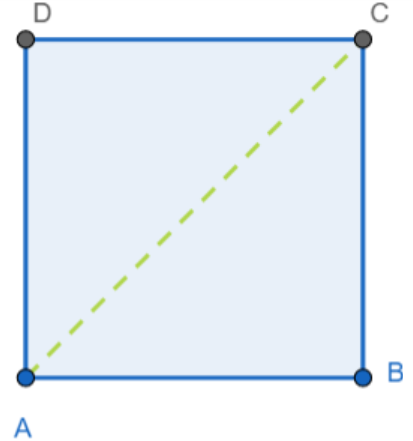
Given: ABCD is a square. The area of ABCD is equal to 16900 square metres.
To find: The length of the diagonal AC.
Let the length of the side AB of the square be x.
We know that the area of the square of side length a is given by $A={{a}^{2}}$
Hence, we have
$ar\left( ABCD \right)={{x}^{2}}$
Given that ar(ABCD) = 16900
Hence, we have
${{x}^{2}}=16900\Rightarrow x=\sqrt{16900}=130$
Hence the length of the side of the square is 130 metres.
We know that by Pythagora’s theorem, the square of the hypotenuse is equal to the sum of the square of its sides.
Applying Pythagora’s theorem in triangle ABC, we get
$A{{B}^{2}}+B{{C}^{2}}=A{{C}^{2}}$
Hence, we have
$A{{C}^{2}}={{130}^{2}}+{{130}^{2}}=2\times {{130}^{2}}$
Hence, we have
$AC=130\sqrt{2}$ metres.
Hence the length of the diagonal of the square is equal to $130\sqrt{2}$ metres.
Hence option [b] is correct.
Note: Alternative solution:
We know that if d is the length of the diagonal of a square, then the area of the square is given by $A=\dfrac{1}{2}{{d}^{2}}$.
Let the length of the diagonal of the square be d.
Hence, we have
$\begin{align}
& \dfrac{1}{2}{{d}^{2}}=16900 \\
& \Rightarrow {{d}^{2}}=2\times 16900 \\
& \Rightarrow d=130\sqrt{2} \\
\end{align}$
Hence the length of the diagonal of the square is $130\sqrt{2}$ metres, which is the same as obtained above.
Hence option [b] is correct.
Complete step-by-step answer:
Given: ABCD is a square. The area of ABCD is equal to 16900 square metres.
To find: The length of the diagonal AC.
Let the length of the side AB of the square be x.
We know that the area of the square of side length a is given by $A={{a}^{2}}$
Hence, we have
$ar\left( ABCD \right)={{x}^{2}}$
Given that ar(ABCD) = 16900
Hence, we have
${{x}^{2}}=16900\Rightarrow x=\sqrt{16900}=130$
Hence the length of the side of the square is 130 metres.
We know that by Pythagora’s theorem, the square of the hypotenuse is equal to the sum of the square of its sides.
Applying Pythagora’s theorem in triangle ABC, we get
$A{{B}^{2}}+B{{C}^{2}}=A{{C}^{2}}$
Hence, we have
$A{{C}^{2}}={{130}^{2}}+{{130}^{2}}=2\times {{130}^{2}}$
Hence, we have
$AC=130\sqrt{2}$ metres.
Hence the length of the diagonal of the square is equal to $130\sqrt{2}$ metres.
Hence option [b] is correct.
Note: Alternative solution:
We know that if d is the length of the diagonal of a square, then the area of the square is given by $A=\dfrac{1}{2}{{d}^{2}}$.
Let the length of the diagonal of the square be d.
Hence, we have
$\begin{align}
& \dfrac{1}{2}{{d}^{2}}=16900 \\
& \Rightarrow {{d}^{2}}=2\times 16900 \\
& \Rightarrow d=130\sqrt{2} \\
\end{align}$
Hence the length of the diagonal of the square is $130\sqrt{2}$ metres, which is the same as obtained above.
Hence option [b] is correct.
Recently Updated Pages
Master Class 11 English: Engaging Questions & Answers for Success

Master Class 11 Social Science: Engaging Questions & Answers for Success
Master Class 11 Maths: Engaging Questions & Answers for Success
Master Class 11 Biology: Engaging Questions & Answers for Success
Master Class 11 Physics: Engaging Questions & Answers for Success
Master Class 11 Chemistry: Engaging Questions & Answers for Success
Trending doubts