




What is the length of the diagonal of a rectangle whose width is \[90cm\]and whose length is \[200cm\]?
Answer
 Verified
540.9k+ views
Hint:
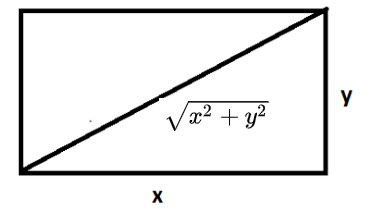
In rectangle we have two measurements \[length = x\] & \[width = y\], and the diagonal is a line which divide the rectangle into two equal right angled triangle
Now according to the Pythagoras Theorem, in a right-angled triangle, the square of the hypotenuse side is equal to the sum of squares of the other two sides.
Therefore, by applying the Pythagoras Theorem in rectangle, we get,
\[{(diagonal)^2} = {(length)^2} + {(width)^2}\]
By substituting the values from the above figure, we get
\[diagonal = \sqrt {{x^2} + {y^2}} \]
Formula used: \[{(diagonal)^2} = {(length)^2} + {(width)^2}\]
\[diagonal = \sqrt {{x^2} + {y^2}} \]
Where,
\[length = x\]
\[\text{width} = y\]
Complete step-by-step solution:
Given that the length of the rectangle is \[200cm\], the width of the rectangle is \[90cm\].
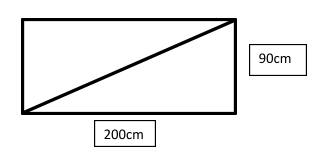
To find: The length of the diagonal of the rectangle.
Now, we shall get into the solution.
Step 1: According to the Pythagoras Theorem, we have
\[{(diagonal)^2} = {(length)^2} + {(width)^2}\]
Now taking square root on both sides we get
\[(diagonal) = \sqrt {{{(length)}^2} + {{(width)}^2}} \]
Step 2: On substituting the given values of length and width in the above formula, we get,
\[(diagonal) = \sqrt {{{(length)}^2} + {{(width)}^2}} \]
\[diagonal = \sqrt {{{(200)}^2} + {{(90)}^2}} \]
Step 3: On further simplification, we get,
\[diagonal = \sqrt {40000 + 8100} \]
\[diagonal = \sqrt {48100} \]
On solving, we get
\[diagonal = 219.317cm\]
Hence, the length of the diagonal of a rectangle whose width is \[90cm\] and whose length is \[200cm\] is equal to\[219.317cm\] which is the required answer.
Note: The Pythagoras Theorem can only be applied to those triangles in which the base of the triangle and one other side of the triangle is at right angles to each other and this type of triangle is known as right angled triangle. Here, in the rectangle the length and the width are at right angles to each other and therefore, we apply Pythagoras theorem.
In rectangle we have two measurements \[length = x\] & \[width = y\], and the diagonal is a line which divide the rectangle into two equal right angled triangle
Now according to the Pythagoras Theorem, in a right-angled triangle, the square of the hypotenuse side is equal to the sum of squares of the other two sides.
Therefore, by applying the Pythagoras Theorem in rectangle, we get,
\[{(diagonal)^2} = {(length)^2} + {(width)^2}\]
By substituting the values from the above figure, we get
\[diagonal = \sqrt {{x^2} + {y^2}} \]
Formula used: \[{(diagonal)^2} = {(length)^2} + {(width)^2}\]
\[diagonal = \sqrt {{x^2} + {y^2}} \]
Where,
\[length = x\]
\[\text{width} = y\]
Complete step-by-step solution:
Given that the length of the rectangle is \[200cm\], the width of the rectangle is \[90cm\].
To find: The length of the diagonal of the rectangle.
Now, we shall get into the solution.
Step 1: According to the Pythagoras Theorem, we have
\[{(diagonal)^2} = {(length)^2} + {(width)^2}\]
Now taking square root on both sides we get
\[(diagonal) = \sqrt {{{(length)}^2} + {{(width)}^2}} \]
Step 2: On substituting the given values of length and width in the above formula, we get,
\[(diagonal) = \sqrt {{{(length)}^2} + {{(width)}^2}} \]
\[diagonal = \sqrt {{{(200)}^2} + {{(90)}^2}} \]
Step 3: On further simplification, we get,
\[diagonal = \sqrt {40000 + 8100} \]
\[diagonal = \sqrt {48100} \]
On solving, we get
\[diagonal = 219.317cm\]
Hence, the length of the diagonal of a rectangle whose width is \[90cm\] and whose length is \[200cm\] is equal to\[219.317cm\] which is the required answer.
Note: The Pythagoras Theorem can only be applied to those triangles in which the base of the triangle and one other side of the triangle is at right angles to each other and this type of triangle is known as right angled triangle. Here, in the rectangle the length and the width are at right angles to each other and therefore, we apply Pythagoras theorem.
Recently Updated Pages
Master Class 12 Business Studies: Engaging Questions & Answers for Success

Master Class 12 Biology: Engaging Questions & Answers for Success
Master Class 12 Chemistry: Engaging Questions & Answers for Success
Class 12 Question and Answer - Your Ultimate Solutions Guide
Master Class 11 Social Science: Engaging Questions & Answers for Success
Master Class 11 English: Engaging Questions & Answers for Success
Trending doubts
Explain the Treaty of Vienna of 1815 class 10 social science CBSE
Who Won 36 Oscar Awards? Record Holder Revealed
What is the median of the first 10 natural numbers class 10 maths CBSE
Why is it 530 pm in india when it is 1200 afternoon class 10 social science CBSE
What is the full form of POSCO class 10 social science CBSE
The highest temperature in Karnataka is recorded in class 10 social science CBSE