




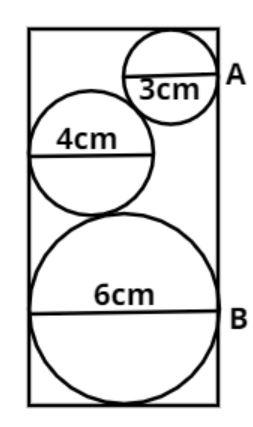
What is the length of AB in the below given figure?
Answer
 Verified
657.6k+ views
Hint: In this particular types of question use the concept of Pythagoras theorem i.e. ${\left( {{\text{hypotenuse}}} \right)^2} = {\left( {{\text{perpendicular}}} \right)^2} + {\left( {{\text{base}}} \right)^2}$ and use that the distance between the center of the two circle if they touch each other is the sum of the respective radii so use this concept to reach the solution of the question.
Complete step-by-step answer:
Given data:
Diameter of bigger circle = 6cm, therefore radius = 3cm
Diameter of the middle circle = 4 cm, therefore radius = 2cm
Diameter of the upper circle = 3 cm, therefore radius = 1.5cm.
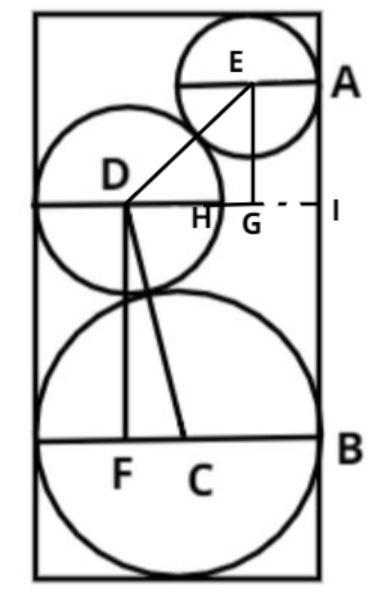
Let C, D and F be the center of the bigger, middle and upper circles respectively.
Draw perpendicular from the center of the middle circle to the lower circle as shown, let it cut the lower circle at point F
So, angle DFC = 90 degrees.
So distance CF = radius of the bigger circle – radius of the middle circle
Therefore, CF = 3 – 2 = 1cm.
Now join C and D as shown.
As C and D bot are centers so the distance CD = sum of the radius of the bigger and middle circles.
Therefore, CD = 3 + 2 = 5cm.
Now extend the diameter of the middle circle towards RHS and draw the perpendicular on this line from the center of the upper circle as shown; let it cut the line at point G.
So, angle EGD = 90 degrees.
Now from figure, GH = HI – GI
Now HI = 6 – 4 = 2cm, and GI = radius of the upper circle = 1.5cm.
Therefore, GH = 2 – 1.5 = 0.5cm
Therefore, DG = GH + DH = 0.5 + 2 = 2.5cm
And ED is distance between the centers of the upper and middle circle so,
ED = 1.5 + 2 = 3.5cm
Now in triangle DFC apply Pythagoras theorem we have,
$ \Rightarrow {\left( {{\text{hypotenuse}}} \right)^2} = {\left( {{\text{perpendicular}}} \right)^2} + {\left( {{\text{base}}} \right)^2}$
$ \Rightarrow {\left( {{\text{DC}}} \right)^2} = {\left( {{\text{DF}}} \right)^2} + {\left( {{\text{FC}}} \right)^2}$
Now substitute the values we have,
$ \Rightarrow {\left( {\text{5}} \right)^2} = {\left( {{\text{DF}}} \right)^2} + {\left( {\text{1}} \right)^2}$
$ \Rightarrow {\left( {{\text{DF}}} \right)^2} = 25 - 1 = 24$
$ \Rightarrow \left( {{\text{DF}}} \right) = \sqrt {24} = 2\sqrt 6 $ Cm
Now in triangle DEG apply Pythagoras theorem we have,
$ \Rightarrow {\left( {{\text{hypotenuse}}} \right)^2} = {\left( {{\text{perpendicular}}} \right)^2} + {\left( {{\text{base}}} \right)^2}$
$ \Rightarrow {\left( {{\text{ED}}} \right)^2} = {\left( {{\text{GE}}} \right)^2} + {\left( {{\text{DG}}} \right)^2}$
Now substitute the values we have,
$ \Rightarrow {\left( {{\text{3}}{\text{.5}}} \right)^2} = {\left( {{\text{EG}}} \right)^2} + {\left( {2.5} \right)^2}$
$ \Rightarrow {\left( {{\text{EG}}} \right)^2} = {\left( {{\text{3}}{\text{.5}}} \right)^2} - {\left( {2.5} \right)^2} = 6$
$ \Rightarrow \left( {{\text{EG}}} \right) = \sqrt 6 $
So the distance AB = DF + EG = $2\sqrt 6 + \sqrt 6 = 3\sqrt 6 $ Cm.
So this is the required answer.
Note – Whenever we face such types of questions the key concept we have to remember is that to solve this problem construction is the key, so construct the diagram as above and calculate all the values required to solve the right triangles in the figure so that we can apply Pythagoras theorem and calculate the distance of DF and EG, effectively AB.
Complete step-by-step answer:
Given data:
Diameter of bigger circle = 6cm, therefore radius = 3cm
Diameter of the middle circle = 4 cm, therefore radius = 2cm
Diameter of the upper circle = 3 cm, therefore radius = 1.5cm.
Let C, D and F be the center of the bigger, middle and upper circles respectively.
Draw perpendicular from the center of the middle circle to the lower circle as shown, let it cut the lower circle at point F
So, angle DFC = 90 degrees.
So distance CF = radius of the bigger circle – radius of the middle circle
Therefore, CF = 3 – 2 = 1cm.
Now join C and D as shown.
As C and D bot are centers so the distance CD = sum of the radius of the bigger and middle circles.
Therefore, CD = 3 + 2 = 5cm.
Now extend the diameter of the middle circle towards RHS and draw the perpendicular on this line from the center of the upper circle as shown; let it cut the line at point G.
So, angle EGD = 90 degrees.
Now from figure, GH = HI – GI
Now HI = 6 – 4 = 2cm, and GI = radius of the upper circle = 1.5cm.
Therefore, GH = 2 – 1.5 = 0.5cm
Therefore, DG = GH + DH = 0.5 + 2 = 2.5cm
And ED is distance between the centers of the upper and middle circle so,
ED = 1.5 + 2 = 3.5cm
Now in triangle DFC apply Pythagoras theorem we have,
$ \Rightarrow {\left( {{\text{hypotenuse}}} \right)^2} = {\left( {{\text{perpendicular}}} \right)^2} + {\left( {{\text{base}}} \right)^2}$
$ \Rightarrow {\left( {{\text{DC}}} \right)^2} = {\left( {{\text{DF}}} \right)^2} + {\left( {{\text{FC}}} \right)^2}$
Now substitute the values we have,
$ \Rightarrow {\left( {\text{5}} \right)^2} = {\left( {{\text{DF}}} \right)^2} + {\left( {\text{1}} \right)^2}$
$ \Rightarrow {\left( {{\text{DF}}} \right)^2} = 25 - 1 = 24$
$ \Rightarrow \left( {{\text{DF}}} \right) = \sqrt {24} = 2\sqrt 6 $ Cm
Now in triangle DEG apply Pythagoras theorem we have,
$ \Rightarrow {\left( {{\text{hypotenuse}}} \right)^2} = {\left( {{\text{perpendicular}}} \right)^2} + {\left( {{\text{base}}} \right)^2}$
$ \Rightarrow {\left( {{\text{ED}}} \right)^2} = {\left( {{\text{GE}}} \right)^2} + {\left( {{\text{DG}}} \right)^2}$
Now substitute the values we have,
$ \Rightarrow {\left( {{\text{3}}{\text{.5}}} \right)^2} = {\left( {{\text{EG}}} \right)^2} + {\left( {2.5} \right)^2}$
$ \Rightarrow {\left( {{\text{EG}}} \right)^2} = {\left( {{\text{3}}{\text{.5}}} \right)^2} - {\left( {2.5} \right)^2} = 6$
$ \Rightarrow \left( {{\text{EG}}} \right) = \sqrt 6 $
So the distance AB = DF + EG = $2\sqrt 6 + \sqrt 6 = 3\sqrt 6 $ Cm.
So this is the required answer.
Note – Whenever we face such types of questions the key concept we have to remember is that to solve this problem construction is the key, so construct the diagram as above and calculate all the values required to solve the right triangles in the figure so that we can apply Pythagoras theorem and calculate the distance of DF and EG, effectively AB.
Recently Updated Pages
Class 10 Question and Answer - Your Ultimate Solutions Guide

Master Class 10 Computer Science: Engaging Questions & Answers for Success
Master Class 10 General Knowledge: Engaging Questions & Answers for Success
Master Class 12 Economics: Engaging Questions & Answers for Success
Master Class 12 Social Science: Engaging Questions & Answers for Success
Master Class 12 English: Engaging Questions & Answers for Success
Trending doubts
Explain the Treaty of Vienna of 1815 class 10 social science CBSE
The slogan Jai Hind was given by A Lal Bahadur Shastri class 10 social science CBSE
10 examples of evaporation in daily life with explanations
What is the full form of POSCO class 10 social science CBSE
Identify the feminine form of noun nephew a shenephew class 10 english CBSE
CSIR full form?