




$\left| {x - 1} \right| + \left| {x + 2} \right| \geqslant 3$ , then the complete solution set of this inequality is?
(The question has multiple correct options.)
A) $[1,\infty )$
B) $( - \infty , - 2]$
C) $R$
D) $[ - 2,1]$
Answer
 Verified
545.7k+ views
Hint: Separate an inequality into two inequalities before attempting to solve it. Many basic inequalities may be overcome by inserting or subtracting all sides before the element is all that remains. Then we decide if the solution should be a fixed union ("or") or a set intersection ("and").
Complete step by step solution:
The absolute value or modulus of a real number $x$, denoted $\left| x \right|$ , is the non-negative value of $x$ regardless of its symbol. In other words, if $x$ is positive, $\left| x \right| = x$ , and if $x$ is negative (in which case $ - x$ is positive), $\left| x \right| = - x$ .
Hence, there are two cases :
Case 1 : when it is positive
$
\Rightarrow x - 1 + x + 2 \geqslant 3 \\
\Rightarrow 2x + 1 \geqslant 3 \\
\Rightarrow 2x \geqslant 3 - 1 \\
\Rightarrow 2x \geqslant 2 \\
\Rightarrow x \geqslant 1 \\
$
Now, since $x \geqslant 1$ , we get $x \in [1,\infty )$
Case 2: When it is negative
$
\Rightarrow x - 1 + x + 2 \leqslant - 3 \\
\Rightarrow 2x + 1 \leqslant - 3 \\
\Rightarrow 2x \leqslant - 4 \\
\Rightarrow x \leqslant - 2 \\
$
Now, since $x \leqslant - 2$, we get $x \in ( - \infty , - 2]$
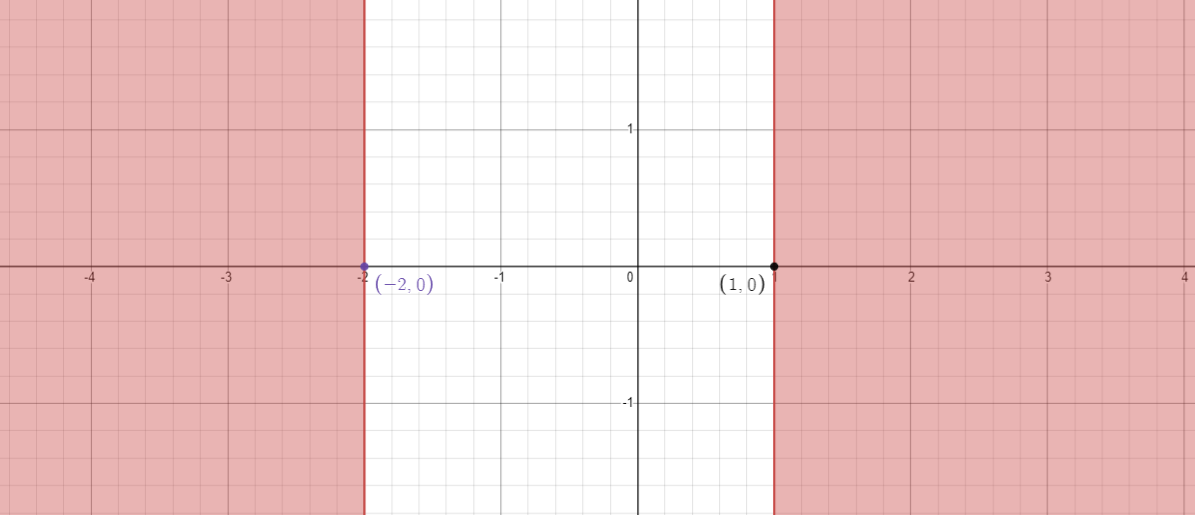
When we combine the above two cases we get, $x \in ( - \infty , - 2] \cup [1,\infty )$
Hence, the correct options are A) $[1,\infty )$ and B) $( - \infty , - 2]$.
The graph of the region (red color) is shown in the below figure.
Note:
If the absolute value expression equals a negative number, the equation has no solution since an absolute value can never be negative. An absolute value inequality can be expressed as a compound inequality.
Complete step by step solution:
The absolute value or modulus of a real number $x$, denoted $\left| x \right|$ , is the non-negative value of $x$ regardless of its symbol. In other words, if $x$ is positive, $\left| x \right| = x$ , and if $x$ is negative (in which case $ - x$ is positive), $\left| x \right| = - x$ .
Hence, there are two cases :
Case 1 : when it is positive
$
\Rightarrow x - 1 + x + 2 \geqslant 3 \\
\Rightarrow 2x + 1 \geqslant 3 \\
\Rightarrow 2x \geqslant 3 - 1 \\
\Rightarrow 2x \geqslant 2 \\
\Rightarrow x \geqslant 1 \\
$
Now, since $x \geqslant 1$ , we get $x \in [1,\infty )$
Case 2: When it is negative
$
\Rightarrow x - 1 + x + 2 \leqslant - 3 \\
\Rightarrow 2x + 1 \leqslant - 3 \\
\Rightarrow 2x \leqslant - 4 \\
\Rightarrow x \leqslant - 2 \\
$
Now, since $x \leqslant - 2$, we get $x \in ( - \infty , - 2]$
When we combine the above two cases we get, $x \in ( - \infty , - 2] \cup [1,\infty )$
Hence, the correct options are A) $[1,\infty )$ and B) $( - \infty , - 2]$.
The graph of the region (red color) is shown in the below figure.
Note:
If the absolute value expression equals a negative number, the equation has no solution since an absolute value can never be negative. An absolute value inequality can be expressed as a compound inequality.
Recently Updated Pages
Master Class 11 Social Science: Engaging Questions & Answers for Success

Master Class 11 English: Engaging Questions & Answers for Success
Master Class 11 Maths: Engaging Questions & Answers for Success
Master Class 11 Chemistry: Engaging Questions & Answers for Success
Master Class 11 Biology: Engaging Questions & Answers for Success
Master Class 11 Physics: Engaging Questions & Answers for Success
Trending doubts
Differentiate between an exothermic and an endothermic class 11 chemistry CBSE
One Metric ton is equal to kg A 10000 B 1000 C 100 class 11 physics CBSE
Difference Between Prokaryotic Cells and Eukaryotic Cells
There are 720 permutations of the digits 1 2 3 4 5 class 11 maths CBSE
Draw a diagram of a plant cell and label at least eight class 11 biology CBSE
Which chemical is known as king of chemicals A H 2 class 11 chemistry CBSE