




Largest cell of the ovule is
A. Spore cell
B. Antipodal cell
C. Central cell
D. Size of cells variable
Answer
 Verified
533.4k+ views
Hint: In seed plants, the ovule is the structure that offers rise to and contains the feminine generative cells. It consists of 3 parts: the covering, forming its outer layer, the plant structure, and therefore the feminine plant life in its center.
Complete answer:
The ovule is the structure in seed plants that gives rise to and contains female reproductive cells. It is made up of three layers: the integument on the outside, the nucellus (or megasporangium remnant), and the female gametophyte (formed from a haploid megaspore) in the middle.
The ovule is found inside the gynoecium, which is a part of the flower in flowering plants. The gynoecium's ovary produces one or more ovules, which eventually become the fruit wall. A stalk-like structure known as a funiculus connects ovules to the placenta in the ovary (plural, funiculi).
1. A spore cell is created within the plant structure. The spore cell is diploid and undergoes meiosis to make four haploid megaspores.
2. Antipodal cells are a unit gift within the embryo sac towards the chalazal pole. These area units are typically 3 in variety.
3. Central cell is the largest cell of the ovule that is given within the centre of the embryo sac. It contains 2 polar nuclei that get consolidated to make a diploid secondary nucleus.
In animals, egg cells also are called ova (singular egg cell, from the Latin word egg cell which means ('egg'). The term ovule in Associate in Nursing Imals is employed for the young egg cell of an animal. In vertebrates, ova area unit made by feminine gonads (sex glands) known as ovaries. variety of ova area unit gift at birth in mammals and mature via gametogenesis.
so, The largest cell of the ovule, located in the center of the embryo sac, is known as the central cell. It has two polar nuclei that are fused together to form a diploid secondary nucleus.
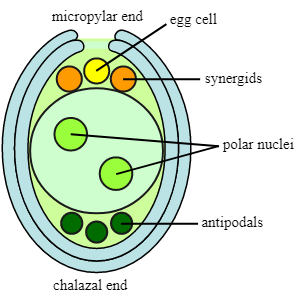
Hence, the choice C: central cell is correct.
Note:
Double fertilization may be an advanced fertilization mechanism of flowering plants' angiosperms. This method involves the connexion of a feminine plant life (megagametophyte, additionally known as the embryo sac) with 2 male gametes (sperm). It begins once a spore grain adheres to the stigma of the pistil, the feminine plant organ of a flower.
Complete answer:
The ovule is the structure in seed plants that gives rise to and contains female reproductive cells. It is made up of three layers: the integument on the outside, the nucellus (or megasporangium remnant), and the female gametophyte (formed from a haploid megaspore) in the middle.
The ovule is found inside the gynoecium, which is a part of the flower in flowering plants. The gynoecium's ovary produces one or more ovules, which eventually become the fruit wall. A stalk-like structure known as a funiculus connects ovules to the placenta in the ovary (plural, funiculi).
1. A spore cell is created within the plant structure. The spore cell is diploid and undergoes meiosis to make four haploid megaspores.
2. Antipodal cells are a unit gift within the embryo sac towards the chalazal pole. These area units are typically 3 in variety.
3. Central cell is the largest cell of the ovule that is given within the centre of the embryo sac. It contains 2 polar nuclei that get consolidated to make a diploid secondary nucleus.
In animals, egg cells also are called ova (singular egg cell, from the Latin word egg cell which means ('egg'). The term ovule in Associate in Nursing Imals is employed for the young egg cell of an animal. In vertebrates, ova area unit made by feminine gonads (sex glands) known as ovaries. variety of ova area unit gift at birth in mammals and mature via gametogenesis.
so, The largest cell of the ovule, located in the center of the embryo sac, is known as the central cell. It has two polar nuclei that are fused together to form a diploid secondary nucleus.
Hence, the choice C: central cell is correct.
Note:
Double fertilization may be an advanced fertilization mechanism of flowering plants' angiosperms. This method involves the connexion of a feminine plant life (megagametophyte, additionally known as the embryo sac) with 2 male gametes (sperm). It begins once a spore grain adheres to the stigma of the pistil, the feminine plant organ of a flower.
Recently Updated Pages
Master Class 5 English: Engaging Questions & Answers for Success

Master Class 5 Maths: Engaging Questions & Answers for Success
Master Class 5 Social Science: Engaging Questions & Answers for Success
Master Class 5 Science: Engaging Questions & Answers for Success
Class 5 Question and Answer - Your Ultimate Solutions Guide
Master Class 9 General Knowledge: Engaging Questions & Answers for Success
Trending doubts
Which are the Top 10 Largest Countries of the World?
The total number of vertebrae in man is a30 b31 c32 class 12 biology CBSE
Draw a labelled sketch of the human eye class 12 physics CBSE
The number of cranial nerves in a frog is A 10 pairs class 12 biology CBSE
Differentiate between homogeneous and heterogeneous class 12 chemistry CBSE
Antibodies present in colostrum which protect the new class 12 biology CBSE