




How do you know that the given angles are supplementary?
Answer
 Verified
592.8k+ views
Hint: For solving this question, we must know about the supplementary angles. The angles that measure up to 180 degrees are termed as Supplementary angles. If the given two angles are supplementary then their adjacent or their non-shared sides generally form a straight line.
Complete step-by-step answer:
The angles are said to be supplementary only when –
One of its angles is an acute angle while the other angle is an obtuse angle.
Both of the angles are right angles.
This, means that $ \angle A + \angle B = {180^0} $
For better understanding we will see the next example.
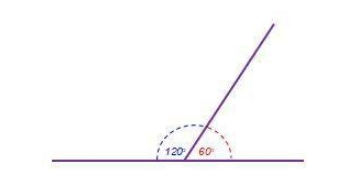
About the supplementary angle theorem
The supplementary angle theorem suggests that if the given two angles are supplementary to the same angle, then these two angles are said to be congruent.
Properties of Supplementary angles:
I.Given two angles are supplementary angles only when their sum is 180°.
II.These two angles must make together a straight line, but the angles need not be together.
III.In supplementary angles the “S” stands for the “Straight” line. This means they must form 180°.
Some of the basic examples of supplementary angles are as follows:
$ \bullet \,\,\,{132^0} + \,\,{48^0} = \,{180^0} $
$ \bullet \,\,\,{90^0} + \,\,{90^0} = \,{180^0} $
$ \bullet \,\,\,{110^0} + \,\,{70^0} = \,{180^0} $
$ \bullet \,\,\,{120^0} + \,\,{60^0} = \,{180^0} $
How to find the Supplementary angles:-
We generally know that the sum of two supplementary angles is $ {180^0} $
Hence, $ \angle A + \angle B = {180^0} $
Or $ \angle A = {180^0} - \angle B $
Note: For solving this question, we must have the basic knowledge about the supplementary angles, and some basic mathematical formulae. The importance of supplementary angles is that they can be used to find the other angles.
Complete step-by-step answer:
The angles are said to be supplementary only when –
One of its angles is an acute angle while the other angle is an obtuse angle.
Both of the angles are right angles.
This, means that $ \angle A + \angle B = {180^0} $
For better understanding we will see the next example.
About the supplementary angle theorem
The supplementary angle theorem suggests that if the given two angles are supplementary to the same angle, then these two angles are said to be congruent.
Properties of Supplementary angles:
I.Given two angles are supplementary angles only when their sum is 180°.
II.These two angles must make together a straight line, but the angles need not be together.
III.In supplementary angles the “S” stands for the “Straight” line. This means they must form 180°.
Some of the basic examples of supplementary angles are as follows:
$ \bullet \,\,\,{132^0} + \,\,{48^0} = \,{180^0} $
$ \bullet \,\,\,{90^0} + \,\,{90^0} = \,{180^0} $
$ \bullet \,\,\,{110^0} + \,\,{70^0} = \,{180^0} $
$ \bullet \,\,\,{120^0} + \,\,{60^0} = \,{180^0} $
How to find the Supplementary angles:-
We generally know that the sum of two supplementary angles is $ {180^0} $
Hence, $ \angle A + \angle B = {180^0} $
Or $ \angle A = {180^0} - \angle B $
Note: For solving this question, we must have the basic knowledge about the supplementary angles, and some basic mathematical formulae. The importance of supplementary angles is that they can be used to find the other angles.

Recently Updated Pages
Master Class 12 Economics: Engaging Questions & Answers for Success

Master Class 12 English: Engaging Questions & Answers for Success
Master Class 12 Social Science: Engaging Questions & Answers for Success
Master Class 12 Maths: Engaging Questions & Answers for Success
Master Class 12 Physics: Engaging Questions & Answers for Success
Master Class 8 English: Engaging Questions & Answers for Success
Trending doubts
What is BLO What is the full form of BLO class 8 social science CBSE
Citizens of India can vote at the age of A 18 years class 8 social science CBSE
Right to vote is a AFundamental Right BFundamental class 8 social science CBSE
Full form of STD, ISD and PCO
What is the area formula of an obtuse triangle class 8 maths CBSE
Give me the opposite gender of Duck class 8 english CBSE