




What do you know about immunity? Name two human vaccines and clarify their importance.
Answer
 Verified
539.7k+ views
Hint: Immunity is a well-known term which everyone is aware of. Immunity describes the defense mechanism of our body or human beings. It is present in almost all animals or organisms. Every organism is born with some kind of immunity and some immunity gets adapted as organisms grow up. Humans are born with inborn immunity which is known as innate immunity which passes on from mother’s body to offspring.
Complete answer:
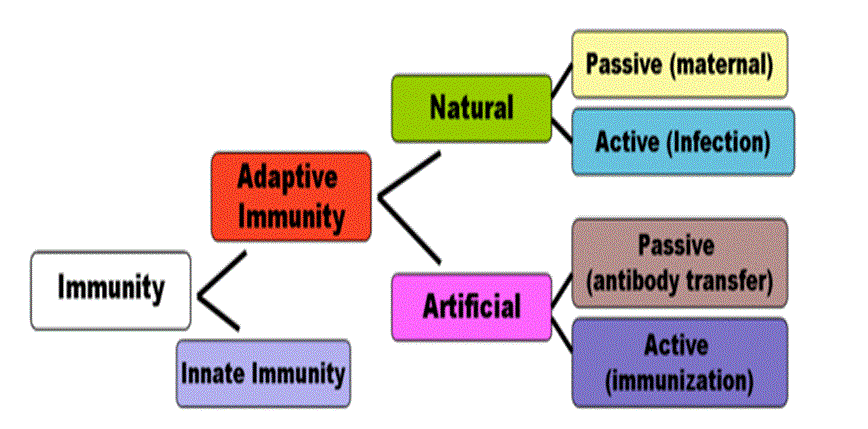
There are two types of immunity which are- Innate immunity and adaptive immunity. Innate immunity is the kind of immunity which is present since birth. It is the primary level of immunity. Innate immunity examples are- monocytes. Monocytes are cells of the immune system that represent immune effector cells with chemokine receptors. It has pathogen detector receptors which immediately recognize and attack the invader and kill it. Innate immunity alone cannot defend a lot of invaders hence some outer immunity or mechanisms are required.
The outer help is the adaptive immunity. As the name suggests-adaptive means a person or organism adapts according to their growth from diet or nutrients which they uptake. Adaptive immunity is stronger than innate immunity. It can help to fight serious health causing microbes or bacteria which can be harmful to the body. Antibiotics, probiotics, and vitamins also help in boosting immunity.
The two human vaccines are extracted from adaptive immunity which are involved in T cells and B cells formation. One is Hepatitis B vaccine which is used for prevention of Hepatitis B infection and another is Hepatitis A used for preventing Hepatitis A infection. DPT vaccines which act against diseases such as tetanus, diphtheria and whooping cough.
Note:
Apart from innate and adaptive, there are other lines of defense in the body. The first line of defense is the mucus, sweat, tears. Mucus is present in the nostrils which prevents the microbial entering, tears is present in lacrimal glands in the eyes, sweat is nothing but water draining from our body which cleans off the skin from impurities. Body hair present on the upper surface protects the body from microbes as it helps in sticking the organisms with sweat.
Complete answer:
There are two types of immunity which are- Innate immunity and adaptive immunity. Innate immunity is the kind of immunity which is present since birth. It is the primary level of immunity. Innate immunity examples are- monocytes. Monocytes are cells of the immune system that represent immune effector cells with chemokine receptors. It has pathogen detector receptors which immediately recognize and attack the invader and kill it. Innate immunity alone cannot defend a lot of invaders hence some outer immunity or mechanisms are required.
The outer help is the adaptive immunity. As the name suggests-adaptive means a person or organism adapts according to their growth from diet or nutrients which they uptake. Adaptive immunity is stronger than innate immunity. It can help to fight serious health causing microbes or bacteria which can be harmful to the body. Antibiotics, probiotics, and vitamins also help in boosting immunity.
The two human vaccines are extracted from adaptive immunity which are involved in T cells and B cells formation. One is Hepatitis B vaccine which is used for prevention of Hepatitis B infection and another is Hepatitis A used for preventing Hepatitis A infection. DPT vaccines which act against diseases such as tetanus, diphtheria and whooping cough.
Note:
Apart from innate and adaptive, there are other lines of defense in the body. The first line of defense is the mucus, sweat, tears. Mucus is present in the nostrils which prevents the microbial entering, tears is present in lacrimal glands in the eyes, sweat is nothing but water draining from our body which cleans off the skin from impurities. Body hair present on the upper surface protects the body from microbes as it helps in sticking the organisms with sweat.
Recently Updated Pages
Master Class 12 Business Studies: Engaging Questions & Answers for Success

Master Class 12 Chemistry: Engaging Questions & Answers for Success
Master Class 12 Biology: Engaging Questions & Answers for Success
Class 12 Question and Answer - Your Ultimate Solutions Guide
Master Class 11 English: Engaging Questions & Answers for Success
Master Class 11 Social Science: Engaging Questions & Answers for Success
Trending doubts
Which are the Top 10 Largest Countries of the World?
The total number of vertebrae in man is a30 b31 c32 class 12 biology CBSE
Draw a labelled sketch of the human eye class 12 physics CBSE
The number of cranial nerves in a frog is A 10 pairs class 12 biology CBSE
Differentiate between homogeneous and heterogeneous class 12 chemistry CBSE
Differentiate between Pyramid of energy and pyramid class 12 biology CBSE