




What kind of lens is used in making a pinhole camera?
$\left( a \right)$ Concave lens.
$\left( b \right)$ Convex lens.
$\left( c \right)$ Concavo-convex lens.
$\left( d \right)$ No lens is used.
Answer
 Verified
607.8k+ views
Hint: This is also another type of camera, and the image is obtained on the screen. Also we should know that the size of the image will be smaller than the actual object. This camera is sometimes used as a surveillance. So by using all this information, we can answer this question.
Complete Step by Step Solution: A pinhole camera is a simple camera without a lens, but has a tiny aperture (a pin-hole). A light proof box with a small hole on one side is placed on a side (behind the pin-hole). Light from a source passes through the aperture and projects an inverted image on the opposite side of the box, which is known as the camera obscura.
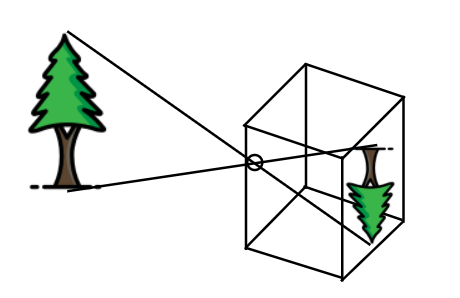
As it is clear in the definition, the option $\left( d \right)$ is correct as a pin-hole camera has no lens.
Additional information: The camera obscure or pin-hole image is a natural optical phenomenon.
The first known description of pinhole photography is found in the book ‘The stereoscope’ by Scottish inventor David Brewster. Sir William Crookes and William de Wirelessly Abney were other early photographers to try the pinhole technique.
We can see the image of a pinhole camera with the help of a translucent screen or we can even trace the image in paper. This type of camera is basically used to study the movement of the sun for a long period of time. People all over the world even celebrate Pinhole Photography Day which comes on last Sunday of April, every year.
Pinhole photographs have nearly infinite depth of field, everything appears to be in focus.
Exposure times are usually long, resulting in motion blur around moving and absence of objects that moved too fast.
Note: we have to see that understanding the definition of the pin-hole camera, and now-a-days we can even find some lenses which can give an effect of pin-hole camera in a digital camera. But that doesn’t make it a pin-hole camera as a whole. A pin-hole camera has no lens in it.
Complete Step by Step Solution: A pinhole camera is a simple camera without a lens, but has a tiny aperture (a pin-hole). A light proof box with a small hole on one side is placed on a side (behind the pin-hole). Light from a source passes through the aperture and projects an inverted image on the opposite side of the box, which is known as the camera obscura.
As it is clear in the definition, the option $\left( d \right)$ is correct as a pin-hole camera has no lens.
Additional information: The camera obscure or pin-hole image is a natural optical phenomenon.
The first known description of pinhole photography is found in the book ‘The stereoscope’ by Scottish inventor David Brewster. Sir William Crookes and William de Wirelessly Abney were other early photographers to try the pinhole technique.
We can see the image of a pinhole camera with the help of a translucent screen or we can even trace the image in paper. This type of camera is basically used to study the movement of the sun for a long period of time. People all over the world even celebrate Pinhole Photography Day which comes on last Sunday of April, every year.
Pinhole photographs have nearly infinite depth of field, everything appears to be in focus.
Exposure times are usually long, resulting in motion blur around moving and absence of objects that moved too fast.
Note: we have to see that understanding the definition of the pin-hole camera, and now-a-days we can even find some lenses which can give an effect of pin-hole camera in a digital camera. But that doesn’t make it a pin-hole camera as a whole. A pin-hole camera has no lens in it.
Recently Updated Pages
Master Class 12 Economics: Engaging Questions & Answers for Success

Master Class 12 Social Science: Engaging Questions & Answers for Success
Master Class 12 English: Engaging Questions & Answers for Success
Master Class 12 Maths: Engaging Questions & Answers for Success
Master Class 12 Physics: Engaging Questions & Answers for Success
Master Class 12 Biology: Engaging Questions & Answers for Success
Trending doubts
Draw a labelled sketch of the human eye class 12 physics CBSE
Which are the Top 10 Largest Countries of the World?
Draw ray diagrams each showing i myopic eye and ii class 12 physics CBSE
Which is the correct genotypic ratio of mendel dihybrid class 12 biology CBSE
Differentiate between homogeneous and heterogeneous class 12 chemistry CBSE
Give 10 examples of unisexual and bisexual flowers