




What kind of glands are mammary glands?
Answer
 Verified
622.2k+ views
Hint: Mammary glands are the glands that are characteristic features of mammals. There are two types of glands: exocrine and endocrine glands. Exocrine glands are known for secreting their products into ducts while in endocrine glands , ducts are not present.
Complete answer:
Mammary glands are those organs that, in the female, are known for secreting milk for sustaining the young ones. They are exocrine glands as they secrete their product i.e., milk in ducts. These exocrine glands are characteristic of mammals, giving this class its name. They are derived from the modification of sweat glands.
Mammary glands are milk producing glands that are functional in female mammals and are present in rudimentary or non-functional form in males. Endocrine system is known to regulate the function of mammary glands. These glands become functional due to hormonal changes caused during parturition. Mammary glands are composed of alveoli (hollow cavities) that are lined by cuboidal cells that secrete milk and surrounded by myoepithelial cells. These alveoli clump together to form lobules and each lobule consists of lactiferous duct that drains into the opening in the nipple. Milk is pushed towards the nipple from alveoli through lactiferous ducts. This process is carried out by the contraction of myoepithelial cells. A simple mammary gland is composed of a single lactiferous duct while in a complex mammary gland, one nipple is served by all the simple mammary glands.
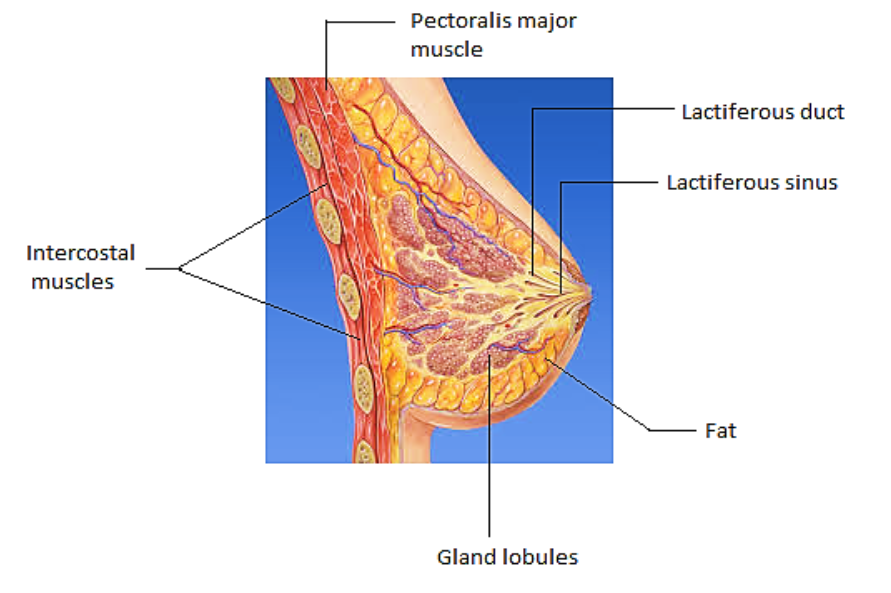
Note: Mammary glands being the characteristic feature of mammals are known to secrete milk in ducts making them exocrine glands. Their function is regulated by hormonal changes associated with parturition.
Complete answer:
Mammary glands are those organs that, in the female, are known for secreting milk for sustaining the young ones. They are exocrine glands as they secrete their product i.e., milk in ducts. These exocrine glands are characteristic of mammals, giving this class its name. They are derived from the modification of sweat glands.
Mammary glands are milk producing glands that are functional in female mammals and are present in rudimentary or non-functional form in males. Endocrine system is known to regulate the function of mammary glands. These glands become functional due to hormonal changes caused during parturition. Mammary glands are composed of alveoli (hollow cavities) that are lined by cuboidal cells that secrete milk and surrounded by myoepithelial cells. These alveoli clump together to form lobules and each lobule consists of lactiferous duct that drains into the opening in the nipple. Milk is pushed towards the nipple from alveoli through lactiferous ducts. This process is carried out by the contraction of myoepithelial cells. A simple mammary gland is composed of a single lactiferous duct while in a complex mammary gland, one nipple is served by all the simple mammary glands.
Note: Mammary glands being the characteristic feature of mammals are known to secrete milk in ducts making them exocrine glands. Their function is regulated by hormonal changes associated with parturition.
Recently Updated Pages
Master Class 11 English: Engaging Questions & Answers for Success

Master Class 11 Social Science: Engaging Questions & Answers for Success
Master Class 11 Maths: Engaging Questions & Answers for Success
Master Class 11 Biology: Engaging Questions & Answers for Success
Master Class 11 Physics: Engaging Questions & Answers for Success
Master Class 11 Chemistry: Engaging Questions & Answers for Success
Trending doubts
Find the value of the expression given below sin 30circ class 11 maths CBSE
Draw a diagram of a plant cell and label at least eight class 11 biology CBSE
Agaragar is obtained from A Chlorella B Spirogyra C class 11 biology CBSE
Agaragar is derived from a A fungi b An algae c Both class 11 biology CBSE
How do I convert ms to kmh Give an example class 11 physics CBSE
In which country Lascaux cave is located A India B class 11 social science CBSE