




Kichu and Sachu were on a morning walk. On reaching a junction, Kichu moved exactly eastward and Sachu moved exactly northwards. Sachu was at a speed of 30 metres per minute more than Kichu. After 10 minutes the shortest distance between them was 1.5 kilometres. Draw a rough figure showing the position of Kichu, Sachu and the junction.
Calculate the distance covered by each. Find their respective speeds. \[\]
Answer
 Verified
575.7k+ views
Hint: We denote the junction by O, the position of Kichu eastward after 10 minute of journey as by B and the position of Sachu northward after 10 minute of journey as by A. We draw the figure and join AB. We assume the speed of Kichu as $x$ km/minute which gives us the speed of Sachu as $\left( x+30 \right)$ km/min. We use speed-distance relation and conclude from the figure that $OA=300+10x,OB=10x$ and given AC=1.5km. We use the Pythagoras theorem in the right angled triangle OAB and solve for $x$. We find the required values. \[\]
Complete step-by-step answer:
We are given the question that Kichu and Sachu were on a morning walk. On reaching a junction, Kichu moved exactly eastward and Sachu moved exactly northwards. Let the junction be denoted by the position O.
We are further given that Sachu was at a speed of 30 metres per minute more than Kichu. After 10 minutes the shortest distance between them was 1.5 kilometres. Let us denote the postion of Sachu be A and Kichu be B. We have the diagram showing the position of Kichu B , Sachu A and the junction O. \[\]
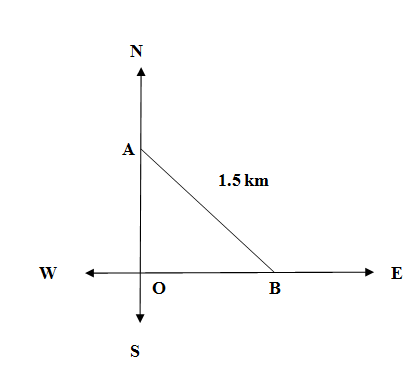
Let us assume the speed of Kichu as $x$ km/minute. Hence the speed of Sachu is $\left( x+30 \right)$ km/min. The time taken by both of them is 10 minutes. So the distance covered by Kichu is$10\times x=10x$ and the distance covered by Sachu is $10\times \left( 30+x \right)=300+10x$. So we have,
\[OA=300+10x,OB=10x\]
We are given the question to find the shortest distance between A and B that is $AB=1.5\text{km}=1.5\times 1000\text{m}=1500\text{m}$. We know from Pythagoras theorem that “In a right-angled triangle the square of the hypotenuse is the sum of squares of the other two sides.” We observe the right- angled triangle OAB and find that AB is the hypotenuse. So we have,
\[\begin{align}
& A{{B}^{2}}=O{{A}^{2}}+O{{B}^{2}} \\
& \Rightarrow {{1500}^{2}}={{\left( 300+10x \right)}^{2}}+{{\left( 10x \right)}^{2}} \\
& \Rightarrow 2250000=9000+600x+200{{x}^{2}} \\
& \Rightarrow 2{{x}^{2}}+60x+900=22500 \\
& \Rightarrow 2{{x}^{2}}+60x-21600=0 \\
\end{align}\]
Let us divide the above equation and have,
\[\Rightarrow {{x}^{2}}+30x-10800=0\]
We solve the above quadratic equation by splitting the middle term method and have,
\[\begin{align}
& \Rightarrow {{x}^{2}}+120x-90x-10800=0 \\
& \Rightarrow x\left( x+120 \right)-90\left( x+120 \right)=0 \\
& \Rightarrow \left( x+120 \right)\left( x-90 \right)=0 \\
& \Rightarrow x=-120,90 \\
\end{align}\]
We reject the root of$x=-120$ for speed and conclude that the speed of Kichu was $x=90$m/min. Hence the speed of Sachu was $30+x=30+90=120$m/min. The distance travelled by Kichu is $10x=10\times 90=900$m and the distance travelled by Sachu is 10 $10\left( 30+x \right)=10\times \left( 30+90 \right)=1200$m. \[\]
Note: We note that speed is always a positive scalar quantity and that is the reason we rejected $x=-120$ but velocity is a vector that can be negative. We can alternatively solve by first finding the coordinate of the position of Sachu and Kichu as $A\left( 0,300+10x \right)$, $B\left( 10x,0 \right)$ and then using distance formula between any two point on a plane $\sqrt{{{\left( {{x}_{2}}-{{x}_{1}} \right)}^{2}}+{{\left( {{y}_{2}}-{{y}_{1}} \right)}^{2}}}$.
Complete step-by-step answer:
We are given the question that Kichu and Sachu were on a morning walk. On reaching a junction, Kichu moved exactly eastward and Sachu moved exactly northwards. Let the junction be denoted by the position O.
We are further given that Sachu was at a speed of 30 metres per minute more than Kichu. After 10 minutes the shortest distance between them was 1.5 kilometres. Let us denote the postion of Sachu be A and Kichu be B. We have the diagram showing the position of Kichu B , Sachu A and the junction O. \[\]
Let us assume the speed of Kichu as $x$ km/minute. Hence the speed of Sachu is $\left( x+30 \right)$ km/min. The time taken by both of them is 10 minutes. So the distance covered by Kichu is$10\times x=10x$ and the distance covered by Sachu is $10\times \left( 30+x \right)=300+10x$. So we have,
\[OA=300+10x,OB=10x\]
We are given the question to find the shortest distance between A and B that is $AB=1.5\text{km}=1.5\times 1000\text{m}=1500\text{m}$. We know from Pythagoras theorem that “In a right-angled triangle the square of the hypotenuse is the sum of squares of the other two sides.” We observe the right- angled triangle OAB and find that AB is the hypotenuse. So we have,
\[\begin{align}
& A{{B}^{2}}=O{{A}^{2}}+O{{B}^{2}} \\
& \Rightarrow {{1500}^{2}}={{\left( 300+10x \right)}^{2}}+{{\left( 10x \right)}^{2}} \\
& \Rightarrow 2250000=9000+600x+200{{x}^{2}} \\
& \Rightarrow 2{{x}^{2}}+60x+900=22500 \\
& \Rightarrow 2{{x}^{2}}+60x-21600=0 \\
\end{align}\]
Let us divide the above equation and have,
\[\Rightarrow {{x}^{2}}+30x-10800=0\]
We solve the above quadratic equation by splitting the middle term method and have,
\[\begin{align}
& \Rightarrow {{x}^{2}}+120x-90x-10800=0 \\
& \Rightarrow x\left( x+120 \right)-90\left( x+120 \right)=0 \\
& \Rightarrow \left( x+120 \right)\left( x-90 \right)=0 \\
& \Rightarrow x=-120,90 \\
\end{align}\]
We reject the root of$x=-120$ for speed and conclude that the speed of Kichu was $x=90$m/min. Hence the speed of Sachu was $30+x=30+90=120$m/min. The distance travelled by Kichu is $10x=10\times 90=900$m and the distance travelled by Sachu is 10 $10\left( 30+x \right)=10\times \left( 30+90 \right)=1200$m. \[\]
Note: We note that speed is always a positive scalar quantity and that is the reason we rejected $x=-120$ but velocity is a vector that can be negative. We can alternatively solve by first finding the coordinate of the position of Sachu and Kichu as $A\left( 0,300+10x \right)$, $B\left( 10x,0 \right)$ and then using distance formula between any two point on a plane $\sqrt{{{\left( {{x}_{2}}-{{x}_{1}} \right)}^{2}}+{{\left( {{y}_{2}}-{{y}_{1}} \right)}^{2}}}$.
Recently Updated Pages
Master Class 10 Computer Science: Engaging Questions & Answers for Success

Master Class 10 General Knowledge: Engaging Questions & Answers for Success
Master Class 10 English: Engaging Questions & Answers for Success
Master Class 10 Social Science: Engaging Questions & Answers for Success
Master Class 10 Maths: Engaging Questions & Answers for Success
Master Class 10 Science: Engaging Questions & Answers for Success
Trending doubts
What is the median of the first 10 natural numbers class 10 maths CBSE
Which women's tennis player has 24 Grand Slam singles titles?
Who is the Brand Ambassador of Incredible India?
Why is there a time difference of about 5 hours between class 10 social science CBSE
Write a letter to the principal requesting him to grant class 10 english CBSE
A moving boat is observed from the top of a 150 m high class 10 maths CBSE